All Products

.svg)




Most plans to improve calling services start in the wrong place. They begin with a feature wish list: a better dialer, a new IVR, an AI add-on, when the real problem is rarely a missing feature. It is a gap between three things a calling operation has to get right: whether you can reach the person at all, whether you can resolve their reason for calling in a single conversation, and whether you learn anything from the call once it ends. Tools matter, but only in service of closing those gaps.
The stakes are easy to underestimate because the failures are quiet. A caller who gives up after two minutes on hold does not file a complaint; they simply hang up, and roughly 60% of people will not wait longer than a minute before doing exactly that. An outbound number that has been flagged as “Spam Likely” does not throw an error; it just stops getting answered. And the phone still carries the conversations that matter most: even as customers move routine questions to chat and self-service, around half still reach for the phone for complex, urgent, or sensitive issues, and that holds true across age groups. When the call is the high-stakes channel, small inefficiencies compound into lost revenue and eroded trust.
This guide is organized around the three gaps rather than a feature checklist. Work through them in order. A faster dialer is wasted if your numbers are flagged; better routing is wasted if agents have no context; and analytics are wasted if nobody changes how they coach. Each section below builds on the one before it.
Key Takeaways
- It’s three gaps, not a feature list: Better calling comes down to whether calls connect (reachability), get resolved in one conversation (resolution), and teach you something (intelligence), fix them in that order.
- Audit before you buy anything: Benchmark abandonment rate, first-call resolution, speed of answer, connect rate, and call quality (MOS) to find the one number quietly costing you the most.
- Reachability is the most overlooked lever: Around 80% of people ignore unknown numbers, so local caller ID and protecting your number reputation decide whether anyone answers.
- First-call resolution pays back the largest: Satisfaction drops ~15% with every callback; CRM-integrated context and logic-based routing solve issues in one call.
- Make every call teach you something: AI speech analytics scores and summarizes all calls, but only matters if someone acts on the data and changes coaching.
- Extend the call, don’t repeat it: A quick SMS (read ~90% of the time within minutes) resolves what would have been a second call, used sparingly and tied to a real interaction.
- Mobility shouldn’t create blind spots: Remote and mobile agents need the same recording, KPIs, and monitoring as desk agents, visibility must not depend on location.
- Fragmentation costs more than licenses: One platform for voice, messaging, CRM, and analytics removes the seams where context and time leak between tools.
- Build compliance into the workflow: Auto-pausing recording for card or ID data protects customers by default, instead of relying on agents to remember.
- Bottom Line: Audit to find your biggest leak, fix it in the connect → resolve → learn order, and treat calling as a system to improve, not a feature to buy.
Start With an Honest Audit, Not a Shopping List
Before changing anything, establish what good looks like for your operation and measure where you actually stand. Improvement is impossible to claim, or to fund, without a baseline. The point of an audit is not to collect every metric a platform can produce, but to find the one or two numbers that are quietly costing you the most.
Two categories of problem hide in most calling operations. The first is technical reliability: dropped calls, choppy audio, and connection delays that have nothing to do with agent skill. These are measurable. A Mean Opinion Score (MOS) calculated in real time tells you objectively whether the audio path itself is healthy, and persistent low scores point to a carrier or network issue rather than a training one. Run periodic test calls across the regions you actually operate in, not just from headquarters.
The second is process: what happens to a call once it connects. Is there a defined path for escalation, transfer, and logging, or does each agent improvise? Benchmark the handful of numbers that reveal whether your process holds up under load. The table below gives realistic reference ranges so you can self-assess rather than guess.
| Metric | A common healthy range | What a poor number is usually telling you |
|---|---|---|
| Call abandonment rate | Roughly 5–8% or lower | Hold times are too long or routing sends callers to the wrong place |
| First-call resolution | 70–80% is a strong target | Agents lack context, authority, or the right information to close the issue |
| Average speed of answer | Under ~30 seconds in queue | Understaffing at peak, or no overflow/callback path |
| Outbound connect rate | ~15–20% for cold outbound | Spam-flagged numbers, wrong dialing windows, or stale lists |
| Mean Opinion Score (MOS) | 4.0+ (call audio quality) | Network, carrier, or device problems degrading the conversation itself |
| After-call work time | Trending down over time | Manual logging and copy-paste between disconnected tools |
Treat these as directional, not absolute: a collections team and a luxury-hotel reservations desk should not aim for identical numbers. The value is in the gap between your current figures and a sensible target, and in watching the trend over time. If you cannot produce these numbers today, that itself is the first finding: you are flying without instruments.
Gap One: Reachability, Fix the Reasons Calls Go Unanswered
The most overlooked driver of calling performance is not how you handle calls but whether they connect in the first place. Answer rates across the industry have fallen for a structural reason: carriers and phones now aggressively label unrecognized numbers, and consumers screen accordingly. Roughly 80% of people let calls from unknown numbers go unanswered. If your outbound numbers are unfamiliar, or worse, marked “Spam Likely”, you are losing conversations before an agent ever speaks. No script or dialer setting fixes a number that nobody picks up.
Use local presence, but maintain caller ID like an asset
Showing a local caller ID that matches the recipient’s region is one of the highest-leverage changes available. In independent tests, people are several times more likely to answer a local number than an unfamiliar or toll-free one, with one widely cited study moving contact rates from 10% to 40%. Automatic local caller ID, assigning the right regional number based on the destination, captures most of that lift without manual work, and it is the single change with the clearest return for any team dialing across geographies.
Local presence is necessary but not sufficient. Numbers accumulate spam reputations when they are dialed too aggressively or flagged by recipients, so treat your numbering as something to maintain, not set and forget. Rotating numbers, capping how many times a single number is used, and checking the reputation of your outbound IDs keep them answerable. Validating numbers before you dial, confirming a line is live and reachable, stops you from burning dials and reputation on dead records.
Stop paying agents to listen to voicemail
On high-volume outbound campaigns, a large share of answered calls are not people, they are voicemail greetings and answering machines. Answering Machine Detection (AMD) analyzes the first few seconds of a connected call and routes machine pickups away from agents, so live agents spend their time on live conversations rather than waiting for a beep. The benefit is straightforward and compounding: the same headcount has more real conversations per hour. Pair it with predictive dialing, which adjusts pacing to agent availability, and the gain in productive talk time is substantial, though it is worth tuning AMD carefully, since overly aggressive detection can occasionally drop a real person, which is worse than a wasted dial.
Everything your team needs in one platform
Gap Two: Resolution, Solve the Problem in One Conversation
Once a call connects, the metric that matters most is whether the reason for it is resolved without a callback. First-call resolution (FCR) has an outsized effect on satisfaction: research from SQM Group finds a near one-to-one relationship between FCR and customer satisfaction, and satisfaction drops by roughly 15% with every additional time a customer has to call back about the same issue. The same research ties even a single-point improvement in FCR to meaningful annual savings for a mid-sized center, because every avoided callback is an avoided cost. FCR is the rare metric where the customer’s interest and yours are perfectly aligned.
Give every call its context before it is answered
Most repeat calls happen because the agent starts cold, no history, no record of the last interaction, no idea what the customer already tried. Integrating calling with your CRM and helpdesk closes that gap by surfacing the caller’s record, recent tickets, and prior conversations the moment the call lands. The agent opens with context instead of “can you remind me what this is about?” Equally important, the interaction should log itself: call outcome, notes, and next steps written back automatically rather than re-keyed by hand. That removes after-call busywork and ensures the next person who talks to that customer is not starting from zero either.
The integration that matters is the one your team already lives in. A sales-led SaaS team running outbound on Salesforce or HubSpot has different needs than a clinic coordinating patient follow-ups or a brokerage tied to a trading platform. Prioritize depth of integration with the system of record your agents actually use, and be honest about where an integration is shallow, a connector that only logs a call stub is not the same as one that writes full context both ways.
Route on logic, and let people serve themselves where it helps them
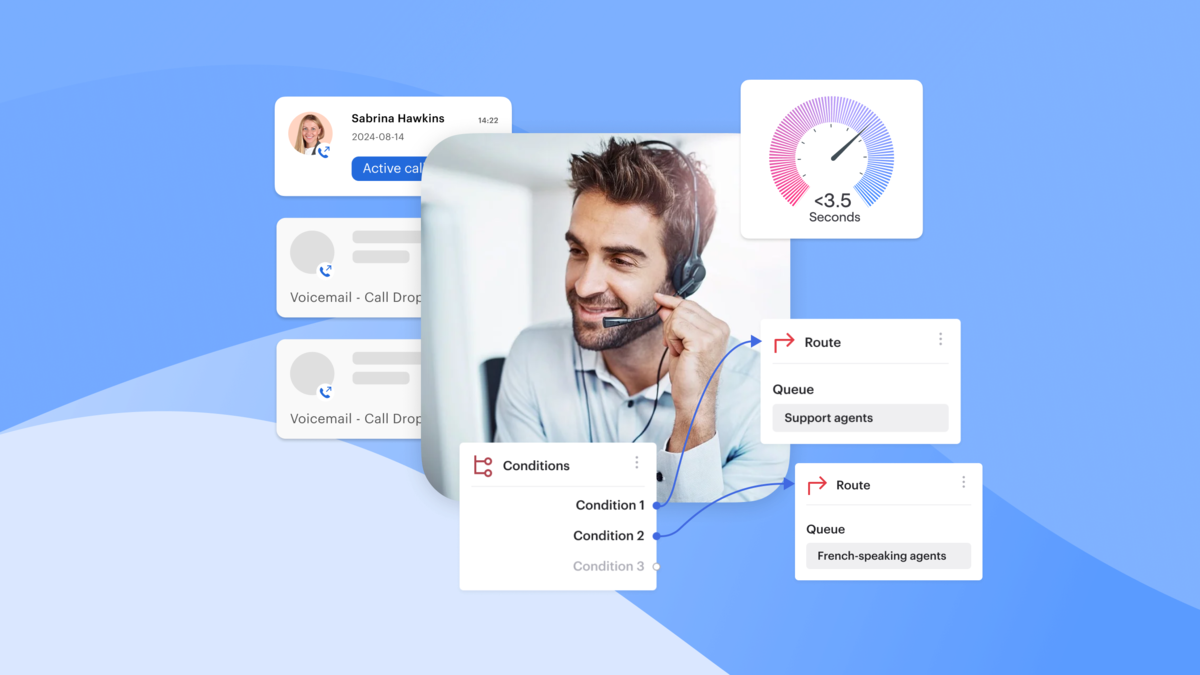
Resolution improves when the right call reaches the right person quickly, and when calls that do not need a person never join the queue. A visual flow builder lets a supervisor design routing without writing code: send high-value or VIP callers to your most capable agents, direct repeat callers to whoever handled them last, and apply rules for skills, time of day, and language. The goal is fewer transfers, because each transfer is a chance to lose context and a reason for the customer to repeat themselves.
Self-service deserves a careful hand. Done well, an IVR or voice bot deflects genuinely routine requests, a balance check, an order status, a booking confirmation and frees agents for the complex conversations that need them. Done badly, it becomes a maze that traps people who simply want help. The test is whether your self-service paths shorten the customer’s journey or lengthen it. And for callers who do not want to wait, a queue callback, holding their place and calling them back rather than making them sit on hold, protects both their time and your abandonment rate.
Gap Three: Intelligence, Make Every Call Teach You Something
A calling operation that does not learn from its own conversations repeats the same mistakes at scale. The third gap is the distance between the thousands of calls you handle and the handful of insights you actually act on. Historically, quality teams listened to a tiny, random sample of recordings; everything else was invisible. Conversation intelligence changes the economics of that by analyzing every call instead of a fraction of one percent.
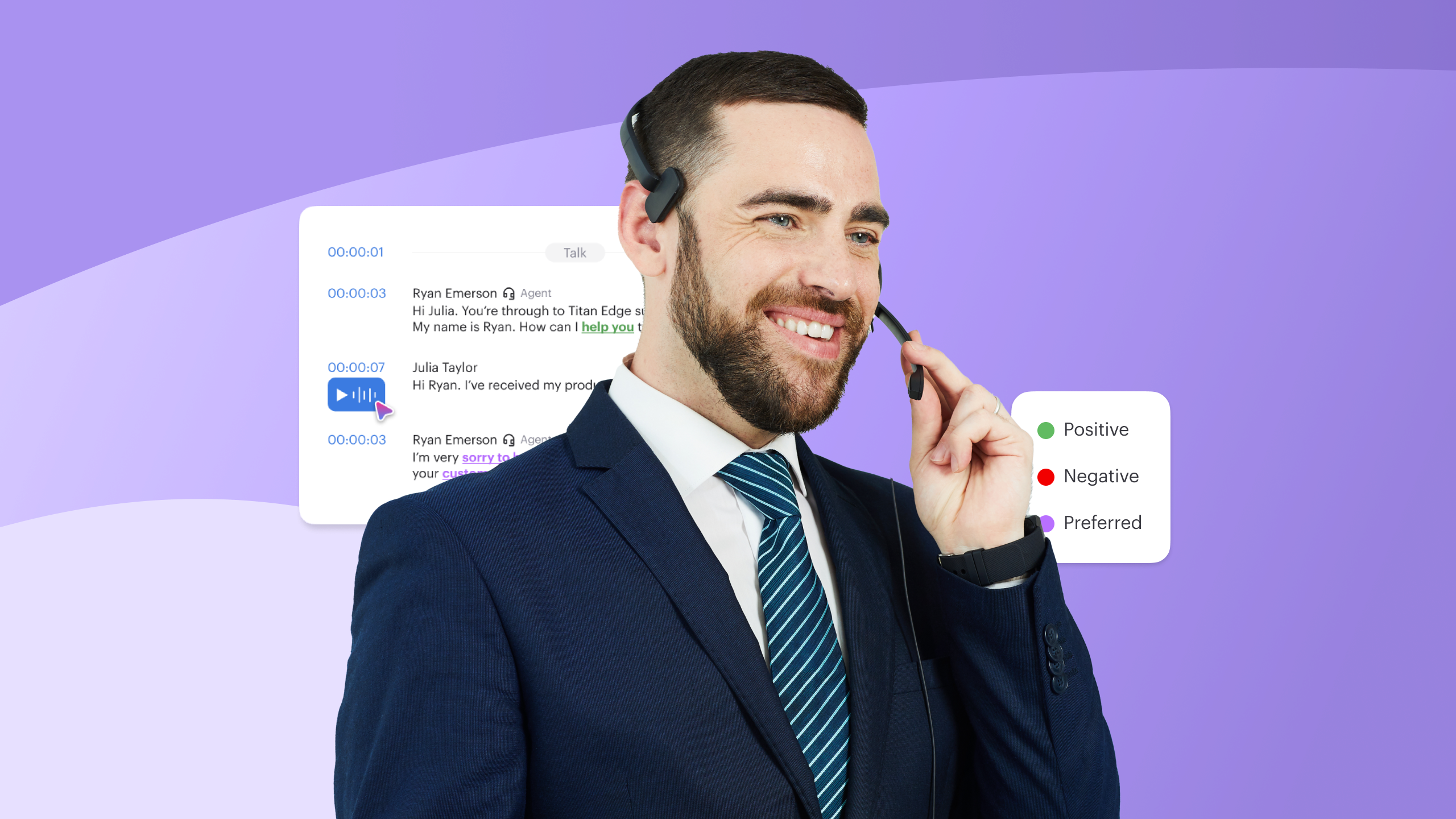
AI speech analytics can transcribe and summarize calls, score them against your own criteria, measure sentiment, and flag keyword patterns, the moments where customers get frustrated, the objections that recur, the competitor names that keep surfacing. Used well, this turns coaching from anecdote into evidence. Instead of “work on your tone,” a supervisor can point to the specific call, the specific moment, and the talk-time ratio that shows an agent talking over customers. Call scores and talk-time data make it possible to coach the whole team on what is actually happening, not on the few calls a manager happened to overhear.
The discipline that separates value from vanity here is the loop. Analytics only matter if they change behavior. Real-time dashboards and live monitoring, where a supervisor can whisper guidance to an agent, join a call, or step in when one is going sideways, are worth having only if someone is responsible for acting on what they show. Decide in advance what a low score triggers, who reviews flagged calls, and how a recurring friction point becomes a change to your script or routing. A dashboard nobody is accountable for is decoration.
Extend the Call Beyond the Call With the Right Follow-Up
Not everything has to happen on the call, and forcing it to does both sides a disservice. A short follow-up message often resolves what would otherwise be a second call: a confirmation, a summary of what was agreed, a link to a form or payment page, a tracking number. SMS is unusually effective for this because it is read, roughly 90% of texts are opened within three minutes of arriving, a reach that email cannot match. A link sent by text during or right after a call is far more likely to be acted on than the same link buried in an email.
The practical wins are speed and accuracy. Rather than spelling out a URL or reference number over the phone, slow, error-prone, and a drag on wrap-up time, the agent sends it. Templated messages for the common cases (appointment reminders, payment links, post-call summaries) cut the effort further and keep wording consistent. The caution is restraint: SMS earns its high open rates precisely because people do not get buried in it. Use it for messages the customer wants, tied to a real interaction, and it strengthens follow-through. Use it as a broadcast channel and you train people to ignore it.
Support Distributed and Mobile Teams Without Losing Visibility
Calling operations are no longer tied to a room full of desk phones. Agents work from home, across time zones, and increasingly from mobile devices. The improvement opportunity is to support that reality without sacrificing the oversight a contact center depends on. A secure mobile and browser-based softphone lets an agent take full-featured business calls from anywhere with calls still recorded, logged, and routed through the same system, rather than resorting to personal phones that leave no trail and protect no data.
The non-negotiable is that mobility must not create a blind spot. Whether an agent is at a desk or on a phone in another country, the same dashboards, KPIs, recordings, and monitoring tools should apply. Supervisors keep one view of queues, performance, and live calls regardless of where agents physically are. Distributed work and managerial visibility are not in tension when the platform treats every endpoint the same way; they only conflict when remote agents fall back on tools that sit outside the system.
Consolidate the Stack: The Real Cost Is Fragmentation, Not Licenses
Many calling operations are stitched together from separate products: one tool for voice, another for SMS, a third for WhatsApp and web chat, a CRM that half-integrates with each, and an analytics layer bolted on top. The obvious cost is the stack of subscriptions. The larger, hidden cost is what fragmentation does to the work. Agents tab between systems mid-conversation, context lives in three places and is reliably current in none, and supervisors cannot get a single view of performance because no two tools count the same thing the same way. Every seam is a place where information and time, leaks.
Bringing voice, messaging channels, dialing, CRM context, and analytics into one platform removes those seams. The benefit is not mainly the lower bill; it is that an agent handles a voice call and a WhatsApp message in the same workspace with the same customer history in front of them, and a supervisor sees one consistent picture. Consolidation also shortens deployment, a single platform can often be live in a day rather than a quarter-long integration project and makes scaling into new markets a matter of adding local numbers and agents rather than re-architecting. For teams expanding internationally, local numbers across many countries, multilingual support, and centralized control over distributed campaigns turn geographic growth into a configuration change instead of a rebuild.
Consolidation is not an argument for ripping out a system that genuinely works. It is an argument for counting the full cost of the seams before you add yet another point tool to bridge them.
Make Compliance and Security Invisible to Agents
In regulated industries, finance, healthcare, lending, gaming, calling is bound by rules on recording, consent, data handling, and retention. The instinct is to treat compliance as a checklist bolted onto the operation. The better approach is to make correct behavior the path of least resistance, so agents do the right thing without having to think about it.
Call recording, secured storage, and clear retention policies are the foundation, and they should be configurable to the jurisdiction you operate in rather than one-size-fits-all. The detail that separates a thoughtful setup from a risky one is what happens during sensitive moments. When an agent collects a card number or verifies an identity, recording should pause automatically so that protected data never enters the recording in the first place, a control that protects the customer and keeps you clean of obligations like PCI DSS, rather than relying on an agent to remember to hit a button. Recordings that can be searched, exported, and deleted on request round out a posture that satisfies both auditors and customers. The principle throughout: build the guardrails into the workflow so compliance happens by default, not by diligence.
Where to Start
Improving corporate calling services is not about handling more calls; it is about precision, context, and learning. If you take one thing from this guide, let it be the order of operations. Audit first so you know which number is hurting you most. Then close the gaps in sequence: make sure your calls connect, then make sure they resolve, then make sure you learn from them. Follow-up channels, mobility, consolidation, and compliance each amplify that core loop rather than replace it.
A practical starting point: pick the single metric from the audit table with the widest gap to a healthy range, trace it to whichever of the three gaps it belongs to, and fix that one thing well before moving on. Reachability problems usually pay back fastest, resolution problems pay back largest, and intelligence compounds over time. You do not need to solve everything at once, you need to stop the biggest leak first, then keep going.
If you want to see how a single platform handles dialing, omnichannel messaging, CRM-integrated context, and analytics together, Voiso is built around exactly this loop, a demo is the fastest way to judge the fit against the gaps you just measured.