All Products

.svg)




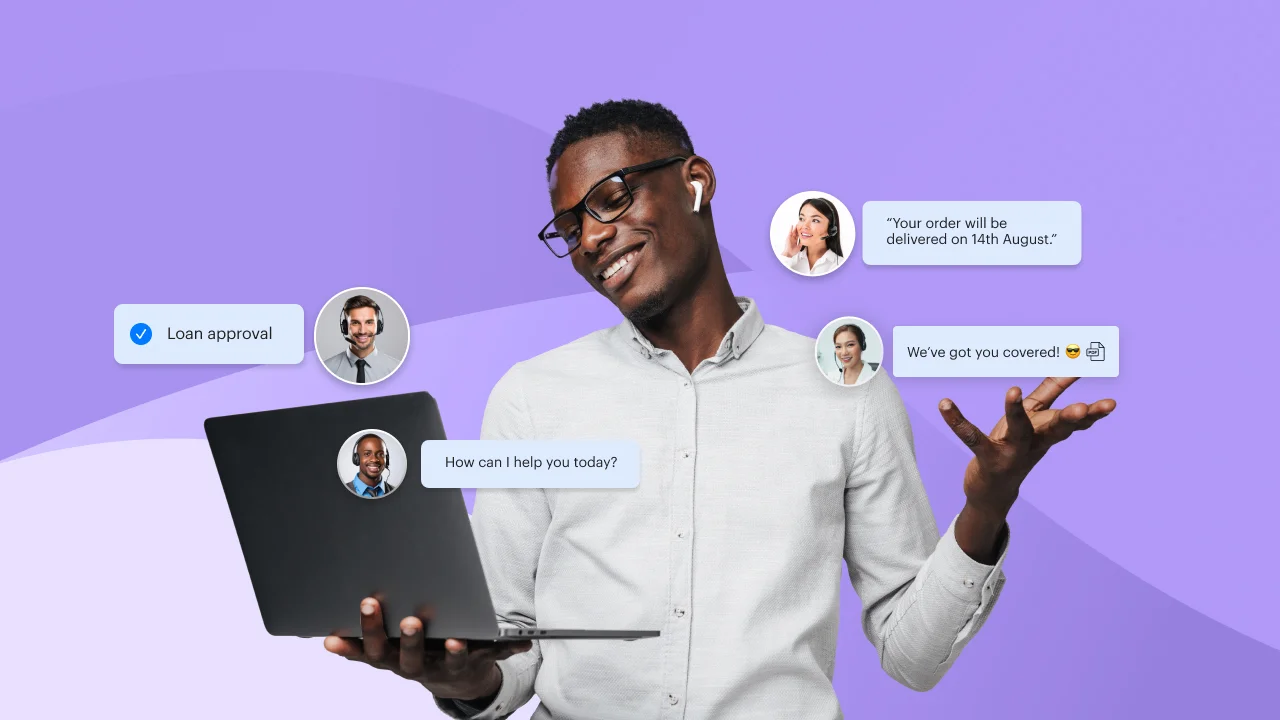
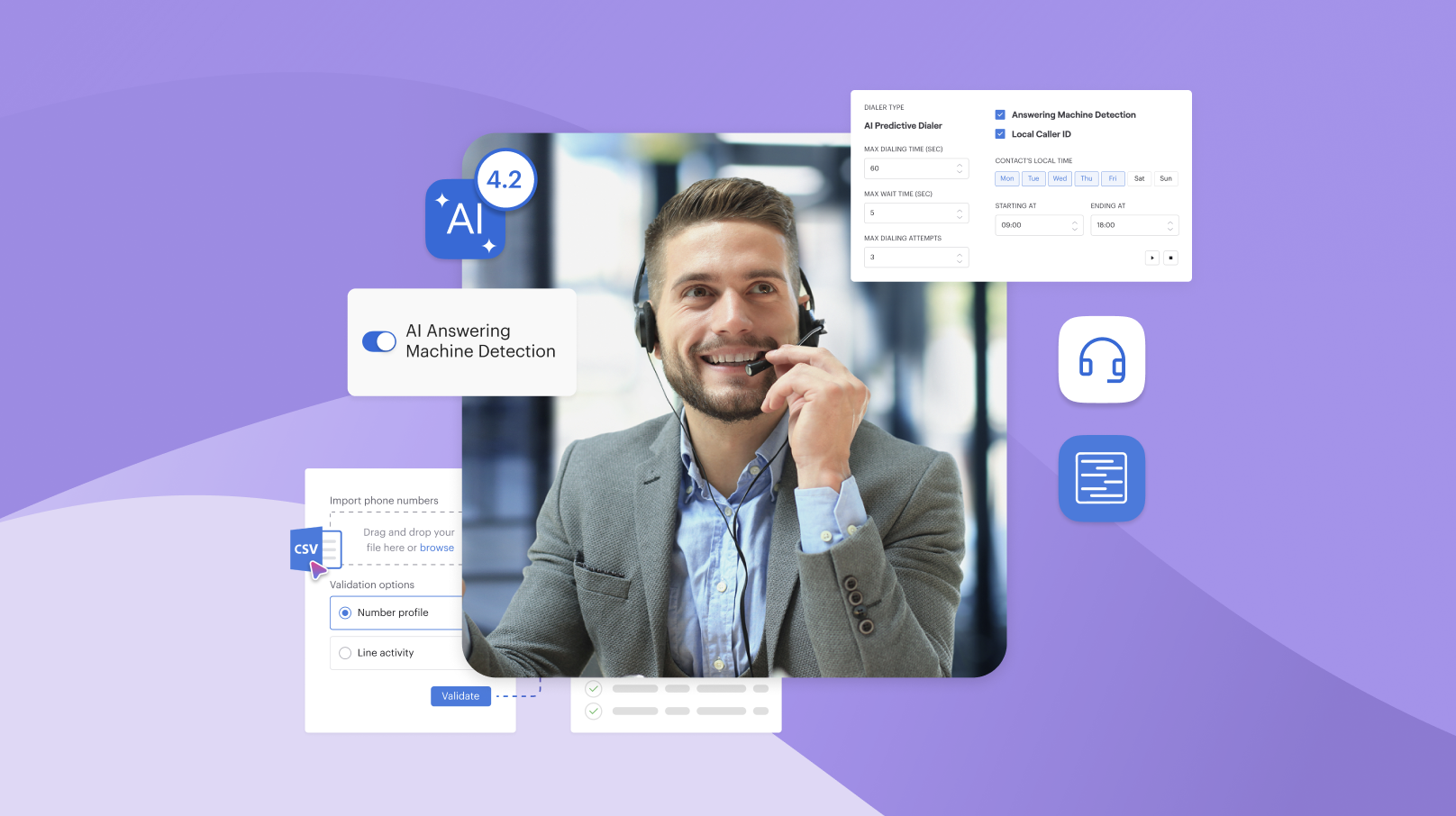
Quick answer: An AI voice agent is an artificial intelligence system that conducts real-time phone conversations by combining speech recognition, natural language understanding, and text-to-speech technology. Contact centers use AI voice agents to answer calls, resolve routine requests, qualify leads, route customers, and assist human agents.
Somewhere between hold music and a text message, there’s a middle ground contact centers have been trying to build for years: something that can actually talk back. That’s more or less what an AI voice agent is, though the phrase gets used loosely enough that it’s worth slowing down and being precise about it. This guide breaks down what these systems do, how they differ from the IVR menus and chatbots everyone already knows, and where they tend to earn their keep, inbound and outbound both. No jargon, no hype, just a plain answer to a question a lot of support teams are asking right now, heading into 2026, as call volumes climb and staffing budgets don’t always keep pace.
What Is an AI Voice Agent, Exactly?
In the simplest terms, it’s a software tool powered by artificial intelligence that handles phone conversations, inbound or outbound, understands natural speech, and responds the way a trained person might, without a human sitting on the other end. It doesn’t read from a fixed script. It listens to what’s actually being said, works out the intent behind the words, and answers accordingly. That’s the whole idea in a word: conversation, not menus.
Call it a voice bot, a voice agent, or an AI agent; the label depends on who you ask, and honestly the industry hasn’t fully settled on one term. What matters more than the name is the behavior. This is a step beyond ordinary voice automation, built to hold something close to a real exchange rather than a decision tree with a friendlier tone attached. For a contact center, that distinction changes what’s actually possible on a phone line.
Why bring this up now? Because voice remains one of the most trusted channels when something feels urgent or complicated. People still reach for the phone when they’re frustrated or in a rush, and a well-built AI voice agent gives teams a way to meet that demand without adding headcount every time volume spikes. It’s not about replacing agents. It’s about covering the interactions that would otherwise go unanswered, or worse, straight to voicemail.
How AI Voice Agents Actually Work
Underneath the conversation, an AI voice agent is running three processes in close succession: it has to hear you, understand you, and answer you, all within a pause that feels normal rather than awkward. Break that down and you get three building blocks worth knowing, especially if you’re evaluating platforms and want to understand what you’re actually buying.
Speech Recognition (STT)
The first step is recognizing what’s actually being said: converting the raw sound of a call into text a machine can process, often called speech-to-text. Recognition quality has gotten remarkably good at handling accents, background noise, and the half-finished sentences people actually use on the phone, though it still isn’t flawless. Anyone who’s shouted a name into an old phone menu and been misheard already knows the limits of this kind of technology.
Natural Language Understanding
Once the words are down, so to speak, the system has to work out what they actually mean, moving from raw text to real intent. Is this caller asking a question, making a complaint, confirming an appointment, or trying to cancel something entirely? A well-built model can hold context across a few exchanges, so callers don’t have to repeat themselves every time they speak.
Voice Output (Text-to-Speech)
The last piece is turning the answer back into spoken words, using text-to-speech to generate a response that sounds natural rather than robotic. This is where a lot of older systems fell apart, with flat, choppy delivery that gave the game away instantly. Newer voice AI handles pacing, tone, and even small pauses well enough that plenty of callers never clock they’re talking to software at all. I’ll admit, the first time I heard a good one, it took me a beat to notice.
AI Voice Agents vs IVR Systems: What’s the Difference?
If you’ve ever pressed 1 for sales and 2 for support, you’ve used an IVR system. It’s tempting to assume this is just a fancier version of the same thing. They’re related, sure, but the gap between them is bigger than it looks from the outside.
How Traditional IVR Works
Traditional IVR runs on a fixed decision tree. Press a number, or say a short phrase from an approved list, and the system moves you down the next branch. It works fine when the options are simple and few, but badly the moment a caller’s need doesn’t match any of the pre-set paths, which, in practice, happens more often than most call flow diagrams admit.
Where AI Voice Agents Diverge
This kind of agent skips the menu almost entirely. Callers just talk, in whatever words come naturally, and the system figures out what they need rather than asking them to pick an option that vaguely fits. There’s no dead end where someone keeps repeating “agent” over and over hoping to escape a loop. That alone is probably the biggest quality-of-life improvement these tools bring to a support line: fewer people stuck, fewer pointless transfers, less repeating themselves twice. It’s a small thing until you’re the one stuck in the loop.
Quick comparison: AI voice agent vs IVR vs chatbot
| AI Voice Agent | Traditional IVR | Text Chatbot | |
| Input | Conversational speech | Touch-tone or fixed voice commands | Typed text |
| Understanding | Full sentences, context, intent | Menu options only | Full sentences, context, intent |
| Output | Natural-sounding voice response | Prerecorded voice prompts | Text on screen |
| Handles unscripted questions | Yes | No | Yes |
| Channel | Phone | Phone | Chat window, app, web |
| Best fit | Conversations needing real depth | Simple routing, few options | Async, digital-first support |
Everything your team needs in one platform
AI Voice Agents vs Chatbots: Same Brain, Different Mouth?
A text chatbot and an AI voice agent often share similar underlying technology: the same kind of language model doing the reasoning underneath. The real difference sits in the channel, and channel changes almost everything about how an interaction feels and what it can realistically handle.
Why the Channel Changes Everything
Typing gives people time to think, edit, and reread before hitting send. Speaking doesn’t offer that luxury; words come out in real time, filled with pauses, false starts, and the occasional “um.” A voice agent has to keep up with that messiness while a chatbot gets to process a tidier, typed message. There’s also urgency to consider: someone calling at 11pm about a locked account usually wants resolution now, not a queue number. Phone conversations tend to carry higher emotional stakes than a chat window, and any AI agent built for phone conversations needs to account for that from the start.
Inbound Use Cases for AI Voice Agents
On the inbound side, these tools typically handle three kinds of calls well, freeing human agents to focus on requests that genuinely need a human touch. The exact split depends on the business, in my experience, but the pattern holds fairly consistently across industries.
24/7 Reception and Call Answering
No hold music, no “our office is currently closed” recording. An AI voice agent answers every call, at 3am on a Sunday just as reliably as 3pm on a Tuesday. That doesn’t mean every request gets fully resolved outside business hours; sometimes the value is simply capturing what’s needed accurately so a human can follow up first thing. Still, a caller who gets acknowledged beats one who gets a busy tone.
FAQ Handling
A large share of calls to any support line are repetitive: hours of operation, order status, pricing, return policies, that sort of thing. Answering these doesn’t require judgment, just accurate information delivered clearly. An agent pulling from an up-to-date knowledge base can close these interactions in under a minute, often faster than waiting on hold for a person to pick up.
Call Routing and Triage
Not every request should be handled by voice alone. Part of the job is figuring out which callers need a specialist, which need a manager, and which can be resolved on the spot. A voice agent that asks a couple of clarifying questions before transferring saves the receiving agent from starting cold; they get context along with the caller, rather than having to ask “so, what’s this about?” all over again.
Outbound Use Cases for AI Voice Agents
Outbound gets less attention in these conversations, but it’s arguably where an AI voice agent saves the most staff hours, since this kind of calling is repetitive by nature and doesn’t always need a skilled closer on the line for the first pass.
Lead Validation and Screening
Before a sales rep spends twenty minutes on a call, it helps to know the lead is real: right phone number, genuine interest, roughly the right budget. An AI agent can run through a short set of qualifying questions at scale, reaching far more contacts in an hour than one rep could manage alone. The leads that qualify get passed along with notes attached; the rest get filtered out before they ever land on a human’s calendar.
Intent Confirmation Before Human Follow-Up
There’s also a quieter use case: confirming someone still wants to talk before a person rings them back. Interest cools fast, sometimes within hours. A short outbound touch from a voice agent, asking whether the timing still works and the need still stands, means reps spend their time on people who are actually ready, rather than chasing contacts who filled out a form three weeks ago and have since moved on.
What This Looks Like in Practice
Everything above describes the category in general terms. Here’s what it looks like once you’re actually setting one up, using Voiso’s AI Voice Agents as the example, since that’s the platform behind this guide. Voiso offers both inbound and outbound voice agents as part of a broader lineup of services for support teams, built to slot into an existing setup rather than replace it entirely.
Configuring Prompts and Knowledge Bases
Setup starts with two things: prompts and knowledge bases. The prompt defines how the agent should behave, its tone, its boundaries, what it should never promise a caller. The knowledge base is where the facts live: product details, policies, pricing, whatever the agent needs to answer accurately instead of guessing. Get these wrong and the agent either sounds stiff and scripted or, worse, starts making things up. Get them right and most callers won’t question who, or what, they’re actually talking to.
Voice Settings and Live Testing
Beyond the logic, there’s the voice itself: accent, pace, tone, all configurable before anything goes live. Voiso lets teams test an agent against real call scenarios before it ever answers a genuine customer, which matters more than it might sound. A script that reads well on paper can come across stilted out loud, and the only way to catch that is to actually listen to it work through a call from start to finish.
Call Recording, Transcripts and CDRs
Every conversation an AI voice agent handles through Voiso gets recorded, transcribed, and summarized, the same way a human agent’s interactions would appear in a call detail record. That means managers can review AI-handled sessions exactly like they’d review a person’s work: pull the transcript, check the summary, listen to the recording if something looks off. Nothing about the reporting changes just because the one answering wasn’t human. That consistency ends up mattering a lot for quality control and compliance both.
Benefits of AI Voice Agents for Contact Centers
Pull back from the mechanics and the benefits break down into two broad categories: what it does for coverage and cost, and what it does for consistency day to day.
Coverage and Cost
Hiring enough staff to cover every hour, every language, every seasonal spike gets expensive fast, and most contact centers simply don’t try. A voice agent changes that math. They don’t need shifts, breaks, or overtime, and adding capacity for a busy period doesn’t require a hiring sprint. For an enterprise fielding thousands of interactions a month, that flexibility alone often justifies the investment before any other benefit gets counted.
Consistency at Scale
Human agents have good days and bad ones, and that variation shows up in call quality whether anyone likes it or not. A well-configured voice agent answers the same question the same accurate way every time, at 9am and at 9pm, on the hundredth conversation of the day just like the first. For support teams chasing steady quality scores, that predictability is worth something on its own, maybe more than people give it credit for.
Limitations and Things to Watch For
None of this makes an AI voice agent a universal fix, and it’s worth being honest about where it still falls short. Not all AI agents are created equal, and quality varies quite a bit between providers. The recognition layer can still struggle with heavy background noise or strong regional accents. Complex negotiations, genuine emotional distress, or anything requiring real judgment still need a person on the line. The technology is good, arguably better than most people expect, but it isn’t magic, and treating it that way sets teams up for disappointment.
Where Human Agents Still Win
Escalation paths matter more than people assume when they’re first setting one of these up. A caller who’s angry, grieving, or dealing with something genuinely complicated shouldn’t get stuck arguing with software; they should reach a person quickly, without having to demand it three separate times. The best deployments treat escalation as a feature, not a failure, building clear handoff points into the design from day one. Get that part wrong, and even a technically strong voice agent will frustrate the exact people who needed the most help.
FAQs
That’s the plain-English version: an AI voice agent listens, understands, and responds in real time. It’s not quite the same as IVR or a text chatbot, even though the three share some DNA, and it earns its place on both inbound and outbound lines once the setup is done properly. A few sharper questions tend to come up once people get this far, so it’s probably worth closing with those.
What is the difference between an AI voice agent and an AI receptionist?
“AI receptionist” is often used as a narrower term, referring specifically to inbound call answering, greeting, and directing callers, similar to a front-desk role. An AI voice agent is the broader category: it covers reception-style tasks but also outbound calling, lead qualification, FAQ handling, and routing across a whole support operation. In practice, many providers use the two terms interchangeably in marketing, so it’s worth checking what a specific product actually does rather than relying on the label alone.
Can AI voice agents replace human customer service agents?
Not entirely, at least not yet. AI voice agents handle repetitive, well-defined interactions well: answering FAQs, confirming details, directing traffic, qualifying leads. They struggle with genuine emotional complexity, ambiguous requests, or situations that need real judgment and empathy. Most contact centers use them to absorb high-volume, low-complexity interactions, freeing human agents for the harder conversations rather than replacing staff outright. The realistic goal for most deployments is added capacity and consistency, not full replacement of a support team.
How accurate are AI voice agents?
Accuracy varies by provider and by call conditions. Recognition on a clear line with a common accent tends to perform very well today, but background noise, heavy accents, or people talking over each other can bring it down. Understanding intent correctly matters just as much as hearing the words correctly, and the strongest systems combine both well. Rather than trusting a single headline accuracy figure from a vendor, it’s worth testing an agent against real, messy call recordings from your own business before rolling it out at scale.
What industries use AI voice agents?
Contact centers across a wide range of industries use AI voice agents, including telecom, retail and e-commerce, financial services, healthcare administration, insurance, real estate, logistics, and B2B sales teams doing outbound prospecting. Any business handling a high volume of repetitive inbound calls, or needing to screen and confirm leads at scale, is a reasonable candidate. Regulated industries like healthcare and finance tend to move more carefully, given the compliance and data-handling requirements involved, but adoption is growing across the board as the technology matures.
How much does it cost to set up an AI voice agent?
Cost depends heavily on call volume, the complexity of the knowledge base, and whether the deployment is inbound only, outbound only, or both. Most providers, Voiso included, price around usage rather than a flat license fee, so a small business testing a single inbound line pays far less than an enterprise running thousands of outbound touches a month. Setup time is usually the bigger factor early on: a narrow, well-scoped agent can go live within days, while a broad, multi-department rollout takes longer to configure and test properly.
Can AI voice agents handle multiple languages or accents?
Yes, a modern AI voice agent typically supports multiple languages, and the better ones handle a decent range of accents within each. Accuracy still varies: heavily accented speech, fast talkers, or noisy environments can trip things up more than a conversation from a quiet home. If a business serves a genuinely multilingual audience, it’s worth testing the agent against real accents from that group before going live, rather than trusting a demo recorded under ideal conditions.
What happens when an AI voice agent can’t resolve a request?
A well-designed agent recognizes when it’s out of its depth and hands the caller to a human, ideally with context attached so nothing has to be repeated. This might trigger because the request is too complex, the caller asks for a person directly, or the system picks up on frustration in the exchange. Deployments that skip this step tend to frustrate people badly. Get it right, though, and escalation becomes part of the design, not an afterthought bolted on later.
Are AI voice agent calls secure and compliant with regulations?
Reputable providers record, encrypt, and store calls the same way they would for human agents, with access controls and retention policies built to meet standards like GDPR where applicable. Because AI-handled interactions get transcribed and logged automatically, they’re often easier to audit than a human call that only exists as an unreviewed recording somewhere. That said, requirements vary by industry and region, so confirm a provider’s specific certifications and data handling practices before rolling this out for anything sensitive.