All Products

.svg)





Contact center management is the practice of running the people, processes, and technology that handle customer conversations, so that service stays consistent whether a customer calls at 9am in Dubai or sends a chat at midnight in Toronto. It sits above the day-to-day work of answering calls. The manager’s job is to make the whole operation predictable: the right staffing, sane routing, clean data, and rules followed in every country the team serves.
That last point is where a lot of guidance falls short. Most advice assumes a single market, usually the US. A head of operations running teams across the UK, the Gulf, and Southeast Asia faces a different set of constraints in each place, from calling hours to consent registers to where recordings may be stored. This guide treats those differences as part of the work, not a footnote.
Key points at a glance
- Contact center management covers staffing, routing, quality, reporting, and regulatory obligations across every market a team serves.
- The strongest managers track a small set of metrics tied to outcomes, not a wall of numbers nobody reads.
- Compliance rules change by country, so a team calling three regions follows three rulebooks at once.
- The right platform gives managers one view of live performance and takes routine decisions off their plate.
What is contact center management?
Contact center management is the coordinated oversight of agents, workflows, and tools across voice and digital channels, aimed at meeting service targets while staying inside the law of each market served. It answers a simple question for the business: are we handling customer conversations well, at a cost we can defend, without breaking any rules?
A working definition
Think of it as three jobs held together. First, people: hiring, scheduling, coaching, and keeping agents productive and reasonably happy. Second, flow: getting each contact to the right place quickly, on whatever channel the customer picked. Third, proof: measuring what happened and showing the business it got value. When any one of the three slips, customers feel it within days.
Contact center management versus call center management
The two terms often get swapped, though they are not identical. A call center handles voice. A contact center adds chat, email, SMS, and messaging apps, so the manager coordinates work that arrives through many doors at once. The move from one to the other reshaped the role: schedules now span channels, and quality review covers a written reply as much as a spoken one. For a fuller breakdown of the distinction, Voiso has a separate piece on contact centers versus call centers.
Who owns it inside the business
Ownership varies with company size. In a small team, a single supervisor may run everything from scheduling to vendor contracts. Larger operations split the work: team leads coach agents, a workforce planner builds schedules, a quality analyst reviews interactions, and an operations director answers for the numbers. The title on the door matters less than the spread of responsibility, which reaches from the phone system to the boardroom. What stays constant is accountability for outcomes; someone has to own the service level, the budget, and the answer when a regulator asks how a campaign was run.
The core responsibilities of a contact center manager
A contact center manager is accountable for five things at once: the workforce, the flow of contacts, the technology, service quality, and the reporting that ties them together. Neglect any one and the others wobble. The sections below take each in turn.
People and workforce management
Staffing is the largest cost and the biggest lever. Getting it right means forecasting demand by half-hour, building schedules that match, and adjusting in real time when volume spikes. In the United States alone, the Bureau of Labor Statistics counts about 2,666,000 customer service representatives as of 2025, on a median wage of $44,770 a year, so small scheduling errors multiply fast across a payroll that size. Voiso supports this side of the role with dedicated scheduling and forecasting tools that turn history into staffing plans.
Operations and call routing
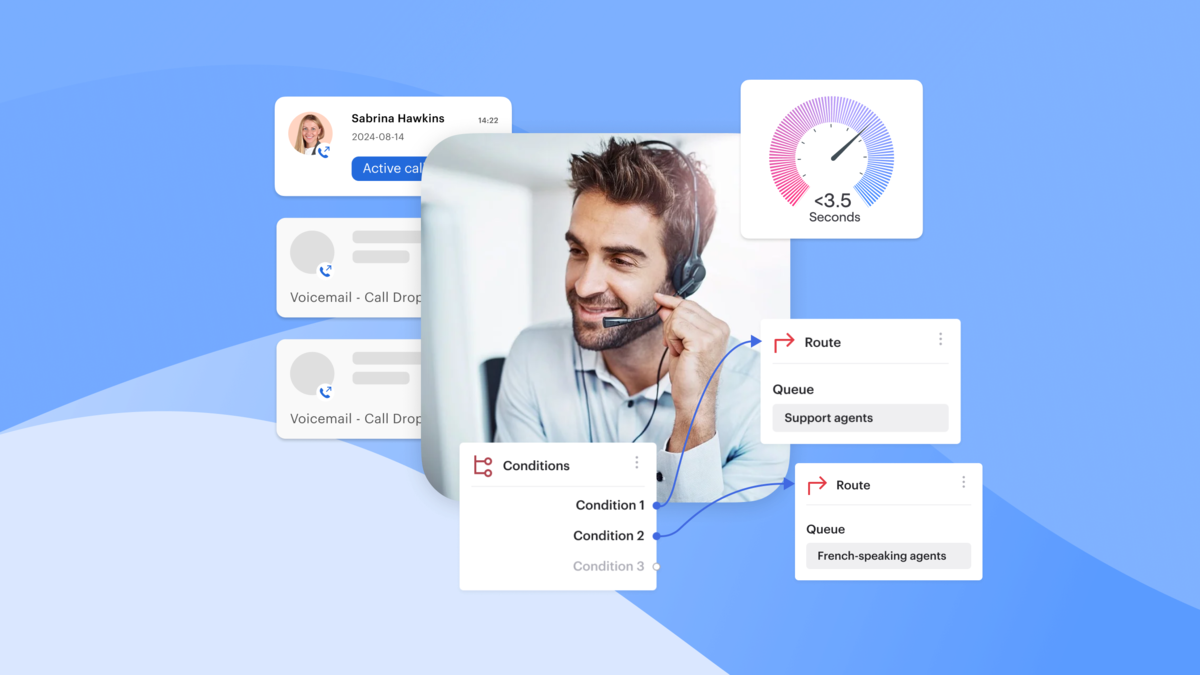
Once agents are on duty, the manager owns how work reaches them. Skills-based routing sends a Spanish billing query to an agent who handles exactly that, not the first free person. Queue rules decide who waits, who gets a callback, and when an overflow team steps in. Small routing choices show up quickly in wait times and abandonment, which is why call routing software tends to be one of the first things a new manager reviews.
Technology and systems
The modern operation runs on a stack of connected tools: a phone system, routing, dialers, analytics, dashboards, and a link to whatever holds customer records. The manager does not need to code, but does need to know what each part does and where the data lives. A gap between two systems usually becomes a gap in the customer’s experience.
Quality management
Quality management is the discipline of checking that conversations meet a standard, then feeding what you learn back into coaching. It relies on scoring interactions against a rubric, spotting patterns, and closing the loop with agents. Voiso covers this with contact center QA tooling and automated scoring, so review is not limited to the handful of calls a supervisor has time to listen to by hand.
Data, reporting, and forecasting
Everything above produces data, and the manager’s final job is to make sense of it. That means live dashboards for the day in progress, historical reports for the week and month, and forecasts that feed next month’s schedule. Good reporting turns a noisy stream of events into a short story leadership can act on.
Everything your team needs in one platform
The metrics that show whether management is working
Sound contact center management shows up in a handful of metrics: service level, occupancy, first contact resolution, handle time, and a customer satisfaction score. Track those well and you can spot trouble before it reaches a complaint. Track everything and you drown.
Service level and the 80/20 rule
Service level measures the share of contacts answered inside a target time. The classic target, often written as 80/20, means answering 80 percent of calls within 20 seconds. It is a convention rather than a law of nature, and plenty of teams pick a different pairing that suits their customers and budget. Voiso explains the trade-offs in its guide to the 80/20 rule in call centers.
Occupancy, shrinkage, and adherence
These three describe how agent time is used. Occupancy is the portion of logged-in time spent on live contacts. Shrinkage covers everything that pulls agents away from the queue: breaks, training, meetings, sick days. Adherence checks whether people work their rostered hours as planned. Push occupancy too high and burnout follows; ignore shrinkage and every forecast comes in short.
First contact resolution and average handle time
First contact resolution asks whether the customer’s problem was solved the first time, without a callback. It usually correlates with satisfaction better than raw speed does. Average handle time measures how long an interaction takes end to end. The two pull against each other, and a manager’s skill lies in holding the balance rather than chasing one at the other’s expense.
CSAT, NPS, and customer effort
Operational numbers tell you what the team did; experience metrics tell you how it felt. Customer satisfaction scores capture reaction to a single interaction. Net promoter scores gauge loyalty to the brand. The customer effort score tracks how hard the customer had to work to get helped, which often predicts churn more sharply than a smile rating does.
How many metrics should you actually track?
Fewer than most dashboards suggest. A workable set pairs two or three operational figures with one experience measure, reviewed on a rhythm the team can sustain. Adding a metric only helps if someone will act on it. If a number never changes a decision, it is decoration, and it quietly buries the figures that matter.
Building the technology stack behind good management
Good tooling for contact center management should give the manager one live view and take routine decisions off their desk. A modern cloud platform bundles the pieces, so nobody is stitching five vendors together and hoping the timestamps line up.
Omnichannel routing
Customers move between phone, chat, and messaging apps within a single issue, and they expect the business to keep up. An omnichannel contact center brings voice, SMS, web chat, and messaging into one queue, so an agent sees the whole history rather than a fragment. For the manager, that means one set of rules and one report instead of a separate world per channel.
Outbound dialing and caller ID
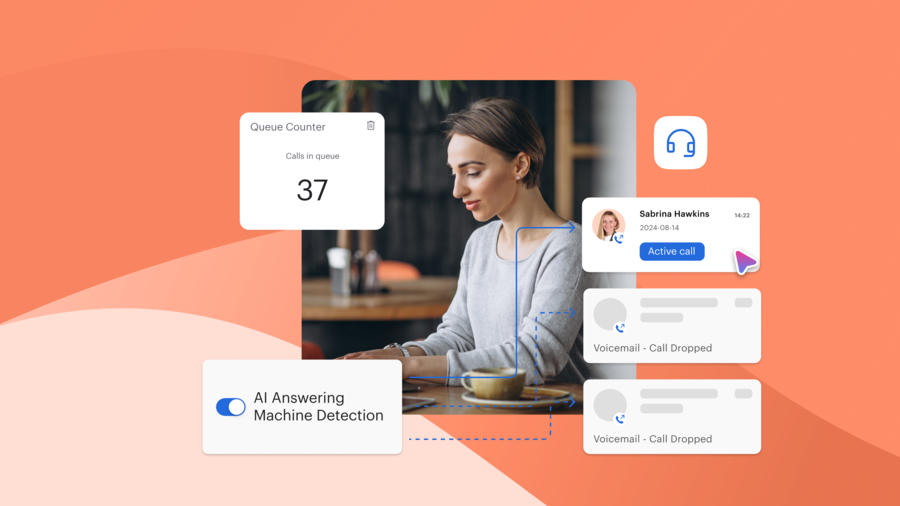
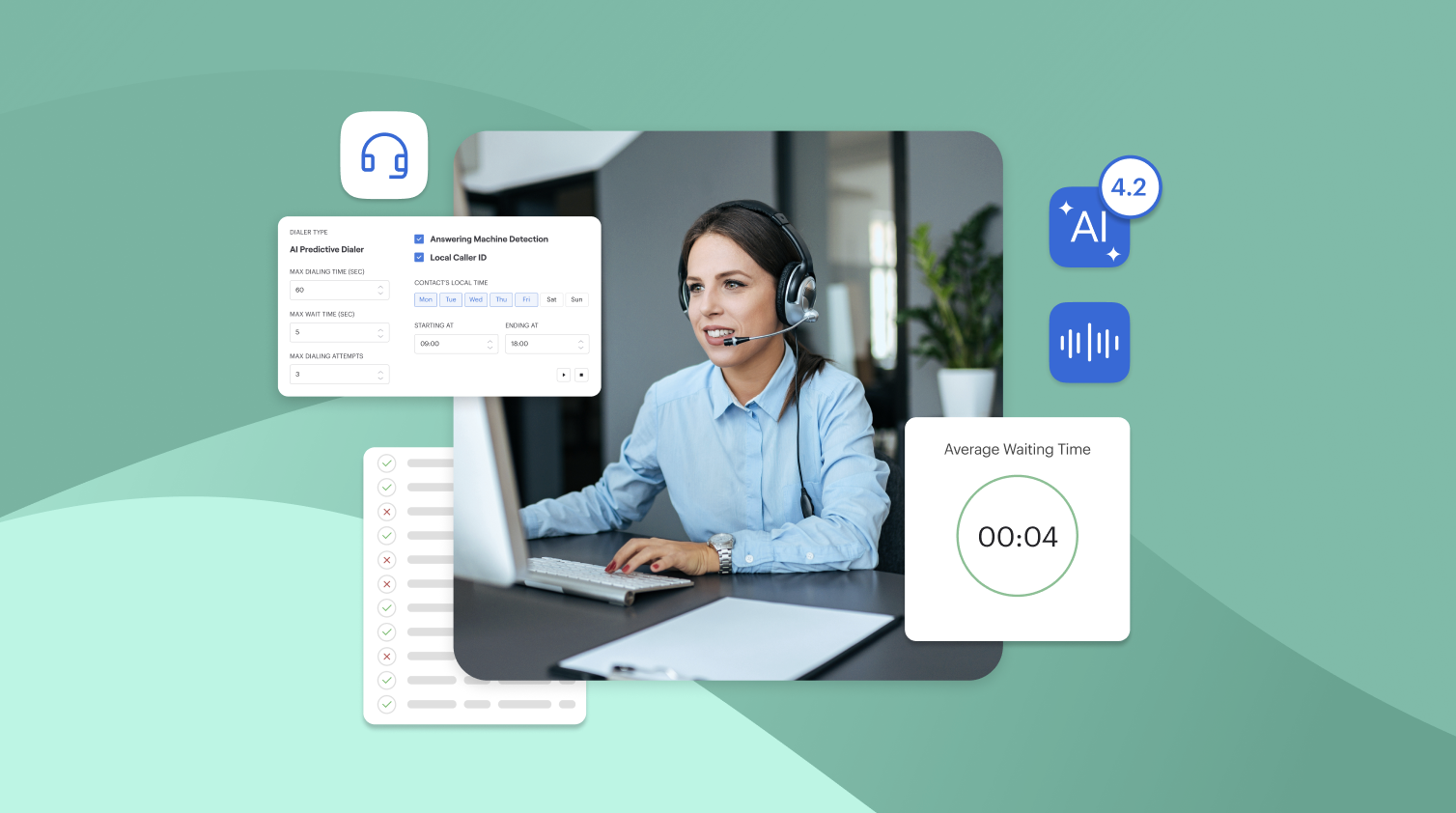
Teams that reach out, whether for sales, collections, or renewals, need pace and answer rates that manual dialing cannot match. An AI predictive dialer paces calls to agent availability, screens out voicemail, and presents a local number to the person being called. Voiso pairs its dialer with local caller ID across many countries, which lifts the odds a call is answered without misleading anyone about who is calling.
Speech analytics and quality at scale
Listening to a few calls a week tells a manager almost nothing about the thousands that happened. AI speech analytics transcribes conversations, scores them, and surfaces the ones worth a human look. Instead of sampling by luck, a supervisor reviews the calls where a customer grew frustrated or a script was skipped, and coaches from evidence.
Real-time dashboards
The manager’s cockpit is the live dashboard. Voiso’s real-time dashboards track more than 60 metrics, from queue depth to agent state, so the person running the floor can move people before a small backlog becomes a bad afternoon. Paired with historical reporting, the same view supports both the next ten minutes and the coming planning cycle.
Where the CRM and systems of record fit
Here is a boundary worth stating plainly. A contact center platform routes, dials, records, and analyzes conversations; it is not the system of record for customer accounts, policies, or payments. Voiso connects to the tools that own those functions, with prebuilt links to platforms including HubSpot, Salesforce, Zoho, and others, plus an open API. The platform is the communication layer, and it passes data to whatever holds the rest.
Managing agents across time zones and languages
Managing a distributed team means planning around clocks, languages, and local rules at the same time, not one after another. A team spread across three regions is really three shifts that must feel like one service to the customer. The tools help, but the discipline is human.
Scheduling and forecasting for a distributed team
When agents sit in Manila, Warsaw, and Bogota, coverage becomes a puzzle of overlapping windows and public holidays that never align. Forecasting has to account for demand in the customer’s time zone while rostering against the agent’s. Get the handoffs right and you gain near round-the-clock coverage without paying anyone a night premium they resent.
Multilingual queues
Serving customers in their own language raises satisfaction and, in some markets, is expected as standard. Routing has to read language preference and send the contact to someone who can help. Voiso’s flow builder supports IVR menus and text-to-speech in more than 20 languages, so a caller in Lisbon and one in Riyadh each land somewhere sensible.
Coaching and agent development
Coaching is where quality scores turn into better calls. The pattern that works is short, frequent, and specific: a supervisor picks one behavior, shows an example, and follows up. Voiso supports this with coaching tools that link feedback to real recordings, so a session rests on what actually happened rather than a hazy memory of last week.
Retention and the cost of turnover
Attrition is the quiet tax on every contact center. Each departure means recruiting, onboarding, and a stretch of lower output while a replacement learns. The United States figures hint at the churn baked into the work: the Bureau of Labor Statistics projects employment of customer service representatives to fall about 5 percent between 2025 and 2035, yet expects roughly 289,500 openings a year as people leave the role. Reading that, a manager sees how much motion sits under a flat headcount.
Compliance is part of the job: rules that vary by market
Compliance in a contact center is not a legal department problem held at arm’s length; it is a daily operational duty that changes with every border. Which rulebook applies depends on where the business holds its license, where the person being contacted sits, and whose personal data is being handled. A team calling three countries follows three sets of rules at once.
| Market | Outbound calling and do-not-call | Data protection | Notable point for managers |
| United States | TCPA and the FTC Telemarketing Sales Rule; screen against the National Do Not Call Registry | State laws such as the CCPA; sector rules like HIPAA for health data | Recording consent varies by state, some requiring all parties to agree |
| United Kingdom | PECR, enforced by the ICO, plus the TPS and CTPS registers | UK GDPR and the Data Protection Act 2018 | Financial services add FCA duties on top |
| European Union | Set nationally, so telemarketing rules differ by member state | GDPR and the ePrivacy Directive | The EU AI Act adds transparency duties for automated agents |
| Australia | Spam Act 2003 and the Do Not Call Register, with a telemarketing standard on hours | Privacy Act 1988 | Permitted calling windows are defined by the standard |
| United Arab Emirates | Cabinet Resolutions 56 and 57 of 2024, with a TDRA registry and defined calling times | Federal Decree-Law No. 45 of 2021 | Health data faces added local storage limits |
Outbound calling and consent
Wherever a team dials out, two questions decide legality: do we have the right to call this person, and are we calling at a permitted time? The United States leans on the FTC’s National Do Not Call Registry and prior consent rules; the UK routes the same duty through the ICO and the Telephone Preference Service; the UAE requires screening against a TDRA registry under its 2024 telemarketing regulations. The concept rhymes across markets, but the register, the consent standard, and the hours differ.
Call recording consent
Capturing calls is standard practice for quality and training, yet the consent rule behind it is not universal. Some US states require every party to agree before a call is recorded, while others accept one-party consent. In the EU and UK, recording brings data protection duties around purpose and retention. A manager running several regions cannot apply one recording policy everywhere and assume it holds.
Data protection and where it applies
This obligation follows the person whose information you hold, not your head office. Process the personal data of an EU resident and the GDPR applies, wherever your team sits. That principle catches out operators who assume their home rules travel with them. Voiso states its own posture on the Trust and Compliance Center, covering GDPR alongside its ISO 27001, ISO 9001, and PCI DSS certifications; regulated industries also complete a country-by-country compliance procedure before going live.
How contact center management changes by industry
The fundamentals hold everywhere, but the pressure points move by sector. A manager stepping between industries keeps the same metrics and changes the emphasis, the integrations, and the compliance load. Voiso’s own solution pages point to where these differences bite hardest.
Fintech and lending
Money attracts rules. A fintech contact center carries heavy identity, consent, and record-keeping duties, and often has to prove who said what during a dispute. Managers here lean on recording, analytics, and tight links to the systems that hold accounts, while keeping the platform firmly on the communication side of that line.
iGaming
Speed and reach define this sector. iGaming operators run high outbound volumes across many countries, so caller ID reputation and local numbers matter as much as script quality. The manager’s task is scale without tripping a consent rule in one of a dozen jurisdictions at once.
Business process outsourcing
A BPO runs many clients on one floor, each with its own targets, brand, and reporting format. The management challenge is separation: keeping data, numbers, and service levels distinct per client while sharing infrastructure. Clean multi-client reporting is not a nicety here, it is the product.
Healthcare and insurance
Sensitive data and duty-of-care raise the stakes. Health and insurance operations handle information that attracts extra protection, so consent, storage, and access controls sit near the front of every decision. The platform routes and records the conversation; the clinical or policy record stays in the system built to hold it.
Common contact center management challenges
Most contact center problems trace back to a few recurring causes: fragmented tools, thin visibility, growth outrunning process, and cost pressure. Naming them helps a manager spot which one is biting today.
Fragmented tools and blind spots
When routing lives in one system, recording in another, and reporting in a third, nobody sees the whole picture. Numbers disagree, and hours vanish into reconciling them. Consolidating onto one platform removes the seams, which is often the single biggest win a new manager can bank.
Scaling without losing control
Growth is welcome until it breaks the process that got you here. Adding agents, numbers, and countries multiplies the things that can drift out of policy. Automation and clear rules let a team grow without the manager personally checking every decision, though the guardrails have to be set before the surge, not after.
Cost pressure
Every operation is asked to do more with less. The temptation is to cut staff or trim training, both of which show up later as longer queues and lower resolution. A steadier route is removing waste: idle time, repeat contacts, and manual work that software can absorb. Voiso’s guidance on reducing customer service costs shows where the savings actually hide. The point worth holding onto is that cost and quality are not always opposites; a good deal of spend goes on rework that better tooling and cleaner routing quietly prevent.
Compliance drift as you expand
Adding a country is exciting until the first regulator letter arrives. Every new market brings its own consent register, calling hours, and data rules, and a policy that was correct in one place can be a violation in the next. Drift creeps in when local rules are treated as a launch-day task rather than a standing duty. Managers who scale cleanly assign clear ownership for each jurisdiction, keep number use tied to the correct license, and revisit the rules on a schedule rather than after a complaint. It is far cheaper to build that habit early than to unwind a fine and a reputation dent later.
How Voiso supports contact center management
Voiso brings routing, dialing, recording, analytics, and reporting into one cloud platform, so a manager runs the operation from a single view instead of a patchwork of tools. New teams can go live in under 24 hours, which shortens the gap between deciding to change and seeing results.
A single place to see performance
The live dashboard is where the platform earns its place in a manager’s day. Queue state, agent status, and more than 60 metrics sit in one view, so a supervisor acts on what is happening now rather than what a report will say tomorrow. The market for this kind of tooling is growing fast: analysts at Fortune Business Insights size the global contact center as a service market at $7.08 billion in 2025, rising to $30.15 billion by 2034, a 17.40 percent yearly rate, while Precedence Research puts the same 2025 market slightly higher and forecasts a steeper climb to $45.19 billion by 2035. The two disagree on the finish line, but not on the direction.
Automation that frees the manager
Routine decisions do not need a human every time. AI-driven routing, answering machine detection, automated scoring, and call summaries take repetitive judgment calls off the manager’s plate, leaving time for the work only a person can do: coaching, planning, and the awkward exceptions. That move, from firefighting to leading, is what good tooling should buy back.
Frequently asked questions
What are the main responsibilities of a contact center manager?
A contact center manager is responsible for staffing, routing, service quality, technology, and regulatory compliance across every channel and market the team serves. In practice that means forecasting demand and building schedules, setting routing rules, running quality reviews, choosing and maintaining tools, and reporting results to leadership. In larger operations the load is split among team leads, workforce planners, and quality analysts, while a smaller team may see one person cover the lot.
What is the difference between a contact center and a call center?
A call center handles telephone calls only, while a contact center adds digital channels such as web chat, SMS, email, and messaging apps within one operation. The practical effect is that a contact center manager coordinates work arriving through several doors at once and reviews quality across both spoken and written interactions. Most cloud platforms today, Voiso included, are built as contact centers so a customer can switch channel mid-issue without starting over.
Which metrics matter most in contact center management?
Service level, occupancy, first contact resolution, average handle time, and a customer satisfaction score cover most of what a manager needs day to day. The first reflects responsiveness, occupancy reveals how agent time is used, and resolution rate tells you whether problems actually get solved. Pairing two or three operational figures with one experience metric keeps the picture honest without burying the team in numbers that never change a call.
How does compliance differ for contact centers in different countries?
Compliance depends on where the business is licensed, where the contacted person sits, and whose data is processed, so obligations change by country. US outbound calling follows the TCPA and the National Do Not Call Registry; the UK uses PECR and the ICO; the UAE applies Cabinet Resolutions 56 and 57 of 2024 through a TDRA registry. Call recording consent and data protection add further local rules, which is why a team serving several regions cannot rely on a single policy.
Can one platform manage calls across multiple time zones and languages?
Yes, a cloud contact center platform can route contacts by language and manage agents across time zones from one system. Voiso offers virtual numbers in over 100 countries, IVR and text-to-speech in more than 20 languages, and scheduling tools that plan coverage against demand in the customer’s time zone. That lets a distributed team present a single, near round-the-clock service while each agent works sensible local hours, with the handoffs between regions handled by the routing rules rather than by hand.
Is contact center management software worth it for a small team?
For most small teams, cloud contact center software pays off once manual work and missed contacts start costing more than a subscription. A hosted platform removes the upfront hardware of an on-premises system, scales agent by agent, and can go live quickly. The decision usually turns on volume and growth plans: a team expecting to add agents or countries benefits sooner than a static, low-volume desk that a simple phone line still serves.
Bring your whole operation into one view
Running a contact center in 2026 means holding people, technology, and a stack of market rules together at once, and doing it from a view you can trust. Voiso brings routing, dialing, analytics, and live reporting into one cloud platform, with the integrations to pass data to the systems that own the rest. If you are weighing a change, book a demo with the Voiso team to see how the platform fits your markets, or start with a free trial to try it against your own numbers.