All Products

.svg)





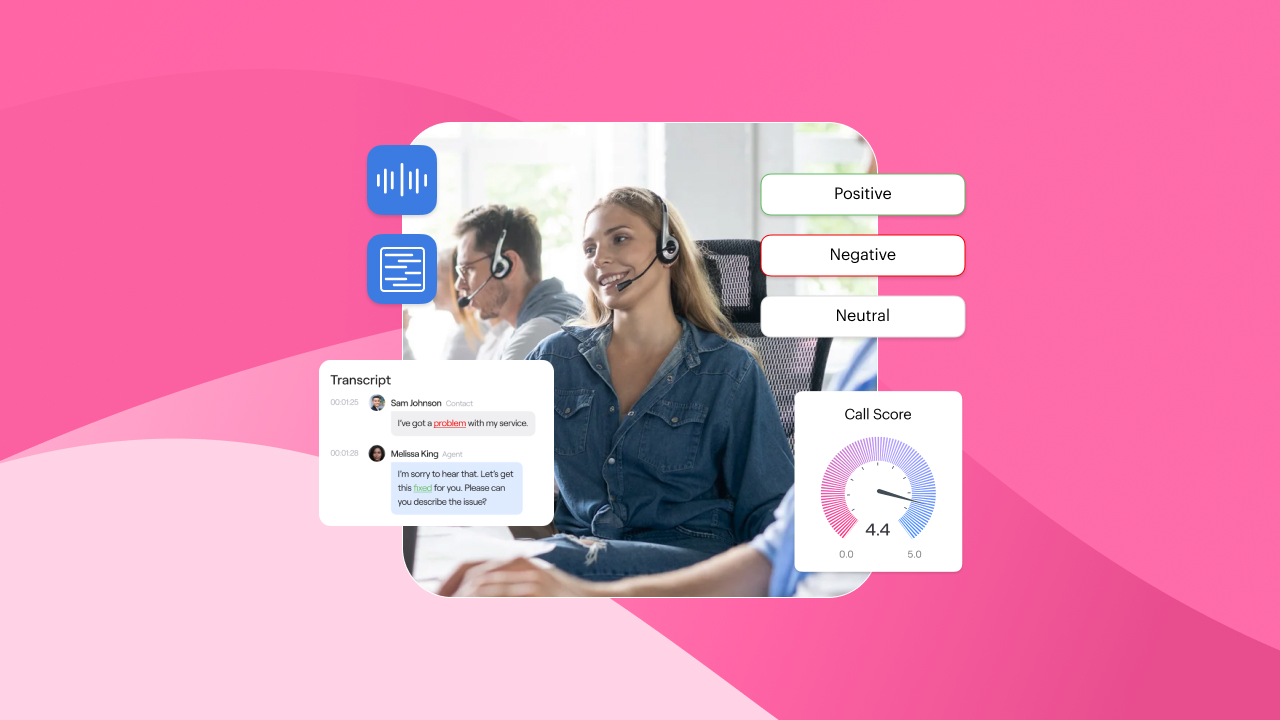
Quick answer: Both turn recorded language into structured data you can search, count, and report on. AI speech analytics analyzes spoken words from calls, which makes it the narrower predecessor covering voice calls only. Conversation analytics extends the same idea across chat, email, messaging apps, and voice together. The difference lies in what goes in rather than what comes out, so the label tells you about channel scope and almost nothing about whether the output will be accurate enough to act on.
That second point is where most buying decisions go wrong, and it is what the rest of this article is about.
Speech and Conversation Analytics at a Glance
| Dimension | AI speech analytics | Conversation analytics |
| Input | Recorded and live calls | Calls plus chat, email, messaging, sometimes tickets |
| Core process | Transcribe, then categorize | Ingest text, transcribe audio, then categorize |
| Typical origin | Quality assurance and compliance in the contact center | Customer experience and product teams |
| Primary customer of the output | QA managers and team leads | CX, product, and marketing |
| Unit reported on | The call | The interaction, sometimes the case across channels |
| Real-time capability | Common | Varies, often historical only |
| Main accuracy risk | Transcription error | Transcription error plus incomparable inputs |
| What it cannot fix | A vague category taxonomy | The same vague taxonomy, across more sources |
The Short Answer
What each label covers
Speech analytics is the older term, built around the contact center’s need to review calls at a scale humans cannot manage. Conversation analytics is broader by design: the same processing applied to every text-bearing channel a customer might use, with the intention of following a single customer thread wherever it goes.
Some vendors use interaction analytics for the wider version, others say conversation intelligence, and a few reserve that last phrase for sales-focused products. Vocabulary here is not settled, which is worth remembering when comparing datasheets.
You will also see customer conversation analytics uses ai framed as though the AI part were the distinguishing feature. It is not. Rule-based keyword spotting has existed in this space for two decades; what changed is accuracy and the breadth of what can be categorized without hand-writing every rule.
Why the newer term appeared
Two forces, mostly. Contact volume moved off the phone, so a voice-only view stopped describing what customers were doing with any accuracy. A person who tries chat first, gets nowhere, then calls has produced two interactions about one problem, and a call-only view sees the second while missing the cause entirely. Meanwhile the underlying language processing got good enough that handling written text alongside transcripts stopped being a separate engineering problem.
There is a real customer experience argument buried in there, and it is the strongest case for the wider approach: you cannot see effort if you can only see one channel.
I would add a third, slightly less charitable reason: “conversation analytics” sounds more modern in a procurement document. Category names are marketing artifacts as much as technical ones.
What Both Actually Do
Strip away positioning and the pipeline is nearly identical in either case.
Capture and convert
Audio becomes text through automatic recognition. Written channels skip that step entirely, arriving as text already. Everything downstream operates on words, which is precisely why the two approaches converge once the conversion is done.
Categorize
The system tags each interaction against categories you define: billing dispute, cancellation risk, competitor mentioned, disclosure delivered. Some categorization runs on keyword rules, some on trained classifiers, most now on a mix. This step generates the value and receives the least attention during evaluation.
Categories are also where customer intent shows up, or fails to. A well-built taxonomy captures why somebody made contact, not merely what words appeared, and that distinction decides whether the resulting insights are usable by anybody outside the analytics team.
Surface and route
Results reach people through dashboards, alerts, sampling queues for reviewers, and increasingly automated scoring of every interaction rather than the two percent a human team could sample. Real time variants prompt during the exchange itself instead of afterward.
Who consumes the output matters as much as what it says. Quality teams want interaction-level detail. Operations leads want trends by queue. Product and marketing want themes across the customer base. One dataset, three audiences, and reporting built for one of them rarely satisfies the others.
Everything your team needs in one platform
Where They Genuinely Differ
Input scope
This is the honest difference. One reads calls; the other reads calls and everything typed. If your customers reach you across four channels and you only measure one, you are describing a quarter of your operation and calling it a picture.
The unit being measured
Subtler, and more consequential. Voice-only tools report on calls. Broader platforms often attempt to stitch related exchanges into one case, so a chat on Monday and a call on Wednesday about the same issue count once rather than twice. Whether any given product does that well is a question worth pressing hard during a demo, because the stitching is difficult and vendors describe it more confidently than they deliver it.
Side-by-Side Comparison
| Question | Voice-only approach | Cross-channel approach |
| Covers phone conversations | Yes | Yes |
| Covers chat and messaging | No | Yes |
| Follows one issue across channels | No | Sometimes, with caveats |
| Suits compliance monitoring on calls | Well established | Depends on the product |
| Complexity of rollout | Lower | Higher, more integration work |
| Risk of misleading comparisons | Lower | Higher, as discussed below |
Why Channel Coverage Is the Wrong Buying Criterion
Coverage is easy to demo and easy to compare, which is exactly why it dominates vendor conversations with prospective customers. It is also close to irrelevant if the resulting measurements are wrong.
Consider what has to go right before a cross-channel dashboard means anything. Audio must transcribe accurately. Categories must be defined so that different reviewers would apply them the same way. Scoring must behave consistently across sources that were produced under completely different conditions. Miss any of those and broader coverage simply distributes the error across more surfaces.
Three problems deserve attention before channel count enters the discussion.
None of this argues against broader coverage. It argues against treating coverage as the decision. A voice-only deployment producing trustworthy data on the channel carrying your hardest customer conversations beats a cross-channel one producing insights nobody believes, and I have seen the second outcome more often than the first.
The Comparability Problem Nobody Mentions
Spoken and written language are different registers
People do not type the way they talk. Speech is spontaneous, unedited, full of false starts, repetition, and interruption. Chat is composed, revisable, punctuated with abbreviations and emoji, and often written while doing something else. Both are language; they are not the same measurement material.
Scoring systems do not transfer cleanly
A classifier trained largely on written text encounters a transcript full of disfluencies and treats hesitation as uncertainty. One trained on transcripts encounters “ok fine” in chat and cannot tell resignation from agreement, because the tonal cues it learned to rely on were never typed.
Vendors rarely disclose which corpus their scoring was trained on. Ask. The answer predicts a lot about where the output will mislead you.
Dashboards that average incomparable things
Here is the practical failure. A cross-channel report puts voice sentiment beside chat sentiment on one axis and computes an overall figure. Those two numbers came from different instruments applied to different material. Averaging them produces something that moves, looks like a trend, and cannot be interpreted with confidence.
I would rather see four separate trend lines with honest labels than one blended index. Less satisfying to present upward, admittedly.
Transcription Error Sets the Ceiling
Word error rate bounds everything downstream
Whatever the categorization can do, it operates on what the recognition produced. If ten percent of words are wrong, every count, every category, every score inherits that error. This gets discussed far less than it should during evaluations, perhaps because it is not a flattering topic for anybody selling.
Errors are not evenly distributed
The uncomfortable finding: accuracy varies by who is speaking. Researchers at Stanford tested five commercial recognition systems from Amazon, Apple, Google, IBM, and Microsoft against 19.8 hours of interview audio, and found an average word error rate of 0.35 for Black speakers against 0.19 for white speakers, roughly double, with the gap traced to the acoustic components rather than the language ones (Koenecke et al., PNAS, 2020).
That study is several years old and recognition has improved since, so treat the exact figures as historical. The pattern, however, has not disappeared. A 2025 analysis of the Pacific Northwest English corpus found African American speakers experiencing a mean error rate of 20% against 15% for Caucasian American speakers across four systems, a relative increase of roughly a third (arXiv preprint, 2025).
Sit with what that means operationally. If your quality program scores agents automatically, and transcription is less accurate for some customers than others, then scores are not equally reliable across your agents’ caseloads. An agent serving a demographically different customer base may be measured with a noisier instrument. Nobody designed that outcome; it emerges anyway.
A note on what customers actually notice. None of the measurement debate reaches the customer directly. What reaches them is whether the next conversation goes better than the last one, which depends on somebody changing a process, a script, or a routing rule off the back of what the data showed. Analytics that never produces a change is an expensive archive.
Which suggests a test for any deployment: name three things your organization did differently because of what the customer data showed. If nobody can, the problem is rarely the platform’s accuracy. It is that no owner was made responsible for turning findings into decisions, and the insights sat in a dashboard that people opened during reviews and closed afterward.
Sentiment Has No Stable Ground Truth
People disagree about what they hear
The other soft spot. Sentiment scoring is presented as measurement, but the thing being measured resists definition. Research on annotation practice reports that human labelers frequently find the task difficult, that missing context makes it harder, and that annotators are often uncertain what they are even labeling: the feeling directed at a subject, the speaker’s emotional state, or something else entirely (Kirk et al., PLOS One via PMC, 2025).
If trained humans reach only modest agreement on the same sentence, an automated score cannot be more accurate than that ceiling. It can only be more consistent, which is a different property and occasionally mistaken for the first.
What to trust instead
None of that makes the technology useless. It makes single sentiment figures unsuitable as headline reporting. More defensible uses:
- Direction over absolute level. Whether negative-leaning exchanges are rising in one queue tells you more than the score itself.
- Anomaly detection. A sudden spike in a category is worth investigating regardless of whether the absolute reading is calibrated.
- Retrieval rather than judgment. Use scoring to find conversations worth listening to, then have somebody listen.
- Objective events alongside subjective ones. Whether a required disclosure was spoken is checkable. Whether the customer felt reassured is not.
That fourth point is why compliance monitoring remains the most reliable application of either approach. The question has an answer, and the answer does not depend on interpreting how somebody felt.
Similar reasoning applies to any objective communication event you can define: whether a callback was promised, whether a competitor was named, whether the customer was told about a fee. Those produce insights you can defend in a meeting. Emotional readings produce discussion.
Your Taxonomy Decides the Value
Almost every disappointing deployment I have heard about traces back to the same place, and it is not the software. Categories were defined vaguely, applied inconsistently, and never revisited.
“Customer frustrated” is not a category; it is a mood. “Customer asked for a supervisor” is a category, because two people would tag it identically. Writing a QA scorecard is the closer analogy, not configuring a platform, and the work is unglamorous enough that it frequently gets skipped in favor of the dashboards. A customer experience team that defines its categories carefully will get more from a modest product than a careless team gets from an expensive one.
A reasonable sequence: define ten categories that matter commercially, validate that reviewers agree on them, measure those for a quarter, then expand. Starting with sixty categories inherited from a template produces sixty unreliable numbers.
Involve the agents in this, incidentally. People handling the conversations daily know which distinctions matter and which are artificial, and they will tell you within an hour that two of your proposed categories describe the same situation. That hour saves a quarter of confused reporting. It also improves adoption, since agents who helped define the measures argue with them less when scores appear.
What to Ask a Vendor
Questions that separate products more usefully than a channel checklist:
- What word error rate do you achieve on audio resembling ours, in our languages and accents?
- Was your scoring trained on spoken transcripts, written text, or both?
- Can I see per-channel results rather than a blended index?
- How are categories defined, and can my team change them without professional services?
- What happens to accuracy on overlapping speech, poor lines, and background noise?
- Do you report confidence, so low-certainty results can be excluded from reporting?
- How do you handle multilingual conversations, including code-switching mid-sentence?
Notice that none of those concern channel coverage. Coverage is a purchasing decision; accuracy is an operational one.
One more, which sounds procedural but matters: ask what proportion of your interactions the system will actually process. Short calls, transfers, and abandoned chats often fall outside default handling, and a platform reporting on eighty percent of your customer contacts while presenting figures as though they covered everything will quietly bias every trend you look at.
Frequently Asked Questions
Is conversation intelligence the same thing?
Broadly it describes the same processing, though usage differs by market. Contact center vendors typically say conversation analytics, while sales technology vendors prefer the intelligence framing for products focused on deal coaching and pipeline signals rather than service quality. Both transcribe, categorize, and report. When comparing options, ignore the label and ask which channels are ingested, what the output categories are, and who inside your organization the reporting was designed for.
Do these tools work in languages other than English?
Coverage varies enormously, and quality varies more than coverage does. A vendor supporting thirty languages may perform well in five and poorly in the rest, since training data is abundant for some and scarce for others. Accents and regional dialects add further variation within a single language. Ask for accuracy figures specific to the languages your operation actually handles, tested on audio resembling yours rather than on clean studio recordings.
Is recording and analyzing conversations legal?
It depends on jurisdiction, on whether one party or all parties must consent, on your sector, and on what you do with the resulting data afterward. European operations must also consider lawful basis and retention under data protection law, and biometric voice processing carries additional obligations in several places. Treat the analysis as a separate question from the recording, since some regimes distinguish them. Take local legal advice rather than relying on vendor assurances.
How much does this typically cost?
Pricing models differ so widely that comparison requires normalizing them yourself. Some vendors charge per seat, others per hour of audio processed, others per interaction, and several bundle basic transcription while charging separately for scoring. Storage and retention add cost that is easy to overlook at signing. Model your own volumes against each structure, because a per-hour price looks attractive until you calculate what your actual recording hours amount to annually.
Can it replace manual quality review?
Not entirely, though it changes what reviewers spend time on. Automated scoring covers every interaction rather than a small sample, which is genuinely useful for finding cases worth attention. Human review remains necessary for judgment calls, for calibration, and for anything a customer might appeal. The practical arrangement most operations settle on is automated coverage for triage, with people reviewing the flagged minority and periodically checking whether the automation still agrees with them.
How long before it produces anything useful?
Basic reporting appears within weeks, since transcription and default categories work immediately. Genuinely useful output takes a quarter or more, because that time goes into defining categories that fit your business, checking that they are applied consistently, and discarding the ones that turn out to be noise. Operations expecting real insight in the first month usually get volume counts instead, which resemble progress without actually being it.
Does it work on live conversations or only recordings?
Both exist, and they solve different problems. Historical processing supports quality review, trend reporting, and compliance auditing. Live processing prompts agents during the exchange, flagging a missed disclosure or a retention offer while it can still matter. Live capability costs more and demands far lower latency, so confirm you have a use case genuinely requiring immediacy rather than buying it because it demonstrates impressively in a sales meeting.
How This Works Inside Voiso
Voiso runs speech analytics as part of the same platform that handles the conversations themselves, which removes a class of integration problems before they start. Transcription feeds automated scoring against criteria your team defines, and conversation scoring applies consistent evaluation across interactions rather than the sample a review team could reach manually.
Because voice and digital channels run through one contact center system, the underlying records sit together rather than in separate stores requiring reconciliation. Agents work inside the same environment being measured, which shortens the loop between a finding and a change in how conversations are handled. That helps with the stitching problem described earlier, though I would still encourage reading per-channel results separately before trusting any combined view.
Worth restating the argument: the useful question is not which category name a product claims. It is whether the numbers it produces are accurate enough, and defined tightly enough, that somebody will act on them.
A final thought, offered tentatively because reasonable people disagree. The category name you buy under will probably look dated within three years, the way voice analytics already does. What will not date is whether your organization built the habit of defining a question precisely, measuring it consistently, and changing something when the customer answer arrives.
Wondering what your conversations would reveal? Talk to the Voiso sales team about your channels, your languages, and the handful of categories that would change decisions in your operation.
Sources referenced in this article
- Koenecke, A., et al. (2020). Racial disparities in automated speech recognition. Proceedings of the National Academy of Sciences, 117(14). pnas.org
- A Sociophonetic Analysis of Racial Bias in Commercial ASR Systems Using the Pacific Northwest English Corpus (2025), preprint. arxiv.org
- Disambiguating sentiment annotation: A mixed methods investigation of annotator experience and impact of instructions on annotator agreement (2025). ncbi.nlm.nih.gov