All Products

.svg)




Teams shopping for a business phone system usually think they’re picking between two rival products: VoIP or a cloud phone system. That framing is the first mistake. One is a transmission technology; the other is a category of platform built on top of it. Putting them head to head is a bit like comparing electricity to a kitchen, related, but not the same kind of thing.
The confusion is largely the industry’s doing. Vendors market routing engines, analytics suites, and automation tools all under the VoIP banner, so products with very different scopes end up sounding identical on a feature page. Throw in a pile of overlapping acronyms, hosted PBX, UCaaS, CCaaS and it becomes genuinely hard to tell what you’re buying.
This article untangles that. Instead of restating textbook definitions, it lays out the layers, what each one demands from your network and budget, and how to tell which one your operation actually needs.
Key Takeaways
- They aren’t rivals: VoIP is the transport that carries voice over the internet; a cloud phone system is a platform built on top of it.
- Think in layers, not labels: VoIP → hosted PBX → UCaaS (internal collaboration) → CCaaS (customer-facing contact center) each adds capability over the one below.
- Network decides call quality, not the tech: Aim for latency under 150 ms, jitter under 30 ms, packet loss under 1%, and a MOS of 4.0+.
- Codec choice sets bandwidth: G.711 is highest quality (~64 kbps), G.729 is lean (~8 kbps), and Opus adapts in real time (~42 kbps average).
- A platform adds what runs an operation: Routing and dialers, omnichannel in one thread, analytics, and CRM integration with screen pops and auto-logging.
- Cheap VoIP hides its real cost: Hardware, IT time, and separate tools add up; a platform’s per-seat fee usually lowers total cost of ownership.
- Basic VoIP is fine when needs are simple: Low call volume, no dedicated sales or support, no routing, dashboards, or multichannel messaging.
- Move to a platform when scale hits: High volume, agent performance tracking, multichannel customers, or recording and compliance requirements.
- Avoid the common traps: Treating it as either/or, underestimating integrations, and pricing on the monthly fee alone.
- Bottom Line: Decide whether you need a way to make calls or a system to run them on, that answer settles the rest of the comparison.
Start With the Layers, Not the Labels
The clearest way to think about this is as a stack, where each layer adds capability on top of the one below it:
- VoIP is the transport. It carries voice over the internet instead of copper phone lines. That is the entire job. It says nothing about routing, reporting, or who answers the call.
- Hosted PBX adds the phone-system basics in the cloud: extensions, transfers, voicemail, an auto-attendant. Roughly the old office phone system, minus the hardware closet.
- UCaaS (Unified Communications as a Service) bundles internal collaboration: calling, video meetings, team chat, presence into one app. These are the tools employees use to reach each other.
- CCaaS (Contact Center as a Service) is built for customer-facing work: skills-based routing, queues, IVR, outbound dialers, omnichannel handling, and the analytics to manage agents at scale.
Most write-ups collapse the top three into one fuzzy phrase, “cloud phone system.” The distinction worth holding onto is UCaaS versus CCaaS, because it maps to a real question: are you equipping employees to talk to each other, or running a team whose job is talking to customers? UCaaS is tuned for the first, CCaaS for the second. Voiso sits in the CCaaS layer.
So the honest version of the comparison isn’t “VoIP or cloud.” It’s “raw transport or a platform” and if it’s a platform, which kind.
What VoIP Does, and What It Asks of Your Network
VoIP converts speech into digital data, splits it into packets, and ships them across the internet to be reassembled as sound at the far end. Two protocols run the show: SIP sets up and tears down the call (the signaling), and RTP carries the audio once the line is open.
A codec decides how that audio is compressed, and the choice has a direct, measurable effect on bandwidth:
| Codec | Bandwidth per call | Best for |
| G.711 | ~64 kbps (80–100 with overhead) | Top quality and maximum compatibility; heaviest on bandwidth |
| G.729 | ~8 kbps (~32 with overhead) | Bandwidth-constrained links, with a modest quality trade-off |
| Opus | Variable, ~42 kbps average | Modern default; adapts to conditions in real time and recovers gracefully from lost packets |
Because packets follow no fixed path, call quality depends almost entirely on the network underneath. Four numbers tell you whether a connection can carry clean voice:
- Latency: keep one-way delay under 150 ms. From 150 to 400 ms is usable but noticeably laggy; past 400 ms, conversation breaks down (ITU-T G.114).
- Jitter: the variation in packet arrival should stay under about 30 ms. Above that, audio begins to stutter.
- Packet loss: aim for under 1%. Voice tolerates a little loss, but more produces audible dropouts.
- MOS: the Mean Opinion Score rates call quality from 1 to 5. A score of 4.0 or above is “toll quality,” the clarity of a landline.
This is the practical reason call quality varies so much between setups running “the same” VoIP. The technology is identical; the network carrying it is not. It is also why monitoring matters, Voiso reports MOS per call, which tells you whether a quality complaint is the software or the connection before anyone wastes time chasing the wrong fix.
Everything your team needs in one platform
What a Platform Adds on Top
Transport alone doesn’t run a sales floor or a support queue. A contact-center platform turns a call into something you can route, measure, and connect to the rest of your stack. The capabilities that matter fall into a few groups.
Routing and automation
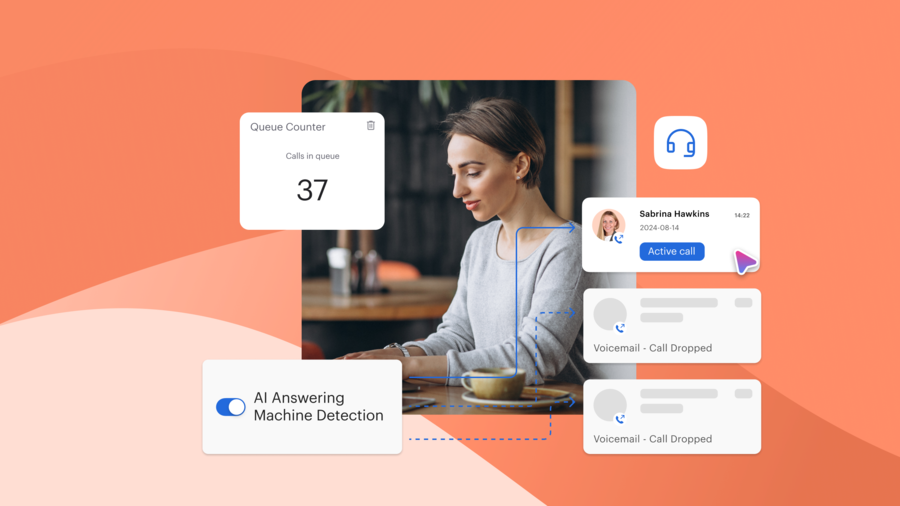
Inbound calls reach the right person through IVR menus, skills-based routing, and queues rather than one ringing line. Outbound, AI-adjusted predictive dialing keeps agents on live calls instead of idling between them, and answering-machine detection screens out voicemail pickups so agents spend their time on real conversations. Voiso’s Flow Builder lets a supervisor assemble these flows in a visual editor without writing code.
Omnichannel, in one place
Voice rarely travels alone anymore. Customers move between calls, SMS, web chat, and messaging apps like WhatsApp, and they expect to pick up where they left off. A platform keeps those threads attached to a single customer record instead of scattering them across separate inboxes.
Analytics and AI
Every interaction is data. Real-time dashboards show what’s happening on the floor now; historical reports surface trends over weeks. Speech analytics can transcribe and score calls automatically, which turns quality assurance from spot-checking a handful of recordings into reviewing the full volume.
CRM integration
This is where the time is actually saved. With the phone system wired into Salesforce, Zoho, Freshdesk, HubSpot, and the like, agents get click-to-call, screen pops with the caller’s history, and automatic logging, no tab-switching, no manual notes, no copy-pasting numbers between windows.
Where the Difference Hits Cost and Operations
Definitions are easy; the decision lives in deployment, scaling, and total cost.
Deployment
VoIP can run on-premise or in the cloud. On-prem gives you control but hands your team the servers, updates, and security patches. A managed cloud platform takes that off your plate and goes live in days rather than weeks.
Scaling
Adding seats, numbers, or a new region on a hardware-based setup means procurement and installation. On a cloud platform it’s a configuration change, which is also what makes distributed teams practical, since agents work from a browser or the mobile app wherever they are.
Cost, past the sticker price
Basic VoIP looks cheaper because the line item is small. The real spend shows up elsewhere: desk phones and networking gear, the IT hours to run it, and the stack of separate subscriptions for routing, analytics, and CRM glue that a bare VoIP service doesn’t include. A platform folds most of that into one per-seat fee, which makes the bill predictable and usually lowers total cost of ownership, not because the monthly rate is lower, but because you’re no longer paying to integrate and maintain five tools. Then there’s the cost that never appears on an invoice: every minute an agent spends dialing dead numbers or switching windows is capacity you paid for and didn’t use.
Which One You Actually Need
Plenty of businesses are well served by basic VoIP, and bolting a contact-center platform onto light needs is just overhead. Stick with simple VoIP if you’re a small team or solo operator with modest call volume, no dedicated sales or support function, and no real need for routing, dashboards, or multichannel messaging. A straightforward calling service covers it.
You’ve outgrown it once any of these become true: call volume is high enough that queues and routing matter, you need visibility into agent performance, you’re handling customers across more than one channel, or compliance requires recording and auditable reporting. The pattern across industries is consistent. BPOs and outsourced call centers live on dialer efficiency and queue management; fintech needs recording, reporting, and CRM trails for compliance; e-commerce and direct-to-consumer brands need SMS and messaging alongside voice because that’s where their customers already are.
A few traps to avoid on the way:
- Treating it as either/or. You’re not choosing VoIP instead of a platform, the platform includes VoIP. The real question is how much sits on top.
- Underestimating integrations. A disconnected setup feels fine at ten agents and becomes a daily tax at fifty. Map your CRM and helpdesk needs before you buy, not after.
- Pricing on the monthly fee alone. The cheap-looking option is often the expensive one once hardware, IT time, and bolt-on tools are counted.
Before comparing vendors, answer four questions honestly: how fast will headcount grow, which channels do customers actually use, what has to integrate with what, and how much reporting and compliance do you really need. The answers narrow the field faster than any feature list.
The Bottom Line
VoIP is how voice gets from one place to another. A cloud contact-center platform is how a team manages the conversations that voice carries, routing them, measuring them, and tying them to customer data. Few businesses struggle with transmitting a call; they struggle with everything around it. Decide whether you need a way to make calls or a system to run them on, and the rest of the comparison answers itself.
Exploring a Cloud Contact Center
If your needs have crossed from “make calls” into “run an operation,” Voiso is a cloud contact-center platform that brings voice, SMS, and messaging into one workspace, with built-in AI analytics, CRM integrations and no-code call flows. It’s worth a look if you’re trying to consolidate tools rather than add another one.