

That’s where modern IVR software changes the game, giving your callers a faster, smoother, and actually helpful way to get what they need. Whether you’re a small business wanting to look more professional or an enterprise ready to scale support, the right IVR setup can save your team time, reduce missed opportunities, and make customers feel heard.
We’ve put together a comprehensive guide on what IVR actually is, why it matters in 2026, and which features you should prioritize when choosing the best IVR platform for your business this year. Let’s dive in.
Key Takeaways
- Modern IVR systems go beyond touch-tone inputs, offering speech recognition and natural language support to streamline call experiences.
- IVR enhances customer experience by routing calls efficiently, enabling self-service, and reducing wait times or unnecessary transfers.
- Key features to look for include speech-enabled routing, CRM integrations, visual IVR, real-time analytics, and multi-language support.
- Top IVR platforms for 2026 include Voiso, NICE CXone, Talkdesk, Five9, Zendesk Talk, and MightyCall, each catering to different business sizes and needs.
- Visual IVR and no-code builders are empowering non-technical users to design and update call flows without IT assistance.
- IVR is valuable across industries including healthcare, finance, retail, and SMBs, supporting everything from appointment booking to secure transactions.
- Common challenges include overly complex menus, poor speech recognition, and lack of CRM or system integration, emphasizing the need for thoughtful planning and testing.
- Trends shaping IVR’s future include conversational AI, RPA integration, and cross-channel workflows, transforming IVR from a simple router to a smart service hub.
- Cost and setup time vary, small teams can start with affordable cloud-based options, while enterprises may invest in more robust, integrated IVR suites.
What is IVR and Why Does it Matter?
Defining Interactive Voice Response (IVR)
In simple terms, IVR is the automated phone system that greets your callers, guides them through menu options, and routes them to the right place. It uses pre-recorded voice prompts, DTMF (keypad) input, and increasingly, speech recognition to interact with callers without needing a human on the line for every request.
While traditional IVR relied heavily on ‘press 1, press 2’ formats, modern systems are shifting toward speech-enabled IVR that lets people simply say what they need. This makes the experience feel less like navigating an outdated phone tree and more like having a conversation that gets things done quickly.
IVR’s role in customer experience
IVR is much more than just cutting costs; it makes your customers’ lives easier while freeing your agents to handle more complex issues. Directing callers to the right department quickly reduces frustration and avoids transferring callers multiple times. Plus, it cuts down on wait times by allowing customers to resolve simple requests, like checking an order status or updating account details, through 24/7 self-service.
IVR is the go-to tool to help customers feel in control while ensuring they’re not left hanging when they need a live agent. It’s the middle ground between complete automation and the personal touch of human support.
Must-Have Features in Modern IVR Software
Call routing and menu logic
- Look for skills-based routing that sends callers to the best-suited agent or department, reducing transfers and resolution time.
- Multi-level menu trees let you organise options clearly while still providing quick pathways to voicemail or live agents when needed.
Natural language and speech recognition
- Modern IVR should support speech recognition and natural language processing, letting customers say things like ‘I need billing’ instead of pressing multiple buttons.
- It enhances accessibility and provides a smoother user experience, especially for callers who prefer voice commands or multilingual support.
IVR analytics and reporting
- A strong IVR system should give you insights into call completion rates, drop-off points, and menu navigation patterns.
- Tracking important metrics helps you spot friction points and refine your call flows to improve customer experience over time.
CRM and third-party integrations
- The best IVR platforms connect seamlessly with CRMs like Salesforce, Zendesk, or Freshdesk, pulling in customer data to personalise interactions.
- Integrations give your agents context when calls are escalated, reducing repetitive questions and improving efficiency.
Visual IVR and omnichannel features
- Visual IVR lets customers interact with your IVR via web or SMS, offering an alternative to voice navigation for those who prefer a screen-based option.
- Coordinating your IVR with chat, email, and social workflows ensures consistent support across channels without losing track of conversations.
Customisation and scalability
- Choose an IVR system that lets you customize scripts, branding, and call flows to match your business’s voice and processes.
- Whether you’re a startup handling a few calls a day or an enterprise managing thousands, your IVR should scale with you without sacrificing performance.
The Top IVR Tools for 2026
| Provider | Key features | Pricing | Pros | Cons |
| 1. Voiso | Visual IVR builder, real-time dashboards, CRM integrations, call recording. | Starts at $24/user/month. | Fast setup, strong CRM sync, built‑in analytics. | UI can feel crowded for advanced users. |
| 2. NICE CXone | Omnichannel IVR, AI speech recognition, workforce management. | Starts at $71/user/month. | Comprehensive enterprise-grade features, scalable. | Higher entry cost, complex pricing structure. |
| 3. Talkdesk | AI-enabled IVR, studio designer, integrated analytics. | Starts at $85/user/month. | Easy visual setup, robust reporting tools. | Can get expensive with add-ons. |
| 4. Five9 IVR | Speech-enabled IVR, visual call flows, callback scheduling. | Starts at $119/user/month. | Reliable speech IVR, strong inbound support. | Limited transparency on add-on costs. |
| 5. Zendesk Talk | Menu-based IVR, call recording/transcription, ticket automation. | Starts at $19/user/month. | Seamless integration with Zendesk suite, per-minute flexibility. | Pay-per-minute can add up, minimal menu logic in lower tiers. |
| 6. MightyCall | Simple IVR setup, call queues, call recording, analytics. | Starts at $15/user/month. | Budget-friendly, perfect for small teams. | Fewer advanced features and integrations. |
1. Voiso
Voiso is a cloud-native platform that blends advanced call routing with real-time analytics, making it a solid choice for teams that need flexibility without heavy infrastructure.
Its AI-enhanced IVR capabilities allow you to design call flows that adapt dynamically to caller inputs, using speech recognition to guide customers to the right place without the frustration of endless menus.
Multilingual support makes Voiso especially useful for businesses handling international call volumes, while real-time configuration means you can tweak call flows on the go without downtime. Voiso also integrates with popular CRMs, allowing you to link caller data and past interactions directly within your IVR journey for a more personalized experience.
2. NICE CXone
NICE CXone is designed for enterprise-level teams that need scalable voice automation without sacrificing control. It features advanced scripting tools for building complex IVR workflows, letting you map customer journeys with conditions, branching logic, and skill-based routing.
Its integration with broader NICE contact centre tools means your IVR isn’t siloed; it connects seamlessly to workforce management, quality monitoring, and omnichannel customer records.
And if your team handles high call volumes and needs granular control over customer interactions, NICE CXone provides AI-enhanced speech recognition and analytics to continuously refine performance while ensuring a consistent caller experience.
3. Talkdesk
Talkdesk’s IVR capabilities are a great fit for teams who value ease of use without losing customization power, making it ideal for support-heavy teams aiming to improve customer journeys without overcomplicating setup.
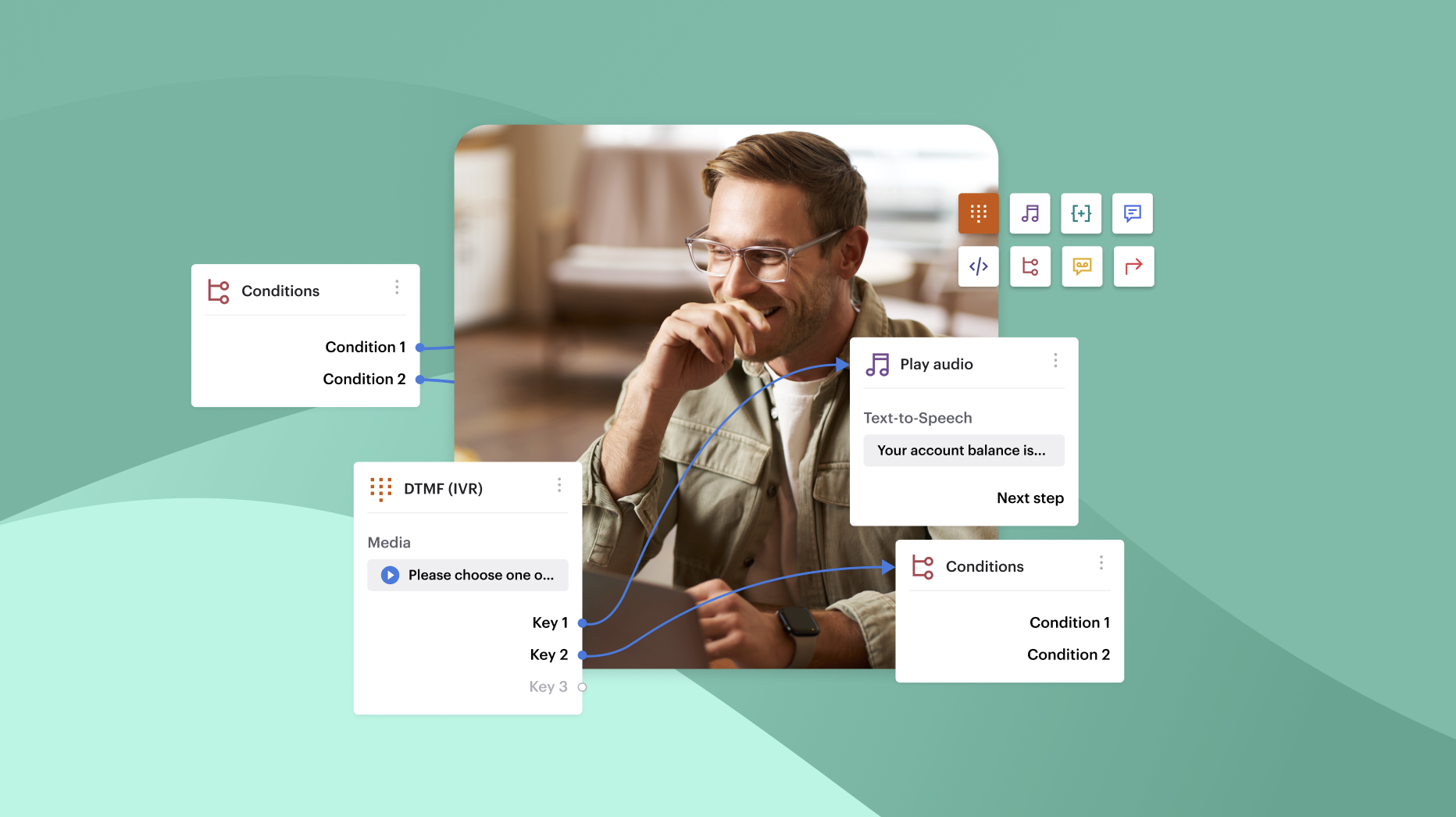
Its drag-and-drop call flow builder allows non-technical teams to design, test, and deploy IVR menus in minutes, while maintaining flexibility with advanced conditions and routing logic.
Talkdesk integrates tightly with CRMs like Salesforce and HubSpot, letting agents see caller history and context the moment they answer. Plus, its workforce engagement management tools link with the IVR to monitor call flows and agent availability, ensuring customers are routed efficiently based on live staffing levels.
4. Five9 IVR
Five9 IVR is built for high-capacity call environments, providing predictive routing that uses AI to determine which calls should be prioritized based on customer needs and agent availability.
Its speech-enabled IVR supports both DTMF and natural language, allowing customers to interact in the way that suits them best. Five9’s built-in AI and workforce engagement tools allow you to align your IVR with broader contact centre operations, using insights from call patterns to refine routing and reduce wait times.
If your business manages complex, large-scale support operations, Five9’s IVR is well-equipped to handle volume while maintaining high service standards.
5. Zendesk Talk
For teams already using Zendesk, Zendesk Talk offers a straightforward IVR system that connects seamlessly to your ticketing workflows. It’s particularly suitable for small-to-medium support teams that need to add voice support without complex onboarding.
You can set up menu-based routing to direct calls to the right department or trigger automated callbacks, reducing missed calls and improving agent efficiency.
While it doesn’t offer the same advanced scripting as enterprise systems, its simplicity and native Zendesk integration make it a practical choice for growing support teams looking to centralise voice within their omnichannel environment.
6. MightyCall
MightyCall provides a budget-friendly IVR solution for startups and small businesses looking to improve their caller experience without heavy costs.
It offers a user-friendly visual IVR editor that makes designing call flows simple, even for non-technical users. Features like call queues, voicemail routing, and simple condition-based routing help small teams manage inbound calls professionally, ensuring no customer is left waiting without direction.
MightyCall also includes call recording and reporting, providing insights into call volume and performance to support continuous improvement. If your team is starting out or scaling gradually, MightyCall helps build a structured phone experience without overwhelming your resources.
How to Choose the Right IVR Software for Your Business
1. Identify business use cases
Before diving into demos, take a clear look at why you need IVR in the first place: are you aiming to route support calls, handle appointment bookings, or manage billing inquiries efficiently?
A small clinic may need a simple system for confirming appointments, while a large retailer might require complex routing for support, sales, and logistics. Some IVR platforms offer plug-and-play menus that suit general needs, while others allow fully custom workflows to align with your business processes.
Matching your daily call challenges with your IVR’s capabilities is what ensures it becomes a genuine productivity tool instead of just another tech subscription.
2. Consider your technical environment
Next, think about where and how your IVR will live: do you prefer a cloud-based system that allows you to update call flows remotely, or does your operation require an on-premise or hybrid setup due to data compliance or legacy infrastructure?
Integration is key: your IVR should connect seamlessly with your current telecom stack and CRM systems, ensuring caller data flows to your agents in real time. Planning this step helps you avoid future headaches and ensures the IVR fits naturally into your daily workflows.
3. Evaluate usability and support
It’s important that your team can easily build, test, and adjust IVR flows without needing a developer each time you want to add a new department or tweak a greeting. Look for platforms with intuitive drag-and-drop editors, clear reporting, and sandbox testing options.
Also, consider the vendor’s support quality: is onboarding included? Do they offer clear documentation, or will your team be stuck on hold with support for every minor tweak? The goal is to find an IVR platform that empowers your team while providing help when you need it.
4. Compare pricing models
IVR pricing can vary significantly, so take time to understand how each vendor structures costs. Some platforms charge per agent, others per minute of usage, while some offer flat-rate licensing with feature-based tiers.
And watch out for hidden costs like premium fees for advanced speech recognition, multilingual menus, or API access. Your choice should align with your call volume expectations to avoid surprises down the line, ensuring you get an IVR solution that scales sustainably with your business.
Benefits of Implementing IVR Software
Improved call efficiency
- IVR systems reduce average handling times by quickly routing callers to the right department without manual agent intervention.
- Handling common questions and tasks automatically gives your team more time to focus on high-value, complex issues that need a human touch.
Enhanced customer satisfaction
- Callers get quick access to information or get sent directly to the right agent, reducing frustration and unnecessary transfers.
- IVR allows your business to provide 24/7 service, helping customers even during after-hours or peak call times.
Consistency and compliance
- IVR ensures all callers receive a standard greeting and experience, helping your business maintain a professional image.
- Calls and menu selections can be logged for quality assurance, making it easier to track and resolve customer issues while staying compliant with regulations.
Common IVR Implementation Challenges
Overly complex menus
Long-winded, confusing menu trees are a common IVR pitfall that drives callers away. To avoid it, prioritize clarity over quantity; limit your main menu to essential options and allow customers to reach a human easily if needed. Regularly review call recordings and customer feedback to spot points where users drop off or get stuck, then simplify accordingly to keep the experience smooth.
Lack of speech recognition accuracy
Speech-enabled IVR systems can elevate customer experience, but only if the technology recognizes inputs accurately. When evaluating vendors, prioritize those with proven, reliable voice AI and multilingual capabilities. It’s also crucial to regularly test the system in real customer scenarios, refining prompts and recognition accuracy to ensure your IVR serves your customers effectively.
Integration barriers
IVR software that can’t connect with your existing CRM or call center systems creates inefficiencies instead of resolving them. Before you commit, confirm the platform’s compatibility with your current environment and check whether APIs or middleware are available to bridge any gaps. A well-integrated IVR ensures seamless data flow, which leads to better customer insights and a smoother caller journey.
Real-World Use Cases for IVR Software
Small businesses
For small businesses, IVR systems can act like a reliable front desk that never sleeps. They help manage incoming calls with simple menu routing so customers can get to the right department or voicemail without frustration.
Small shops and local services can use IVR to share store hours or holiday schedules automatically, cutting down on repetitive calls. Many also use IVR for appointment scheduling, allowing clients to book or confirm visits without waiting for someone to pick up the phone, freeing up staff to focus on in-person customers.
Enterprise contact centres
Large-scale contact centres lean on IVR to manage high volumes of calls efficiently while maintaining quality service. They enable advanced call distribution by skill, priority, or language, ensuring customers reach the right agent without bouncing between departments.
Enterprises also use IVR alongside call blending, letting agents handle inbound and outbound calls based on volume fluctuations. With built-in analytics, managers can track call flows, drop-off points, and resolution rates, helping them optimize scripts and improve customer experience systematically.
Healthcare and finance
In healthcare and finance, IVR isn’t just about convenience, it’s about security and compliance. Such industries often use IVR for secure ID verification before routing callers to the correct agent, reducing fraud risk.
Financial institutions can automate payment processing, allowing customers to check balances or pay bills over the phone without human intervention. Meanwhile, pharmacies and clinics use IVR for prescription refill requests, appointment confirmations, or lab results, reducing manual call handling while keeping sensitive information secure.
Trends Shaping the Future of IVR Technology
Conversational IVR with generative AI
We’re moving beyond rigid ‘press 1, press 2’ systems toward conversational IVR that feels like talking to a helpful assistant.
Powered by generative AI, they can understand natural speech, clarify customer intent, and dynamically guide users without forcing them to navigate layered menus. This means customers can say ‘I need to reschedule my appointment,’ instead of guessing which number to press, improving accessibility and satisfaction while reducing call friction.
Visual IVR and no-code builders
Visual IVR is gaining traction, allowing customers to interact with it through their smartphones via clickable menus or SMS links, reducing the frustration of navigating audio-only prompts. At the same time, no-code builders are empowering non-technical teams to design, deploy, and update IVR flows easily, enabling businesses to adapt quickly to customer needs without waiting on IT support. It creates a level of flexibility that keeps customer service agile, especially during promotions, emergencies, or seasonal shifts.
Integration with RPA and workflow automation
The future of IVR is tied closely to backend automation. Integration with robotic process automation (RPA) allows IVR systems to handle complex requests like checking order status, updating customer information, or scheduling follow-ups by interacting directly with billing systems, inventory management, or scheduling tools.
This makes the IVR not just a call router but a powerful workflow hub that can complete tasks and reduce the need for human intervention while ensuring consistent, fast customer service.
FAQs
What industries benefit most from IVR software?
Industries like healthcare, finance, retail, utilities, and travel benefit most, as they handle high call volumes and require efficient routing or self-service options.
How long does it take to set up and configure an IVR system?
Setup can take anywhere from a few hours to a couple of weeks, depending on the complexity of call flows and integrations needed.
Is IVR technology expensive for small businesses?
Many cloud IVR solutions are affordable for small businesses, with plans starting under $30 per user per month.
Can IVR be used for outbound calls, such as surveys or reminders?
Yes, IVR can handle outbound calls for payment reminders, appointment confirmations, and customer surveys.
What’s the difference between hosted IVR and cloud IVR?
Hosted IVR typically uses on-premise hardware managed by a provider, while cloud IVR runs entirely online and requires no physical equipment.
How does IVR handle multiple languages and accents?
Modern IVR systems use multilingual prompts and advanced speech recognition to understand various languages and regional accents.
Do IVR systems require internet to function?
Cloud-based IVR systems require an internet connection, while traditional hosted IVR can operate via standard phone lines.
Can I update my IVR script or flow without technical help?
Many IVR platforms now offer no-code or drag-and-drop editors, allowing you to update scripts and call flows without developer support.
Further Reading
- Types Of IVR Systems
- Guide To IVR Technology
- Benefits Of Text To Speech In Your IVR
- What Is Call Routing