All Products

.svg)




Patient no-show rates sit between 15% and 30%, according to a 2023 NIH systematic review of 36 studies across primary care settings. Meanwhile, McKinsey’s 2022 Consumer Health Insights survey found that 29% of patients who abandoned a scheduling attempt cited friction, long hold times, unclear phone trees, or calls that never connected to the right person.
Both problems share a root cause. The phone system that handles a routine follow-up call is the same one that needs to route an urgent symptom to a nurse. Most legacy setups weren’t designed to tell the difference.
We look at where cloud telephony actually changes that dynamic, in appointment management, telehealth, small-practice call handling, and large health system operations and where the practical constraints are worth knowing before a migration.
Key Takeaways
- Legacy phone systems create care delays: Urgent symptoms, appointment changes, refill requests, and billing calls often end up in the same queue.
- Automated reminders reduce missed visits: SMS and voice reminders give patients time to confirm, cancel, or reschedule before slots go unused.
- Dynamic waitlists recover cancellations: Cloud systems can notify eligible patients fast and refill open appointments without manual calling.
- Routing improves triage: Intelligent call flows send urgent, after-hours, language-specific, or department-specific calls to the right team.
- Phone-based telehealth protects access: Voice calls help patients who struggle with apps, video links, bandwidth, or digital portals.
- Smaller practices gain flexibility: Clinics can update call paths, manage overflow, support remote staff, and reduce voicemail backlogs.
- Large health systems need centralized control: Multi-location routing helps distribute demand across clinics, departments, and specialist teams.
- Compliance depends on behavior: Encryption, audit logs, MFA, and BAAs matter, but personal phones and unmanaged messaging create real risk.
- Bottom Line: Cloud telephony works best when it fixes specific healthcare communication failures, not when it simply replaces desk phones.
Why legacy phone infrastructure breaks under healthcare load
Most healthcare communication still runs on desk-phone setups designed for lower call volumes and simpler triage. Front-desk staff work across disconnected tools: one screen for scheduling, another for patient records, a handset for calls. When call volume spikes after a holiday weekend or a seasonal illness surge, the gaps between those systems become visible fast.
Three problems compound each other. First, manual triage, receptionists routing calls by instinct rather than defined logic, creates inconsistency. Urgent symptom calls sit in the same queue as appointment changes. Second, visibility is limited: most legacy systems don’t produce queue data, so managers can’t identify bottlenecks until the voicemail is already full. Third, remote staff are cut off. A scheduling coordinator working from home loses access to the same call workflows available in the office.
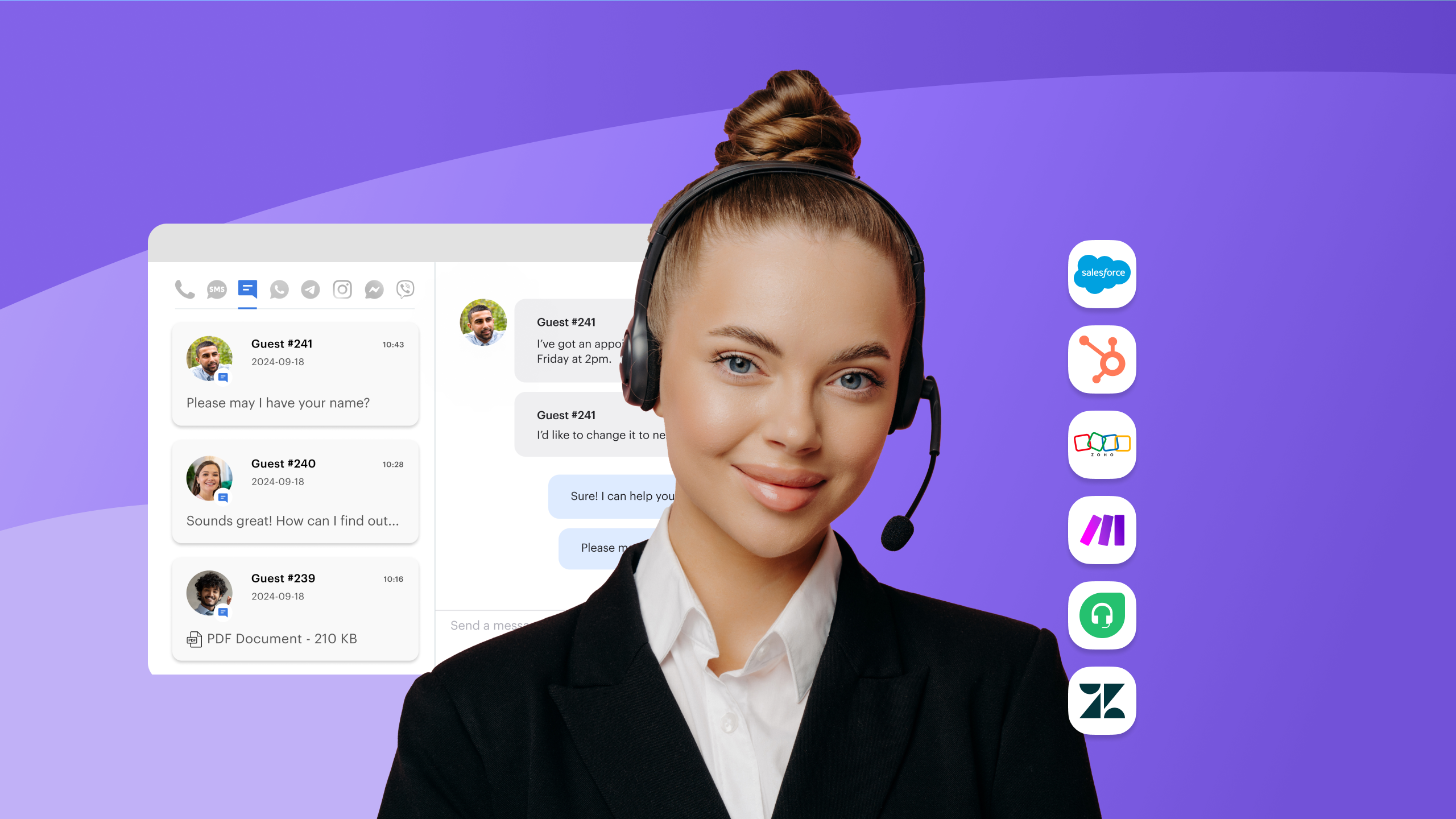
Cloud telephony fixes those gaps by bringing routing, reporting, and access into one platform. Voiso supports that shift with visual call flow design, omnichannel communication, CRM integrations, and analytics that help healthcare teams manage patient calls from one workspace.
Appointment scheduling and no-show management
How automated reminders actually reduce missed appointments
The admin logic behind reminder automation is straightforward: a patient who receives a reminder 48 hours out and again the morning of an appointment has more opportunity to cancel, reschedule, or confirm than one who hears nothing. That cancellation window is what matters. A cancellation two days early can be refilled; one at 7am usually can’t.
A typical reminder sequence works like this: once an appointment is booked, the scheduling platform triggers an SMS or automated voice message at a predefined interval. The patient responds, via keypad input or SMS reply and the system updates the attendance record automatically without staff intervention. If there’s no response by a set threshold, a follow-up alert goes to the front desk.
SMS works better for most patients because of how people actually read messages. Open rates for SMS hover around 98% compared to roughly 20% for email. Voice reminders still serve a real purpose for patients who rarely use SMS, older patients in particular, and primary caregivers who may be managing multiple family members’ appointments.
The staff relief matters more than it sounds. A single reminder call takes two minutes; 200 of them consume the better part of a workday, and someone still has to update the schedule afterward. Automation doesn’t remove the work so much as move it from manual to background.
| Workflow | Legacy phone setup | Cloud telephony workflow |
| Appointment reminders | Manual outbound calls | Automated SMS or voice sequence |
| Cancellations | Staff call waitlist manually | System notifies eligible patients |
| Urgent symptoms | Same queue as admin calls | Routed to clinical team |
| After-hours calls | Voicemail backlog | On-call forwarding or callback queue |
Dynamic waitlists: filling cancellations before the slot goes cold
Last-minute cancellations are expensive. A cardiologist’s 45-minute slot that goes unfilled doesn’t just cost revenue, it’s time another patient on the waitlist needed. Manual waitlist management rarely moves fast enough to recover it.
Automated slot refill changes the timing. When a cancellation comes in, the system identifies eligible waitlist patients and sends outbound notifications immediately. The first confirmed response gets the appointment. No staff member needs to work through a list by phone.
The matching logic matters here, though. A same-day cardiology opening shouldn’t go to the first name on a generic waitlist if a higher-urgency patient exists. Platforms that pull from CRM data, filtering by appointment type, language preference, or clinical priority, refill slots in ways that are medically sensible, not just fast.
Everything your team needs in one platform
Patient communication beyond the appointment
Scheduling is a fraction of the actual phone load in most practices. A typical day includes refill questions, post-discharge check-ins, lab result notifications, billing questions, and preventive care outreach. Without some triage logic, a patient calling about a prescription refill waits in the same queue as a patient with post-op complications.
Automation handles the predictable, low-stakes interactions. A refill request can be acknowledged by SMS with an estimated pickup time. A lab result can trigger an automated voice call directing the patient to next steps. Post-visit follow-up texts ask whether recovery is going as expected and flag responses that need clinical review.
What this changes for staff: they pick up calls that actually need a person, rather than spending half their day on callbacks that didn’t require one. That’s not a small shift in a short-staffed clinic.
Consistency across locations is an underappreciated benefit. A patient who gets one set of discharge instructions from a downtown clinic and a slightly different version from a suburban location notices. Template-based messaging makes the language consistent without making it feel impersonal.
Targeted outreach campaigns
Outreach based on clinical criteria outperforms generic mass messaging because patients can tell the difference between a broadcast and a message that’s relevant to them.
A pediatric practice sending vaccine reminders to parents of children in a specific age range gets better engagement than one blasting the entire patient list. A cardiology department scheduling medication adherence follow-ups for high-risk patients is providing something that looks like care, not marketing.
Cloud telephony platforms allow clinics to segment outreach by age range, existing condition, language preference, appointment history, or medication schedule. Campaigns are scheduled in advance, triggered automatically, and tracked from the same workspace, without increasing staffing requirements.
Telehealth and virtual care coordination
Voice-first access for patients who can’t navigate apps
The assumption that every patient can use a video platform is one of telehealth’s persistent equity problems. Rural patients may have bandwidth constraints. Elderly patients, especially those managing chronic conditions with frequent appointments, often struggle with app installations, password resets, and virtual waiting rooms.
A phone call doesn’t have those failure points. No download required, no wrong waiting room, no frozen screen five minutes into a consultation. For some patients, picking up a scheduled call is genuinely easier than joining a video link and that access gap can determine whether a consultation happens at all.
Healthcare providers using cloud telephony can combine automated reminders, queue management, and intelligent call routing inside the same communication flow, so a patient going through phone-based telehealth isn’t navigating a different, less reliable system.
Escalation paths from voice to video to specialist
Many telehealth interactions start as symptom discussions and stay that way. Some don’t. A nurse taking an initial triage call may realize a visual assessment is needed, or that a specialist should be involved.
The handoff is where fragmented systems cause real problems. If the nurse moves a patient from voice triage to video consultation and the cardiologist joining the call has no context about what was already discussed, the patient starts over. That’s frustrating when healthy; it can affect care quality when they’re not.
A shared interaction history, previous calls, messages, routing notes, gives the next clinician a starting point rather than a blank screen. An omnichannel platform that keeps voice and messaging history in one workspace makes that handoff cleaner in practice.
Call management for smaller practices
Routing without the guesswork
A small clinic with two receptionists handles more call types than most enterprise call centers: scheduling, prescription questions, referral follow-ups, urgent symptom triage, billing, and the occasional confused patient who got the wrong number. Manual routing works until it doesn’t, and when it fails it usually means the wrong patient waited too long.
Intelligent call routing uses predefined logic instead. A patient pressing 1 reaches the scheduling team. A patient describing chest pain gets routed to a clinical queue. A call arriving at 7pm goes to the after-hours protocol, forwarded to the on-call clinician, or directed to an urgent care line, depending on what was configured.
Visual call flow builders let clinic managers make those routing changes themselves, without filing an IT request. That matters during a staffing shortage or a sudden surge in calls about a local health event.
After-hours without a blind spot
Voicemail as a default after-hours solution creates a problem: someone has to listen to it in the morning, triage it manually, and return calls while the day’s incoming volume is already building. The pile is invisible until it becomes a delay.
Configured after-hours routing eliminates the blind spot. Urgent calls can forward to an on-call clinician. Non-urgent requests go to voicemail transcription so staff can read rather than listen. Overflow can route to an external answering service. Callback requests queue for the next business day. Patients don’t see any of this, they just get a clear path rather than a ringing line.
Internal communication across distributed care teams
Patient care coordination depends heavily on what happens between staff before, during, and after patient interactions. A nurse who can’t quickly locate an available colleague to warm-transfer an escalating call is a bottleneck in the clinical workflow, not just the phone system.
Cloud telephony addresses distributed workforce challenges that legacy systems genuinely can’t. A scheduling coordinator working remotely can handle the same call workflows as someone in the office. A clinician rotating between two facilities stays reachable through the same system at both. A home-based triage team logs activity and takes calls through a secure app without patient data touching personal devices.
Presence visibility, seeing in real time who’s available, already on a call, or offline, speeds up internal handoffs significantly. Warm transfers, where the transferring staff member introduces the patient to the next person before dropping off, reduce the patient experience of feeling passed around. Both of those are workflow features that sound minor until you’re watching a busy front desk operate without them.
Healthcare call centers at scale
Centralized routing across a multi-location network
A health system running 15 clinics across a metro area has a routing problem that a single-location practice doesn’t. Calls arrive with different clinical contexts, different language requirements, different urgency levels. Without centralized logic, patients bounce between locations looking for the right department.
Multi-location cloud routing solves this by treating the network as one system. A caller reaching the main number can be routed to the nearest available clinic, to a staff member who speaks their preferred language, or to a specialist team based on what they say in the IVR. Overflow during peak demand distributes across locations rather than collapsing a single queue.
Specialized departments: oncology, pediatrics, behavioral health, often need routing rules that are different from the rest of the network. Oncology patients may need a dedicated support team with different escalation thresholds. Pediatric inquiries involve different consent workflows and family communication norms. Generic routing applied uniformly to those cases creates real clinical risk.
QA and performance monitoring
Healthcare call centers operate under communication standards where gaps aren’t just service failures, they can be compliance failures. A missed consent disclosure, an incomplete medication instruction, a delayed escalation: all of these have operational and regulatory consequences.
Call recording and analytics give supervisors visibility into those interactions without requiring manual review of thousands of calls. Speech analytics can transcribe conversations, surface recurring complaint topics, flag sentiment shifts in escalating calls, and generate summaries that supervisors can review in seconds rather than minutes.
Automated quality filters, flagging calls by keyword, topic, or sentiment score rather than randomly, change how supervisors spend their time. Instead of spot-checking, they’re reviewing the calls most likely to contain a problem.
HIPAA compliance and PHI security in daily practice
The compliance risk in healthcare telephony isn’t primarily a platform problem. Most enterprise cloud phone systems offer encryption in transit, encryption at rest, role-based access controls, audit logs, and MFA. Those controls are table stakes for any HIPAA-compliant vendor.
The actual risk is behavioral. A nurse who calls patients from their personal phone because the official app is inconvenient has created a gap no platform can fix. Personal call logs, saved contacts, and voicemail are outside the organization’s control.
Three specific areas deserve attention in any compliance review. First, call recording consent: several US states require dual-party consent before recording a conversation, and healthcare organizations need to define when recording starts and what triggers it. Second, retention policy: indefinitely retaining every recording isn’t inherently safer than a defined schedule, large unmanaged archives increase exposure in litigation and breach scenarios. Third, remote access: staff working outside the office need secure softphone apps that route calls through the organization’s system, not their personal carrier.
A practical starting question: can you identify, right now, every channel through which patient information has been communicated in the last 30 days? If the answer involves personal phones, personal email, or messaging apps outside your approved stack, the platform controls you’ve purchased aren’t covering the actual risk surface.
How to evaluate a healthcare phone system
The right starting point isn’t a feature comparison. It’s identifying the failure modes you’re currently accepting: which calls get dropped, which triage paths are unreliable, which after-hours scenarios produce silence, which remote staff workflows don’t work.
Six areas tend to separate adequate from genuinely fit-for-purpose systems in healthcare:
| Area | What to actually test |
| Clinical routing reliability | Run a scenario where an urgent symptom call arrives during peak volume. Does it bypass standard queues? |
| Integration depth | Can call history, notes, and patient details follow the interaction into your CRM or EHR? |
| Workflow flexibility | Can a clinic manager update an IVR path without raising an IT ticket? |
| Security controls | Does the mobile app route calls through the organization’s system, not personal carrier lines? |
| Omnichannel coordination | Are voice, SMS, and messaging history visible together, or does staff still switch between tabs? |
| Scalability | Has the vendor run this at the number of locations and call volume you expect in 18 months? |
Reliability during peak volume is the one that catches most healthcare buyers off guard. Vendor demos happen on quiet days. The stress test is a Monday morning in flu season.
The underlying shift
The case for cloud telephony in healthcare isn’t really about replacing desk phones. It’s about whether patient communication infrastructure can keep pace with how care delivery actually works now: distributed staff, telehealth, multi-location networks, patients who expect to reach someone quickly and reliably.
Legacy systems weren’t designed for that load. The real question isn’t whether cloud telephony sounds better. It’s whether it fixes the workflows already failing. And whether the compliance and security controls match how staff actually behave, not just how policy says they should.
Voiso supports healthcare communication across omnichannel workflows, visual call flow design, CRM integrations, secure mobile access, and AI-powered analytics. Whether those capabilities map to your specific gaps is worth testing directly.
FAQs
Is cloud telephony HIPAA compliant?
Cloud telephony platforms can be configured for HIPAA compliance, but the platform is only part of the answer. Encryption, role-based access, audit logging, secure call recording storage, and a Business Associate Agreement from the vendor are the minimum technical requirements. The harder part is ensuring staff behavior matches those controls, particularly around personal devices, remote access, and messaging outside approved channels.
Can healthcare providers use cloud systems for emergency calls?
Yes, with a specific caveat. Traditional phone systems tie calls to physical locations automatically; cloud systems require manual address configuration for each device or user. A remote clinician calling from a softphone app may have an incorrect emergency location on record. Before deployment, healthcare organizations should test how emergency location data is handled for every user scenario: fixed desk, remote laptop, and mobile app.
Can clinicians use personal mobile phones safely?
The short answer is no, not for patient communication. Personal phones create gaps in call logging, expose patient contact records outside the organization’s control, and leave voicemail and call history on carrier infrastructure. A secure softphone app routes calls through the organization’s system using a professional number. Patients see a clinic number; the organization retains the call record.
What happens if internet connectivity fails?
Most enterprise cloud telephony platforms include fallback options: automatic forwarding to backup numbers, mobile rerouting, and overflow routing between facilities. For urgent care centers, hospitals, and high-volume clinics, a connectivity failure without a tested fallback plan is a patient safety issue, not just a service disruption. Redundancy planning, a secondary internet connection, a tested mobile fallback, should be part of the deployment specification, not an afterthought.
How long does implementation take?
A small private clinic with straightforward routing needs might be fully operational within a week. A multi-location health system integrating with an existing EHR, migrating phone numbers from multiple carriers, and retraining staff across departments typically needs 4–8 weeks for a phased rollout. Complex triage paths and compliance requirements add time. The variable that most often causes delays isn’t the technical setup, it’s testing edge cases in the routing logic and ensuring staff have actually internalized the new workflows before go-live.