

Call abandonment isn’t just a nuisance, it’s a measurable threat to revenue. ContactBabel reports that the average contact center loses 27% of its inbound calls to abandonment. That means over a quarter of customer conversations never reach a human. And many of those callers don’t come back.
More than half won’t retry after a failed service attempt. For high-intent queues like billing or fraud support, that silence costs more than just goodwill, it cuts directly into retention, conversion, and reputation.
But abandonment isn’t a symptom, it’s a signal. A warning that something inside the contact center is failing: overloaded queues, bad routing logic, mismatched staffing, or a phone tree that feels like a maze. Fixing it requires more than “answer faster.” It calls for visibility, segmentation, and tools built for nuance.
That’s exactly what this guide delivers. No vague promises, just sharp tactics, grounded in data, and tailored for real-world teams under pressure.
Key Takeaways
- Contact centers lose up to 27% of inbound calls to abandonment, and over half of those callers never retry, leading to lost revenue, lower CSAT, and increased churn risk.
- Top causes include long wait times, complex IVRs, poor staffing alignment, and lack of channel flexibility; Voiso’s Call Flow Builder, AI forecasting, and omnichannel routing address each directly.
- Real-time dashboards and predictive AI help identify at-risk calls before abandonment occurs, automating callbacks, fast-tracking frustrated callers, and triggering live agent intervention.
- Segmenting abandonment by queue type, wait time, and intent reveals the most critical leaks in your CX funnel, especially in high-intent verticals like fintech, healthcare, and BPOs.
- Reducing abandonment is more than improving speed, it’s about designing smarter systems; brands that act in real time and route with context gain a lasting competitive edge.
Why Call Abandonment Really Matters, and What It’s Costing You
Nearly 6 out of 10 customers won’t call back after being kept on hold too long, and 32% will never return at all if they abandon a service interaction midway. That’s not a KPI dip, it’s a revenue bleed.
Abandoned calls aren’t the problem. They’re the result. When customers hang up before reaching someone, they’re reacting to what’s happening inside the contact center: long queues, unavailable agents, broken routing logic, or confusing IVRs. The source might be operational or technical, but the signal is clear, customers are leaving because the system gave them a reason to.
And the cost runs deeper than a dropped call.
When a potential buyer disconnects, the sale dies with the dial tone. When an existing customer can’t get through, frustration builds, quietly at first, then publicly. Abandonment directly chips away at Net Promoter Scores, raises churn risk, and makes each acquisition more expensive. Every missed call adds pressure to support staff, inflates repeat contact volume, and distorts performance metrics.
Worse still, abandoned calls send the message that your service can’t be trusted to show up when needed.
Cost of Abandonment by Sector (per 1,000 Calls)
| Industry | Avg. Abandonment Rate | Est. Revenue per Missed Call | Revenue Lost / 1,000 Calls |
|---|---|---|---|
| BPO / Telemarketing | 10% | $15 | $1,500 |
| Healthcare | 8% | $50 | $4,000 |
| Fintech / Trading | 7% | $100 | $7,000 |
| Travel & Hospitality | 6% | $80 | $4,800 |
Note: Calculations reflect average call abandonment rates by industry and estimated lost revenue from dropped conversations based on ICP analysis and industry research. Source data includes PwC, Forrester, and Voiso client benchmarks.
Across sectors, the numbers vary, but the impact is consistent. High abandonment sends a clear signal that the contact center isn’t responsive. And when trust goes down, so does retention.
A contact center leader doesn’t need a reminder that calls matter. They need the tools to understand why people are hanging up, and how much damage it’s doing when they do.
Forget the Formula—Let’s Talk Practical Benchmarks
The standard formula for abandonment rate shows up in every contact center training manual:
Abandonment Rate = (Abandoned Calls ÷ Total Incoming Calls) × 100
Yes, it’s useful, but only if you know what counts as abandoned. Most operations exclude hang-ups under five seconds. Others apply a grace period of up to 10. That cut-off matters, because short calls often come from redials, misdials, or routing errors, not from frustrated customers. If your data lumps them all together, you’re solving the wrong problem.
A cleaner benchmark starts with filtering your queue. Define what qualifies as a real abandoned call—then compare your numbers against industry norms.
Call Abandonment Benchmarks by Industry
| Industry | Average Abandonment Rate | What “Good” Looks Like |
|---|---|---|
| Healthcare | 7–9% | Below 5% |
| Financial Services | 5–7% | Below 3% |
| Retail & E-Commerce | 4–7% | Below 3% |
| Telecommunications | 8–10% | Below 6% |
| Government Services | 6–8% | Below 4% |
| Travel & Hospitality | 5–8% | Below 4% |
| Technical Support | 10–15% | Below 8% |
Looking at your industry average is a decent starting point, but it won’t help you understand why your rate is spiking this week or in this queue. Benchmarks don’t show queue design flaws, staffing gaps, or IVR dropout points. That’s what your own internal data is for.
One fintech client we worked with saw abandonment rates drop by 4.2% just by adjusting IVR hold logic in one call queue. They weren’t doing worse than their peers, but that one optimization meant 600+ more answered calls per week. When each of those carries $200 in lifetime customer value, chasing benchmarks alone leaves money on the table.
Track your trends over time. Segment by time of day. Break down by intent. That’s where the real benchmarks live, inside your own data, not industry averages.
What Causes Call Abandonment (That You Can Actually Fix)
Call abandonment doesn’t just happen. Customers leave for a reason, and it’s rarely random. Most of the time, the fault sits with something entirely within your control: a wait that stretched too long, a path too confusing to follow, or an agent who wasn’t available when they needed to be.
Let’s break down the most common friction points, and how to start fixing them.
Waiting Time Mismatch
Every contact center sets service level targets. Not every customer cares.
Someone who just lost access to their banking app won’t wait calmly for 10 minutes, no matter how reasonable that SLA looks on paper. They expect help now, and anything short of immediate attention feels like neglect.
And it’s not just the actual delay. It’s the silence. No position in the queue. No estimate. No acknowledgment. The second uncertainty creeps in, hang-ups follow.
To fix that, use queue messages that offer more than music. Say where they stand. Set expectations early. And if the wait’s going to run long, offer a callback, don’t make them keep guessing.
IVR Fatigue
When customers have to listen through three menus just to hear “press 9 for more options,” they stop pressing. They stop waiting too.
Overbuilt IVRs are a common pain point. They’re not just annoying, they’re destructive. Every extra menu is another reason to hang up. Especially when nothing sounds like the option someone actually needs.
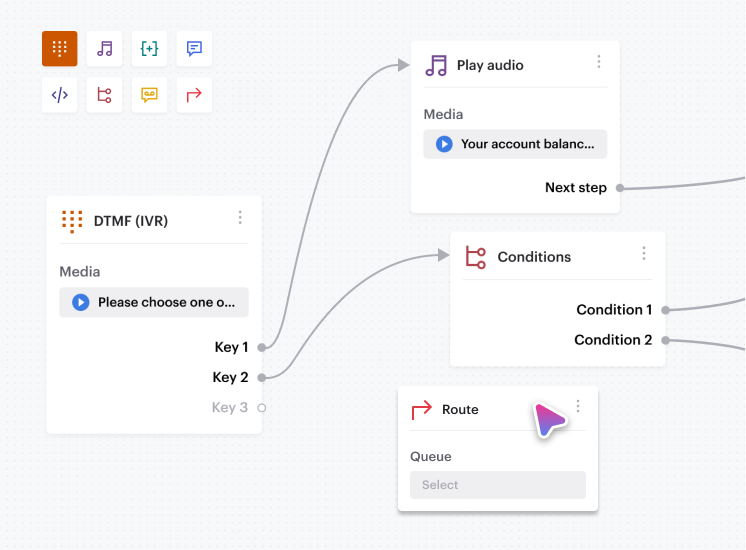
Most IVRs are built with internal logic in mind. Customers don’t care how departments are structured, they just want to get to the right person. Use your call flow builder to fit into the real intent, not team structure, to strip out the noise.
Misaligned Agent Schedules
You can have great training, top-tier tools, and smart routing, none of it matters if agents aren’t available when demand spikes.
Lunch breaks, shift transitions, holidays, and marketing promotions all affect volume. But many schedules ignore those patterns, sticking to flat rotations that don’t adapt to actual behavior.
That’s where abandon spikes happen. Not because agents are slow, but because they’re not there when the calls come in.
Using real-time forecasting, flexible shift planning, and intraday reforecasting makes coverage fit demand, not the other way around. Fintech contact centers using AI-driven workforce tools have reported up to 22% fewer abandoned calls, just by matching their staffing to when people actually dial in.
Channel Friction
Sometimes, a call never should’ve happened at all.
When customers only see a phone number, they’ll call, even when they’d rather message, email, or chat. And if the issue isn’t urgent enough to stay on hold, they’ll hang up halfway through.
The problem isn’t impatience, it’s lack of options. Channel friction happens when people don’t find the path they want, so they try voice by default. But voice fails when it’s not built for those types of inquiries.
Omnichannel contact centers route those low-urgency conversations to messaging apps or web chat before they reach the IVR. That keeps lines open for the calls that matter, and clears out queues without making people disappear.
Visual: Where Customers Drop Off in a Typical Call Journey
Here’s a simplified flowchart showing where abandonment usually spikes. Each point reflects a specific cause that can be diagnosed and resolved.
Inbound Call →
├─ Long Ring Time → 🛑 Hang-up #1 (No prompt)
├─ IVR Menu →
│ ├─ Confusing Structure → 🛑 Hang-up #2
│ ├─ Option Loop → 🛑 Hang-up #3
├─ Queue Hold →
│ ├─ No Time Estimate → 🛑 Hang-up #4
│ ├─ Over 2-Minute Wait → 🛑 Hang-up #5
└─ Agent Connect →
├─ Delay in Greeting → 🛑 Hang-up #6
Every red flag in that journey is preventable.
Diagnosing the Drop-Off Points: How to Use Your Own Data
Most contact centers know their average call abandonment rate. Far fewer know which queues leak the most calls, when customers bail, or why they’re quitting before speaking to someone.
Raw percentages can’t answer that. Segmented data can.
Segment by Queue, Wait Time, and Intent
Start with queue types. Billing, tech support, sales — they each carry different expectations. Someone calling to close their account won’t wait as long as a caller looking for an update on a shipment. Treating all abandonment equally hides the truth behind customer intent.
Then layer in wait time. When does the drop-off start? At 60 seconds? After the second queue message? Find the threshold for each interaction type, because it won’t be the same for all of them.
Finally, look at the call. Voiso clients often use disposition codes, but those only work if a conversation happens. For dropped calls, route metadata and IVR paths offer better clues. Match call flow to exit points, and you’ll start to see patterns that explain what the surface-level numbers don’t.
What They Say Before They Hang Up
Speech Analytics tools track what customers say before they disconnect, whether they reach an agent or not. That’s the difference between guessing and knowing.
A spike in phrases like “I’ve already tried this,” or “no one ever picks up,” isn’t random. It points to pain points buried deep in the system, repeat attempts, long silences, bad handoffs. And when sentiment turns negative before the drop, that’s a red flag worth acting on now, not next quarter.
Pair that insight with call metadata (like queue name, IVR path, and call length), and you get a full picture of what broke down and where. No survey required.
Act in Real-Time. Optimize After.
Some abandonment signals call for instant attention. If queue drop-off rates triple during a single shift, don’t wait for the monthly report. That’s where real-time dashboards come in, especially when paired with automated alerting and dynamic queue logic.
Others require a long view. Seasonal patterns. Product launch spikes. Agent adherence trends. Those don’t show up in a day, but they do show up when historical abandonment is tracked by segment.
Voiso’s dashboard lets teams switch between real-time and historical views without digging through exports. And if you’re using queue-specific logic, you can iterate instantly. Want to redirect high-abandon queues to callbacks after 90 seconds? Go live in minutes with the Call Flow Builder. No code. No downtime.
Strategies That Actually Reduce Abandonment Rates
Lowering abandonment rates doesn’t start with guesswork or vague promises. It starts with fixing what’s broken, queues that keep callers in the dark, IVRs that frustrate, and schedules that collapse during spikes. Each of the following strategies tackles those points directly, with a focus on clarity, speed, and customer control.
Smarter Queue Management
Let’s start where the frustration usually begins, the queue.
When callers have no idea how long they’ll be waiting or what their place is in line, patience runs thin fast. Setting expectations matters. Announcing estimated wait time and position in queue isn’t just polite, it’s proven to reduce early hang-ups. A simple, “You’re third in line, estimated wait time is under two minutes,” keeps many from giving up.
But not everyone has time to wait at all. Offering a callback option after a set wait threshold, say, 90 seconds, is one of the fastest ways to cut abandonment. And it’s even better when the call-back can be scheduled for a specific time window. That tells your customer: you respect their time.
For customers who try and fail to connect more than once, intelligent queue logic should fast-track them on the next attempt. Callers shouldn’t need to explain they already waited 10 minutes earlier.
Workforce and Schedule Optimization
Even the smartest queue won’t help if no one’s available to answer.
AI-powered forecasting models can map demand with surprising precision, right down to expected surges around product drops, seasonal events, or even lunch hours. But forecasting only works when operations actually respond to the signals. That’s where intraday reforecasting comes in. Demand can shift mid-shift. Staffing must shift with it.
And coverage doesn’t always need to come from the main floor. With Voiso’s Mobile App, supervisors can activate trained remote agents instantly when wait times spike. No VPNs, no clunky desktop logins. Just fast reinforcement, exactly when it’s needed.
Tighter alignment between staffing and call flow means fewer overloads and fewer missed connections.
Fixing the IVR Experience
Call abandonment doesn’t always happen in the queue. Sometimes, it happens two minutes into a badly designed IVR menu.
Complex IVRs kill momentum. Too many layers, irrelevant options, or unclear language confuse more than they help. Every added second in a poorly structured menu raises the risk of drop-off.
Keep options focused, no more than five main menu items. Use short, action-oriented phrases. And route based on intent, not department name. No one calls because they want “customer care.” They call to fix something.
Where appropriate, divert calls to messaging channels without forcing the caller to hang up. For instance, a customer looking for a shipping update doesn’t need to wait on hold, they need a smart deflection to SMS or WhatsApp. With Voiso’s omnichannel solution, that shift happens seamlessly, without making the customer restart their journey.
Real-Time Alerting and Dashboards
Operations teams shouldn’t learn about abandonment spikes from a weekly report.
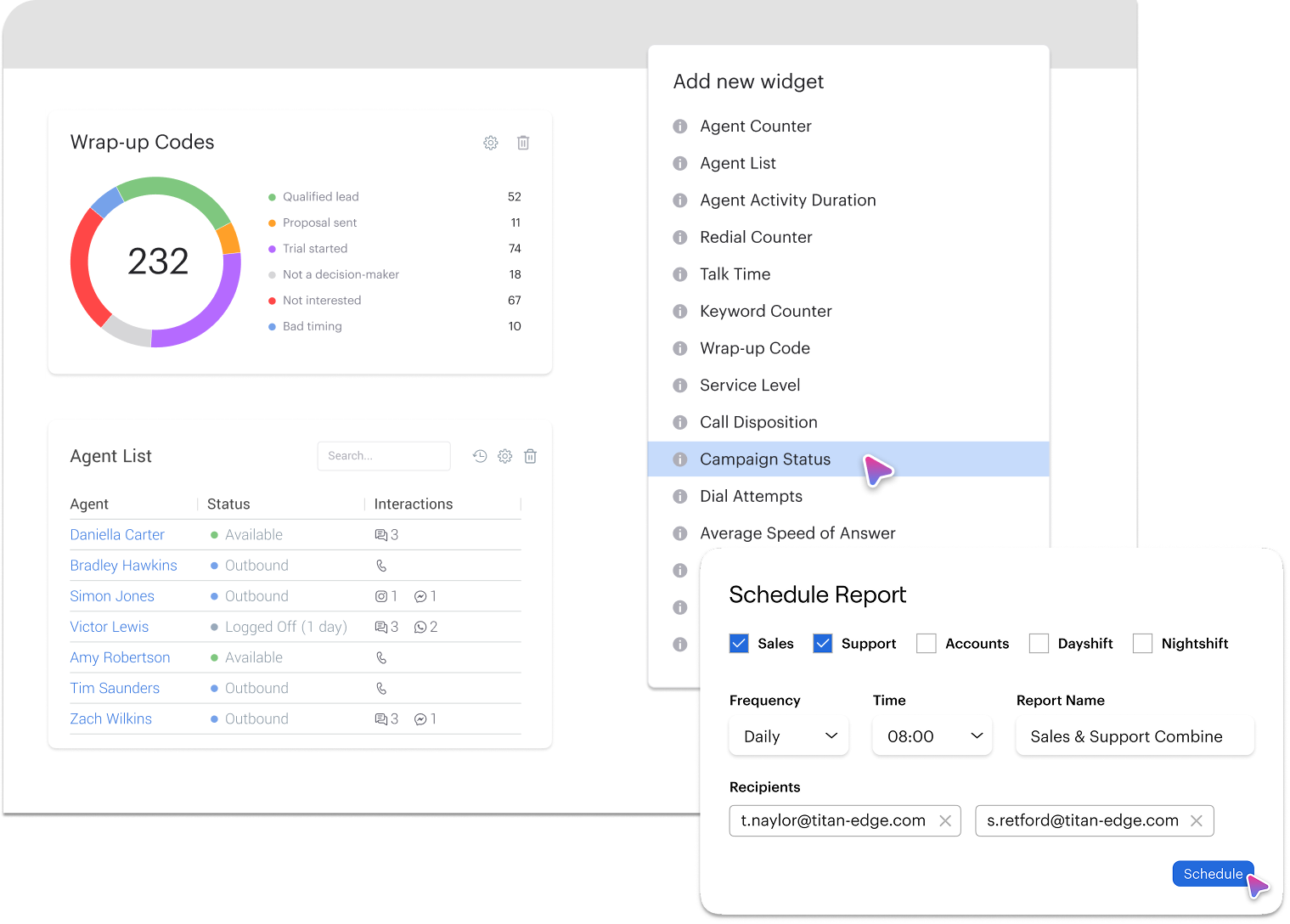
Set abandonment thresholds per queue, not globally. When a specific line, like tech support, starts bleeding calls, trigger an alert immediately. That alert shouldn’t just ping a dashboard; it should activate a playbook. Supervisors need fast visibility and direct tools to act.
With Voiso’s real-time dashboard, supervisors can barge into ongoing calls, whisper to agents, or reassign resources with a few clicks. And when trends point to a sustained shift, not just a random burst, they can tweak queue logic or reallocate schedules in real time. No IT ticket required.
Reducing Abandonment, Industry by Industry
Abandonment doesn’t happen in a vacuum. The triggers, and tolerance thresholds, shift depending on who the caller is, what they need, and how urgent that need feels. A fintech customer reporting fraud won’t wait as long as a BPO lead checking order status. That context matters.
Here’s how abandonment plays out across key industries, and what to do about it.
Fintech: When Compliance Meets Crisis
Fraud suspicions, login issues, declined payments, every second of silence in a fintech call can raise blood pressure and risk.
Many of these calls are time-sensitive. Some are legally time-bound. And nearly all come with heightened compliance requirements. That means no transfers to generic queues. No wait times beyond a few seconds. And absolutely no dropped handoffs.
Voiso Tactic: Use smart IVR intent mapping to fast-lane fraud-related calls. Pair it with queue-specific SLAs that trigger real-time alerts the second wait time creeps past safe thresholds. That keeps urgency under control, and regulators off your back.
Healthcare: Emotions Run Higher, Patience Runs Shorter
Healthcare calls aren’t just transactional, they’re emotional. A parent trying to reschedule a child’s appointment. A patient asking for test results. Those callers aren’t waiting to hear “your call is important.”
And when anxiety meets delay, abandonment skyrockets.
Voiso Tactic: Tag emotionally sensitive call types based on IVR path or keywords (e.g., “lab,” “diagnosis,” “prescription”). Route them to agents trained for empathy-heavy conversations. Voiso’s Flow Builder lets you build those queues in minutes, and update them instantly as needs evolve.
BPOs: Peaks, Valleys, and SLA Whiplash
No vertical faces more volume volatility than BPOs. Client campaigns spike without warning. New scripts roll out mid-week. And every missed call dents SLA targets.
Success depends on staying ahead of the curve, even when the curve changes by the hour.
Voiso Tactic: Combine intraday forecasting with flexible routing logic. When volume surges hit, Voiso’s Mobile App lets you activate standby agents remotely, without breaking compliance or workflows. Your response time holds steady. Your client doesn’t see the scramble behind the scenes.
Tracking Progress Without Drowning in Metrics
Fixing abandonment means tracking it, but not obsessing over the wrong numbers. Raw drop counts don’t tell the full story. Timing, intent, and resolution context turn disconnected calls into actionable signals.
Start with the Right Baseline
Don’t just track how many calls drop. Track when they drop. Abandonment in the first five seconds? That’s often accidental, wrong number, caller hang-up, or IVR bounce. Treat those separately. They don’t reflect actual experience failure.
The real signal starts around the 15-second mark. That’s when frustration usually sets in. Build filters into your reports to separate noise from meaningful disconnections. It’s not just cleaner, it’s smarter.
Measure Abandonment in Context, Not Isolation
Abandonment doesn’t live in a vacuum. A 3% rate might seem fine, until you realize it’s happening on high-intent queues like payments or cancellations. Losing those calls hits harder than general support lines.
Add queue-level abandonment filters. Tie drop-offs to caller intent, not just volume. If 20% of your payment-related calls never reach an agent, that’s not a metric problem, it’s a revenue problem.
Build Smarter KPIs, Not Just More KPIs
Focusing on abandonment alone can lead to false fixes. Shortening queue time might reduce drop-offs, but if it tanks CSAT or drives up handle time, you’ve only shifted the problem.
Instead, track blended KPIs:
- Queue-specific Abandonment Rate
- Handle Time Variance by Call Type
- CSAT Delta on Reconnected Abandonments
- Re-engagement Conversion (from SMS or callback)
Look at them side by side, not in silos. When one metric moves, you’ll see what else shifts with it.
The Future of Call Abandonment Management
Call abandonment used to be a reactive metric. Now it’s a prediction problem. Leading contact centers don’t wait for drop-offs, they intercept them. The tech isn’t abstract. It’s already reshaping how smart teams operate.
Predictive Abandonment Prevention Is Already Here
Machine learning models can spot a drop-off before it happens. Not in theory, in real queues. By analyzing live signals like IVR time, wait duration, sentiment tags, and caller intent, those models surface risk in real time.
It’s not just about routing anymore. It’s about escalation logic that kicks in before callers give up. Add callback options when risk crosses a threshold. Trigger alerts when a queue crosses its historical drop-off point.
Voiso already feeds these models with live queue and behavior data, no extra integration layers needed.
Journey-Aware Routing Is the New Default
Routing used to mean skill groups. That’s outdated. The next step is journey-aware routing: linking the current call to prior outcomes, not just caller ID.
If someone dropped during IVR last time, don’t send them through it again. If their last three chats flagged billing issues, send them straight to account support.
Voiso’s platform already makes this actionable using CRM integrations like Salesforce and Zoho, so customer context doesn’t get lost between calls.
Voice AI That Detects Frustration Before the Agent Joins
The pre-agent window, those 30 to 90 seconds before connection, is packed with clues. Customers mutter. They repeat menu options. They get silent.
Voiso’s AI Speech Analytics listens during that window. It catches frustration cues, then flags the call. Supervisors get the signal instantly. They can whisper in, reroute, or jump in live.
The longer you wait to act, the more likely the drop-off. With voice AI, that window becomes a chance, not a liability.
Conclusion: Turning Call Abandonment into a Competitive Advantage
Call abandonment doesn’t just dent performance metrics, it erodes trust. Each missed connection leaves a mark. Customers remember when support fails to meet the moment.
But abandonment doesn’t have to be a wild card. It can be modeled, tracked, and prevented, when the right data informs the right decisions. Queue design, routing logic, agent workflows, follow-up timing, they’re all levers. Smart teams don’t just pull them. They calibrate them, constantly.
The brands that reduce abandonment most effectively aren’t just faster. They’re more intentional. And customers notice.
See how Voiso helps teams reduce abandonment and boost retention — Request a demo.
Further Reading