


Inbound-only contact centers often run at 60–70% occupancy, leaving up to 40% of agent time idle during low call periods. At the same time, outbound teams face a different problem: up to 78% of outbound calls reach voicemail, meaning agents spend a large portion of their day on non-revenue conversations.
Running inbound and outbound teams separately creates idle time on one side and low connection rates on the other. A blended cloud contact center solves that operational gap by combining both models into a single workforce strategy. Instead of waiting for calls, agents automatically switch between inbound support and outbound campaigns based on queue conditions and availability.
A blended cloud contact center isn’t a feature. It’s a workforce optimization model designed to increase talk time, protect revenue during slow periods, and stabilize agent utilization across the day.
Key Takeaways
- What It Is: A blended contact center combines inbound and outbound work so agents switch between queues based on real-time demand.
- Main Goal: Increase agent utilization, reduce idle time, and keep agents in live conversations throughout the day.
- Why It Matters: Inbound teams often run at 60–70% occupancy, while up to 78% of outbound calls reach voicemail, blending solves both problems.
- How It Works: When inbound volume drops, predictive dialing starts outbound calls. When inbound demand rises, outbound slows or pauses.
- Core Technology: Blended models require routing logic, predictive dialers, omnichannel support, and unified analytics working in one system.
- Operational Benefits: Higher occupancy, more revenue during slow periods, lower cost per contact, and better compliance visibility.
- Key KPIs to Track: Blended occupancy, revenue per agent hour, First Contact Resolution (FCR), SLA adherence, and conversion rate.
- Biggest Challenges: Training agents for dual roles, setting correct KPIs, and balancing inbound service levels with outbound campaigns.
- Best Fit Industries: FinTech, collections, BPOs, travel companies, and high-value e-commerce with fluctuating inbound demand.
- Bottom Line: Blending turns idle time into productive conversations without increasing headcount, when routing and dialer logic are set correctly.
What Is a Blended Cloud Contact Center?
A blended cloud contact center works as a single operation where agents handle both inbound and outbound interactions based on real-time demand. Instead of assigning agents to only one task, the system moves them between queues automatically.
How a Blended Workflow Works in Practice
Imagine a typical day in a support and sales team. Morning hours bring high inbound volume, so agents handle customer inquiries. Around midday, inbound traffic drops. The system then pushes available agents into outbound campaigns such as follow-ups, renewals, or sales calls. When inbound volume rises again, outbound dialing slows or stops, and agents return to inbound queues.
That workflow runs automatically through routing logic and dialer rules. Managers don’t need to manually move agents between teams.
Simple blended workflow example:
| Time | Inbound Queue | Outbound Campaign | Agent Action |
| 09:00 | High | Off | Handle inbound calls |
| 12:00 | Low | On | Start outbound calls |
| 15:00 | Medium | Reduced | Mix of inbound and outbound |
| 17:30 | Low | On | Outbound follow-ups |
This model keeps agents in active conversations instead of waiting for the next inbound call.
How Inbound Queue Logic Connects With Predictive Dialing
The key to blending sits in queue logic. The system monitors queue wait time, SLA targets, and agent availability. When service levels sit safely within targets, predictive dialing starts placing outbound calls. When inbound wait times rise, the dialer automatically reduces call volume or pauses campaigns.
Answering Machine Detection (AMD) improves outbound efficiency by filtering voicemail calls and connecting agents only to real conversations, which increases live talk time and reduces wasted dialing time.
Blending only works when inbound routing and outbound dialing operate as one system, not as separate tools.
How Cloud Infrastructure Enables Elasticity
Cloud infrastructure allows teams to add or remove agents, launch campaigns, and change routing logic without hardware changes. Teams can scale outbound activity during slow seasons and prioritize inbound during peak periods.
Cloud systems also allow agents to work from any location while staying connected to the same queues, dashboards, and workflows. That flexibility makes workload balancing possible across time zones and regions.
Mini Blended Contact Center Workflow Diagram
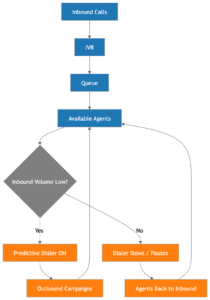
This operational model explains why many revenue and support teams are moving away from separate inbound and outbound departments.
Why Companies Are Moving Away from Siloed Inbound and Outbound Teams
Running inbound and outbound teams separately creates utilization problems, reporting gaps, and revenue instability. Many companies started with separate teams because the workflows looked different. Over time, the cost of keeping them separate became harder to justify.
The Hidden Cost of Inbound-Only Models
Inbound volume rarely stays consistent throughout the day or year. Peaks and drops create paid idle time that never generates revenue.
Idle time math example:
| Metric | Inbound-Only Team |
| Agents | 20 |
| Paid hours per day | 8 |
| Occupancy | 65% |
| Idle time | 35% |
| Idle hours per day | 56 hours |
In this example, the company pays for 160 agent hours per day but loses 56 hours to idle time. That equals seven full agent shifts lost every day.
Seasonal industries feel the problem more strongly. Travel companies and OTAs often experience extreme swings between peak booking periods and quiet months. During off-season periods, inbound teams sit idle while sales opportunities remain untouched.
Staffing also becomes difficult to plan. Hiring for peak season leads to overstaffing in slow months. Hiring for average demand leads to long wait times during peak periods.
The Limits of Outbound-Only Sales Floors
Outbound teams face a different efficiency problem. Up to 78% of outbound calls reach voicemail, which means agents spend a large portion of their time without live conversations.
Compliance requirements add another layer of complexity. Financial services, loans and trading companies must record calls, track consent, and monitor conversations. Separate outbound teams often use different tools, which creates reporting gaps and audit risks.
Data fragmentation also becomes a problem. Customer history often sits in different systems for sales and support teams. Agents lack full context when speaking with customers, which affects conversion and resolution rates.
Core Architecture of a Blended Cloud Contact Center
A blended model only works when several layers operate together. Routing, dialing, messaging, and reporting must share the same logic. Otherwise, agents switch tasks, but the operation still runs in silos.
Intelligent Call Distribution (ACD + Routing Logic)
The first layer controls who handles each interaction and when. In a blended setup, routing no longer sends inbound calls to one fixed team and outbound work to another. It makes live decisions based on skills, queue pressure, time of day, and service targets.
Skills-based routing matches interactions with agents who can handle them well. A billing issue can go to a service-trained agent. A renewal call can go to someone with stronger sales results. When agents cover both roles, the system needs clear rules for when each skill takes priority.
Time-based routing adds another control point. A team can give inbound support first priority during peak hours, then release more agents into outbound campaigns later in the day. Queue prioritization does the same job in real time. If wait times rise, inbound gets the next available agents first.
Overflow rules matter when queues stretch too far. A blended setup can widen the eligible agent pool instead of letting callers sit in line. Voiso’s Flow Builder supports drag-and-drop routing logic, IVR paths, cross-channel handover, HTTP requests, and error checking, which gives operations teams more control over how calls move through the system.
Routing logic in a blended environment often follows this pattern:
- Check caller intent through IVR or CRM data
- Match the interaction to the right skill group
- Review queue thresholds and service targets
- Reserve available agents for inbound when pressure rises
- Release idle agents back into outbound when demand drops
Dialing Infrastructure for Revenue Teams
The next layer controls outbound pace. Different dialers suit different campaign goals, and a blended environment often needs more than one mode.
Predictive dialing works best when speed matters. The system dials multiple numbers ahead of agent availability to keep talk time high. Progressive dialing takes a slower approach. It places one call per available agent, which gives managers tighter control. Preview dialing gives agents time to review contact details before calling, which suits higher-value sales or regulated conversations.
Answering Machine Detection removes a major source of wasted time. Voiso states that up to 78% of outbound campaign calls are answered by voicemail, and that AI AMD keeps agents focused on live conversations. Voiso also reports over 95% AMD accuracy and lower time-to-detection. Local Caller ID adds another layer by showing a familiar regional number, which Voiso says can raise pickup rates by 5x in its mobile app materials.
In a blended contact center, the dialer cannot run at full pace all day. It needs throttling rules tied to inbound demand. When queue depth or wait time crosses a threshold, the platform slows calls or pauses them. When inbound pressure falls, dialing resumes. That link between routing and dialing turns idle time into live conversations without putting service levels at risk.
Omnichannel Layer
The third layer handles channel movement. Customers rarely stay on one channel from start to finish, so the platform needs to preserve context when they move.
Voiso’s omnichannel materials describe a single workspace for voice, SMS, WhatsApp, Viber, webchat, Facebook, Instagram, Telegram, and more, with trackable interaction history and handovers between channels. That matters in a blended model because agents may handle a phone call, then continue the same case in messaging.
One useful example comes from IVR deflection. A caller can enter a voice flow, then choose to continue on WhatsApp. Voiso’s Flow Builder shows that handover directly in the interaction flow. That shift reduces queue pressure on voice while keeping the conversation active.
Blended agents can also handle messaging between calls when response-time rules allow it. Voiso’s omnichannel workspace includes agent capacity controls, so teams can cap simultaneous digital interactions based on skill and workload. That makes channel mixing more controlled and less chaotic.
Data + Analytics Layer
The final layer gives managers one view across service and sales work. Without that layer, blended teams become harder to coach and harder to measure.
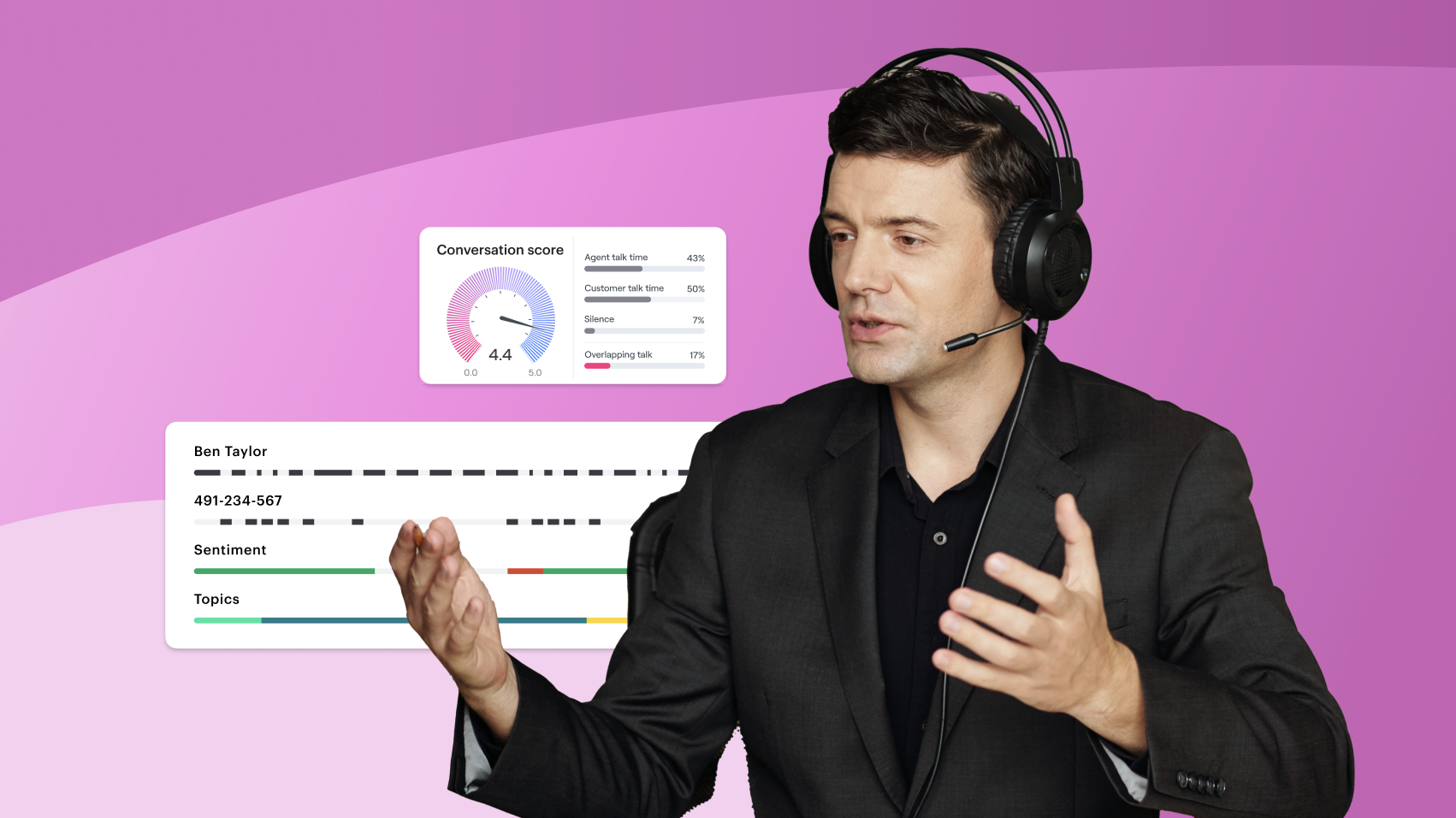
Voiso’s AI Speech Analytics includes conversation score, sentiment analysis, topic identification, summaries, transcripts, and searchable call records. Those tools matter more in blended operations because one agent may handle a support complaint at 10:00 and a cross-sell call at 10:15. Managers need a way to review both types of conversations in one reporting structure.
Unified reporting helps teams connect service outcomes with revenue outcomes. A manager can review queue data, outbound results, call topics, and agent-level performance without jumping between separate systems. Speech analytics also helps with QA and compliance reviews by flagging keywords, surfacing sentiment changes, and making calls easier to find.
Blended teams also create more KPI complexity. A pure support team can focus on resolution and response times. A pure sales team can focus on connection and conversion. A blended team needs both views at once. That’s why architecture matters. When routing, dialers, channels, and analytics work from the same system, performance becomes easier to manage.
Before looking at the business impact, it helps to see what this architecture changes at the operational level day to day.
Operational Benefits of a Blended Contact Center
The value of a blended model shows up in utilization, revenue stability, hiring structure, and compliance visibility. The impact becomes clear when you look at daily operations, not just technology.
Higher Agent Utilization (With Math)
Most inbound teams operate below full occupancy. Industry benchmarks often place inbound occupancy around 60–70%, which leaves a large portion of paid time unused.
Here’s a simple example:
| Metric | Inbound Only | Blended Model |
| Agents | 30 | 30 |
| Paid hours per day | 240 | 240 |
| Inbound occupancy | 65% | 65% |
| Idle time | 35% | 10–15% |
| Productive hours | 156 | 204–216 |
A blended model fills idle time with outbound work. That change alone can add 48–60 productive hours per day without hiring more staff.
A BPO or FinTech sales floor benefits heavily from this structure. During quiet inbound periods, agents can call leads, follow up with prospects, or handle account management calls. Talk time increases without increasing headcount.
Revenue Protection During Slow Periods
Inbound demand drops during certain hours, days, or seasons. A blended model protects revenue during those gaps by switching agents to outbound activity.
Common examples include:
- E-commerce teams calling customers about high-value abandoned carts
- Travel companies upselling packages during off-peak booking periods
- Microlenders running repayment reminder or collections campaigns
- FinTech teams calling leads when trading activity is low
Instead of waiting for inbound demand to return, teams continue generating revenue through outbound campaigns.
Lower Cost per Contact
Blended operations reduce cost per contact because the company no longer needs fully separate inbound and outbound teams.
Cost reduction usually comes from three areas:
| Cost Area | Siloed Teams | Blended Team |
| Hiring | Separate sales + support hiring | Cross-trained agents |
| Software | Multiple systems | One platform |
| Infrastructure | Fixed capacity | Cloud scaling |
Cloud platforms also allow teams to scale seats up or down based on demand. That prevents overstaffing during slow periods.
Better Compliance and Auditability
Blended environments create a single record of inbound and outbound interactions, which makes audits and compliance reviews easier.
Voiso’s Flow Builder allows teams to control call flows, automate disclosures, and pause recordings when sensitive data is shared, which supports PCI DSS and GDPR requirements. Voiso’s AI Speech Analytics also transcribes calls, detects topics, and tracks sentiment, which helps teams monitor compliance and review conversations faster.
This level of tracking matters for FinTech, trading platforms, and microlenders, where regulations require clear records of customer communication.
These operational gains explain why many companies move to blended models, but the transition also introduces new management challenges. The next section explains the main challenges and how to solve them.
Challenges and How to Solve Them
Blended teams solve clear operational problems, but they also create new management demands. Most issues come from people, planning, and measurement rather than technology alone.
Training Agents for Dual Roles
Not every strong support agent will succeed in outbound work. Not every seller will handle service conversations well. Hiring needs to focus on adaptability, listening, composure, and structured communication.
A good blended profile usually includes three traits:
| Hiring trait | Why it matters in blended teams |
| Fast context switching | Agents move between service and revenue conversations |
| Strong call control | They need to guide both reactive and proactive calls |
| Coachability | Managers must shape two skill sets over time |
Training should happen in stages, not all at once. Start with one core function first. Once agents can handle that role consistently, add the second layer.
A practical ramp often looks like this:
| Phase | Focus | Outcome |
| Phase 1 | Core inbound handling | Agents learn systems, queue discipline, and resolution basics |
| Phase 2 | Simple outbound tasks | Agents handle callbacks, renewals, or warm follow-ups |
| Phase 3 | Mixed workload | Agents switch between queues using live rules |
| Phase 4 | Advanced specialization | Managers assign higher-value sales or complex support cases |
This structure lowers burnout and protects service quality during rollout.
KPI Confusion in Blended Teams
Many blended teams fail because managers keep using siloed scorecards. Support metrics alone miss revenue impact. Sales metrics alone ignore service quality.
Four metrics need clear definitions from day one:
| KPI | What it measures | Why it matters in blended teams |
| Occupancy | Share of paid time spent handling work | Shows whether idle time is being used productively |
| Conversion rate | Share of outbound conversations that produce the target action | Tracks revenue output from blended capacity |
| FCR | First Contact Resolution | Protects service quality while agents take on mixed work |
| Revenue per agent hour | Revenue generated divided by paid agent hours | Connects labor cost to commercial return |
Occupancy should include both inbound and outbound handling time. Conversion rate should only count live, qualified outbound conversations. FCR should stay tied to inbound or service cases only. Revenue per agent hour gives leadership one financial view across the model.
Without those boundaries, teams argue over performance instead of improving it.
Balancing Inbound Spikes with Outbound Campaigns
The hardest part of blending comes when inbound demand jumps suddenly. If outbound keeps dialing at full speed, queues build fast. If outbound stops too early, agents sit idle.
The answer is threshold-based control. Managers should set clear triggers that tell the dialer when to slow down, pause, or resume.
A simple structure might look like this:
| Trigger | Action |
| Queue wait time below target | Outbound runs normally |
| Queue depth rises above threshold | Dialer reduces pace |
| SLA risk appears | Outbound pauses |
| Queue stabilizes | Outbound resumes gradually |
Queue thresholds should reflect actual service commitments, not guesswork. A support line with strict response targets needs tighter thresholds than a lower-priority queue.
Automated dialer throttling matters here. Managers should not rely on supervisors to pause campaigns manually every time volumes move. The platform should react in real time based on queue depth, wait time, and available agents.
That operating model keeps inbound protected without wasting the outbound window. The next step is turning those controls into a practical rollout plan.
How to Implement a Blended Cloud Contact Center
A blended model works best when rollout follows an operating plan, not a rushed platform switch. The goal isn’t to turn every agent into a generalist overnight. The goal is to match demand, routing, and staffing in a controlled way.
1. Operational Assessment
Start with workload patterns, not software demos. Review inbound volume by hour, day, and season. Then map outbound use cases that can fill those low-demand periods.
Look for three gaps:
- idle time in inbound teams
- missed outbound opportunities
- duplicated staffing across separate teams
This phase should also identify queue priorities, service-level commitments, and compliance requirements. A FinTech team may need stricter call controls than a retail support desk. A travel brand may face strong seasonal swings that change staffing needs each quarter.
Outcome: a clear view of where blended operations can create value without damaging service levels.
2. Technology Selection
Once the operating model is clear, choose a platform that can support it. The system needs to connect routing, dialing, messaging, reporting, and compliance controls in one environment.
At a minimum, the platform should support:
- inbound queue logic with prioritization and overflow rules
- multiple outbound dialing modes
- automated dialer throttling
- shared reporting across service and sales work
- call flow control for disclosures, routing, and data handling
Voiso’s Flow Builder supports drag-and-drop routing, IVR design, HTTP requests, and recording controls for sensitive data handling. Voiso’s omnichannel workspace and AI Speech Analytics also support shared agent workflows and unified reporting across channels.
Outcome: one platform architecture that can manage blended traffic without separate tool stacks.
3. Workflow Design
This phase turns strategy into operating rules. Define when agents should stay on inbound, when they can move to outbound, and what happens when queue pressure changes.
Build workflows around real demand patterns. For example, a support queue might keep first priority from 9:00 to 12:00, release some capacity to outbound after lunch, then tighten again in late afternoon.
Design decisions should cover:
| Workflow area | What to define |
| Queue thresholds | Wait time, queue depth, and SLA triggers |
| Agent eligibility | Which agents can take which call types |
| Outbound windows | When campaigns can run safely |
| Escalation rules | What happens during spikes or failures |
| Channel handover | When voice should move to messaging |
This stage should stay narrow at first. Start with one queue and one outbound use case. A limited launch exposes weak points before they affect the wider operation.
Outcome: a controlled ruleset that tells the platform how blended traffic should move.
4. Training and KPI Reset
Once workflows are ready, prepare managers and agents for a different operating model. Training should focus on task switching, queue discipline, call control, and clear role expectations.
Agents need to know when speed matters, when resolution matters, and when revenue takes priority. Managers need a scorecard that reflects mixed work. If they keep using separate inbound and outbound benchmarks, confusion starts fast.
A simple KPI reset should define:
- what counts toward occupancy
- which conversations qualify for conversion rate
- how first contact resolution is measured
- how revenue per agent hour is calculated
Team leads also need coaching plans for dual-role agents. A strong support performer may need help with proactive conversations. A strong sales rep may need more structure on service calls.
Outcome: a team that knows how success is measured and how work should shift during the day.
5. Optimization Phase
The first version of a blended setup won’t be perfect. Queue thresholds may be too loose. Outbound pacing may be too aggressive. Some agents will adapt faster than others.
Use the first weeks to review:
- occupancy by interval
- queue response times
- live outbound connection rates
- conversion by campaign type
- QA and compliance results
Then adjust one variable at a time. Tighten thresholds. Change campaign windows. Refine skill groups. Remove complex work from newer blended agents until they gain consistency.
Speech analytics and reporting tools help here by showing where conversations break down, where sentiment drops, and where coaching should focus.
Outcome: a blended model that improves through measured adjustments, not guesswork.
A strategic rollout keeps the transition practical and lowers risk. Once that structure is in place, the next question becomes where blended operations create the most value by industry.
Blended Contact Center Use Cases by Industry
Blended operations don’t look the same in every industry. The model changes depending on call types, compliance rules, and revenue structure. Below are practical examples where blended teams create measurable operational impact.
FinTech & Trading Platforms
FinTech companies rely heavily on outbound sales, onboarding calls, and account management. At the same time, they must handle inbound support, trade issues, and compliance-related communication.
A blended model works well here because agents can move between inbound client support and outbound sales or follow-ups throughout the day. That keeps highly trained agents in live conversations instead of waiting between calls.
FinTech teams typically use blended operations for:
- Lead conversion calls
- Account activation follow-ups
- Cross-selling financial products
- Client support and trade assistance
- Compliance and recorded advisory calls
Answering Machine Detection plays an important role in this industry. Outbound teams often work large lead lists, and voicemail filtering helps agents focus on live conversations. Speech analytics also helps managers monitor regulated conversations, track sentiment, and review call topics for compliance.
Microlenders & Collections
Microlenders manage both inbound support and outbound collections. That combination makes them a strong fit for blended operations.
Inbound work usually includes repayment questions, account support, and payment issues. Outbound work includes repayment reminders, collections calls, and cross-sell offers.
Blended teams allow lenders to keep agents productive between inbound calls by running outbound repayment campaigns. SMS follow-ups also play a major role in collections strategies. Voiso reports that 90% of SMS messages are read within three minutes, which makes SMS useful for payment reminders and links.
A blended workflow in lending often looks like this:
| Time | Primary Work | Secondary Work |
| Morning | Inbound support | Payment reminder SMS |
| Midday | Outbound collections | Follow-up calls |
| Afternoon | Inbound inquiries | Restructure offers |
| Late day | Outbound reminders | Promise-to-pay follow-ups |
This structure keeps collection activity running all day without reducing service availability.
BPOs Transitioning to Cloud
Outsourced contact centers often struggle with idle time when inbound projects slow down. A blended model helps BPOs keep agents billable by switching them between inbound support and outbound campaigns for different clients.
Local caller ID becomes important here because outbound pickup rates depend on showing a local number. Voiso reports that using local caller ID can increase pickup rates significantly, especially in international campaigns.
Blended operations help BPOs:
- Increase agent utilization across multiple client projects
- Run outbound lead generation between inbound peaks
- Maintain service levels while improving billable hours
- Reduce agent downtime between campaigns
This model often determines whether a BPO project remains profitable.
Travel & OTAs
Travel companies and online travel agencies deal with seasonal demand. Booking periods create heavy inbound traffic. Off-peak months create long quiet periods.
Blended teams allow travel companies to:
- Handle inbound booking and support calls during peak periods
- Run outbound upselling campaigns during slow periods
- Promote upgrades, add-ons, and loyalty programs
- Manage international customer communication across time zones
This model helps travel companies generate revenue even when inbound booking demand drops.
D2C & Specialist E-commerce
High-value e-commerce brands often receive inbound calls for complex or expensive orders. Many customers want to speak with an agent before purchasing.
Blended teams help e-commerce companies:
- Handle inbound product inquiries
- Call back high-value leads
- Recover abandoned carts through outbound calls
- Send order links and confirmations via messaging
- Provide post-purchase support
Many D2C brands also combine WhatsApp and voice communication, allowing agents to move between calls and messaging depending on customer preference and order value.
Across these industries, the goal stays the same: keep agents in productive conversations while maintaining service coverage. The next step is measuring whether the blended model actually improves performance.
Measuring Success in a Blended Contact Center
Blended operations need a different measurement model. Traditional inbound metrics and outbound sales metrics alone won’t show whether the model works. Performance needs to be measured across productivity, revenue, customer experience, and operational stability.
Agent Productivity
Productivity in a blended team means how much paid time agents spend in live work across all channels. The main metric here is blended occupancy.
Blended Occupancy Formula:
| Metric | Formula |
| Blended Occupancy | (Talk Time + Hold Time + After Call Work + Outbound Talk Time) / Paid Time |
This formula includes both inbound and outbound work. If outbound time isn’t included, occupancy appears lower than it actually is.
Managers should track occupancy by time interval, not just daily averages. That makes it easier to see when agents sit idle and when queues become overloaded.
Revenue Metrics
A blended model must connect agent time to revenue output. The most useful metric here is revenue per agent hour.
Revenue per Agent Hour Formula:
| Metric | Formula |
| Revenue per Agent Hour | Total Revenue Generated / Total Paid Agent Hours |
This metric allows managers to compare inbound-heavy days and outbound-heavy days using the same financial measure.
Other useful revenue indicators include:
- Conversion rate from outbound conversations
- Average deal value
- Revenue generated during off-peak hours
Those numbers show whether outbound blending actually fills revenue gaps or just fills time.
Customer Experience
Blended teams must maintain service quality while adding outbound work. Customer experience metrics help ensure that service levels don’t drop.
Key service indicators include:
| Metric | What it shows |
| First Contact Resolution (FCR) | Whether issues are solved without repeat contact |
| Average Speed of Answer | How quickly inbound calls are answered |
| Abandonment Rate | Whether customers hang up before reaching an agent |
| CSAT or QA Score | Conversation quality |
If these numbers drop after blending, queue thresholds or staffing rules need adjustment.
Operational Efficiency
The final group measures how well the operation runs overall. These metrics show whether the blended model actually improves efficiency.
| Metric | Why it matters |
| Cost per contact | Shows total handling cost across channels |
| Utilization rate | Shows how much agent time is productive |
| Dialer connection rate | Shows outbound list quality and dialing efficiency |
| Queue SLA adherence | Shows whether service targets are protected |
When these four metric groups improve together, the blended model works. If only occupancy rises but service levels fall, the model needs adjustment. If service improves but revenue doesn’t move, the outbound strategy needs work.
Once measurement is clear, the final step is deciding whether a blended model fits your business.
Is a Blended Contact Center Right for Your Business?
Not every contact center needs a blended model. It works best in environments where workload changes during the day and revenue depends on outbound activity. The decision should come from operational patterns, not trends or software features.
A blended model makes sense if your team needs to keep agents in conversations without overstaffing inbound queues. It also helps when outbound campaigns depend on agent availability rather than fixed shifts.
Use the checklist below to evaluate fit:
| Question | Why it matters |
| Do you run outbound campaigns? | Idle inbound time can be used for revenue-generating calls |
| Do inbound volumes fluctuate during the day or season? | Blending helps balance workload across peaks and slow periods |
| Do you want to increase agent talk time? | Blended queues reduce idle time between inbound calls |
| Do you need strong compliance visibility? | Blended platforms centralize recording, analytics, and audit trails |
If you checked most of these, a blended model will likely improve utilization, stabilize staffing, and create more outbound opportunities without increasing headcount.
The most important factor isn’t company size. The most important factor is workload variability. When call volume changes throughout the day, blended routing creates structure around that variability instead of overstaffing for peak hours.
Explore how Voiso supports blended cloud contact centers with intelligent routing, AI Speech Analytics, and outbound automation.
FAQs
What’s the difference between a blended contact center and a hybrid contact center?
A blended contact center combines inbound and outbound work inside one operating model. Agents move between both based on queue demand, campaign rules, and availability.
A hybrid contact center usually means a lighter version. Some agents stay specialized, while a smaller group handles mixed work. That setup can work well for companies that want more flexibility without fully changing team structure.
Does every agent need to handle both inbound and outbound?
No. Most teams start with a selected blended group, not the whole floor. That group usually handles simpler service cases and lower-complexity outbound tasks first.
This approach lowers risk and makes training easier. Over time, managers can expand the model based on performance, confidence, and service stability.
Will blending hurt customer service levels?
It can, if routing rules are weak or outbound pacing is too aggressive. It usually won’t when queue thresholds, SLA protections, and dialer throttling are set correctly.
The model works best when inbound demand always gets first priority. Outbound should fill spare capacity, not compete with urgent service work.
Which businesses benefit most from a blended model?
Teams with fluctuating inbound volume and active outbound use cases usually see the clearest value. That includes FinTech, collections, BPOs, travel companies, and specialist e-commerce brands.
The common pattern is simple. They all have periods where agents would otherwise sit idle, while revenue or follow-up work still needs attention.
How long does it take to implement a blended contact center?
That depends on team size, process complexity, and compliance requirements. A small pilot can launch quickly when the routing logic and use cases are clear.
A full rollout takes longer because it involves workflow design, training, KPI resets, and threshold tuning. The smartest path starts with one queue, one campaign type, and a narrow blended agent group.
What metrics matter most in a blended environment?
Four areas matter most: productivity, revenue, customer experience, and operational control. Looking at only one side gives an incomplete picture.
For most teams, the most useful starting set includes blended occupancy, revenue per agent hour, first contact resolution, and SLA adherence. Together, they show whether the model is filling idle time without damaging service quality.
Is a blended model harder to manage than separate teams?
At first, yes. Managers need tighter routing rules, better forecasting, and clearer scorecards. Agents also need stronger coaching because their work shifts more often.
After rollout, many teams find the operation easier to control because staffing becomes more flexible and idle time drops. The complexity moves from manual supervision into system logic and planning.
Do blended contact centers work for regulated industries?
Yes, but only when compliance controls sit inside the workflow. Regulated teams need recording controls, audit trails, transcription, and clear routing logic.
That’s especially important in industries like FinTech and microlending, where conversations need stronger oversight. In those environments, blending should never mean looser control. It should mean better workload balance with the same compliance discipline.