All Products

.svg)





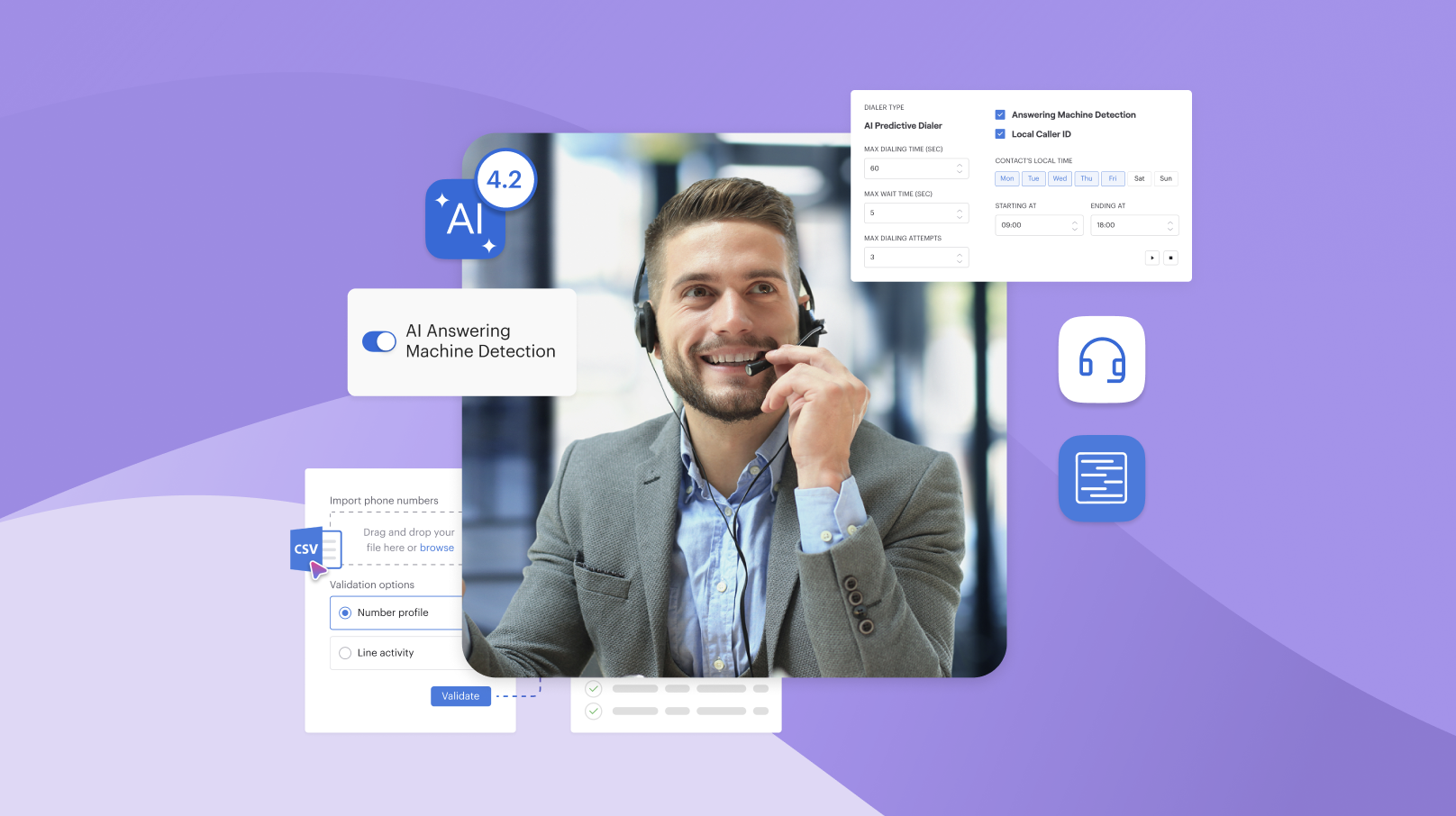
AI cold calling is the use of conversational voice AI to automate or support outbound sales calls, from dialing a list to handling the opening exchange and booking a meeting. It ranges from AI that coaches a human rep mid-call to an autonomous voice agent that holds the whole conversation. For a sales or growth leader in 2026, the real decision is not whether AI belongs in outbound, but how much of the call to hand it and how to stay inside the law while doing so.
This guide explains what AI cold calling is, how it works, where it helps and where it does not, and, crucially, how the rules differ by market. Consent and disclosure requirements for automated voice calls have tightened, and getting them wrong is far more expensive than any efficiency gain.
Key points at a glance
- AI cold calling uses voice AI to automate or assist outbound prospecting, lead qualification, and appointment setting.
- It comes in two forms: assisted AI that coaches human reps live, and autonomous AI voice agents that run the call.
- Rules on automated and AI voice calls vary by market; the US treats AI-generated voices as “artificial” under the TCPA, and the EU AI Act requires disclosure that a machine is calling.
- AI handles volume and the early stages well, while humans still close complex deals and build real rapport.
What is AI cold calling?
AI cold calling applies artificial intelligence to outbound prospecting, using voice technology to dial, speak, listen, and act on a prospect’s responses. Rather than a rep manually working a list, AI can carry the routine parts of outreach, freeing people for the conversations that need judgment. The term covers a spectrum, and the two ends behave quite differently.
Assisted AI versus autonomous AI
Assisted AI sits beside a human rep, listening live and offering prompts, objection responses, and next steps, while the person still leads the call. Autonomous AI, by contrast, is a voice agent that dials and talks on its own, handling the opening, answering basic questions, and passing warm prospects to a human. Assisted AI carries less regulatory and reputational risk; autonomous AI scales further but demands tighter controls. Voiso’s take on where automation fits sits in its guide to conversational AI for call centers.
How does AI cold calling work?
AI cold calling works by combining a dialer, speech technology, and a connection to your customer data, so the system can call a prospect, understand the reply, and respond naturally. Several parts run together in real time.
Voice synthesis and speech recognition
The system converts text to lifelike speech and turns the prospect’s words back into text it can act on. Modern text-to-speech is low-latency enough to hold a back-and-forth without the awkward pauses that gave older systems away. Voiso offers text-to-speech in more than 20 languages within its flow builder, which matters when a list spans several markets.
Data and CRM integration
An AI caller is only as good as the data behind it. Integration with a CRM lets the system dial the right list, personalize the opening, log outcomes, and update records without manual entry. Voiso connects to CRMs including HubSpot, Salesforce, and others so the calling layer feeds the system that owns the customer record, rather than trying to be that system.
Dialing, pacing, and answering machine detection
On the outbound side, a dialer paces calls to keep agents or AI agents talking rather than waiting. Answering machine detection screens out voicemail, and local caller ID raises the odds a call is answered. These are the same tools that power human outbound, now feeding AI-driven conversations too.
Hybrid handoff to humans
The most reliable setups keep a human in the loop. AI fields the opening, answers simple questions, and qualifies interest, then transfers a warm prospect to a rep for the part that needs a person. This hybrid model captures the scale of automation without losing the human touch where it counts.
Everything your team needs in one platform
AI cold calling versus traditional cold calling
The difference is one of scale and consistency, not a change in the underlying goal. Traditional cold calling depends entirely on human reps, whose energy, tone, and follow-through vary through the day. AI cold calling adds a layer that never tires, dials continuously, and says the compliant opening the same way every time.
That consistency cuts both ways. AI does not have a bad afternoon, but it also cannot read a room the way a skilled rep can, or improvise when a prospect goes off-script in a promising direction. The strongest outbound operations use AI for reach and reps for the moments that reward human judgment, rather than treating one as a full replacement for the other. Voiso’s comparison of cold calling versus warm calling is a useful companion here.
Benefits of AI cold calling
The gains cluster around volume, consistency, and freeing reps for high-value work. Framed honestly, AI removes the grind from the top of the funnel rather than closing deals by itself.
- Scale, since AI can work a large list continuously without burning out.
- Consistency, because the opening and the disclosure are delivered the same way on every call.
- Faster qualification, filtering out poor-fit prospects before a rep spends time.
- Better data, as every call is transcribed and logged automatically.
- More selling time for reps, who inherit warm, qualified conversations rather than cold lists.
Limitations and risks
AI cold calling is not a magic switch, and treating it as one invites trouble. A few limits deserve honest attention before you scale.
- Rapport has limits, since prospects often sense an AI and some resent being called by one.
- Complex conversations still need people, especially anything requiring negotiation or nuance.
- Compliance risk is real, because automated and AI voice calls face stricter rules than manual dialing.
- Reputation is at stake, as a clumsy or deceptive AI call can damage a brand faster than a missed target.
Is AI cold calling legal? Rules that vary by market
AI cold calling is legal in many markets when done with consent and clear disclosure, but the specific rules differ sharply by country, and penalties for getting them wrong are steep. Two duties come up everywhere: telling people they are dealing with AI, and holding the right to call them at all.
In the United States, the FCC ruled in February 2024 that AI-generated voices are “artificial” under the TCPA, so calls using them require the called party’s prior express consent, and outbound teams must still screen against the National Do Not Call Registry under the Telemarketing Sales Rule. AI does not create a loophole; it falls squarely inside existing robocall law.
In the European Union, the EU AI Act requires that people be told when they are interacting with a machine, with transparency duties that took effect in August 2026, alongside GDPR consent rules for the data behind the campaign. The United Kingdom applies PECR and the Telephone Preference Service to live marketing calls. Operators in other markets should expect similar disclosure and consent rules, whether or not they exist yet. Whatever the jurisdiction, the duty to disclose and to hold consent sits with the business running the campaign, and regulated industries complete a country-by-country compliance step before going live.
Best practices for compliant, effective AI cold calling
Getting AI cold calling right means pairing good outreach with strict compliance, in that order. The steps below keep campaigns both effective and defensible.
Disclose the AI. Tell the prospect they are speaking with an automated system where the market requires it, and lean toward disclosure even where it does not.
Hold consent and screen lists. Confirm you have the right to call, and scrub against the relevant do-not-call register for each market.
Respect calling windows. Follow permitted hours and frequency caps, which differ by country.
Keep a clean handoff. Move warm prospects to a human smoothly, so interest is not lost at the switch.
Monitor and record responsibly. Use transcription and scoring to improve, while meeting local recording-consent rules.
Give an easy opt-out. Make it simple for a prospect to decline further contact, and honor it immediately.
AI cold calling use cases
The value of AI cold calling shows up wherever outbound volume is high and the early stages are repetitive. A few use cases recur across industries.
Sales teams use it to qualify inbound leads faster and to work large prospect lists that reps could never cover by hand. Appointment setting is a natural fit, with AI booking meetings straight into a calendar. In lending and insurance, AI handles first-contact and renewal reminders, passing anything sensitive to a licensed agent. In iGaming and other high-volume sectors, AI supports reach across many markets, provided disclosure and consent are met in each. Recruitment teams use it to screen candidates at the first touch, and BPOs deploy it to run early outreach for several clients from one platform. The pattern holds across all of them: AI takes the predictable top of the funnel, people take the rest, and the compliance rules of each market shape how far the automation can reasonably go.
How to measure AI cold calling results
Judge AI cold calling on the outcomes it is meant to drive, not on raw call counts, which flatter automation without proving value. The right measures show whether AI is filling the pipeline with real opportunities.
Track connect rate to see how often calls reach a live person, and qualification rate to see how many of those become genuine leads. Watch meetings booked and, further down, the conversion of AI-sourced conversations into deals, since a bot that books meetings nobody attends is not working. Keep an eye on opt-out and complaint rates too, because a spike there signals the outreach is annoying people, whatever the pipeline numbers say. Compare all of this against a human baseline for the same list, so you know what AI actually added. Honest measurement, reviewed on a steady rhythm, is what separates a useful AI channel from an expensive experiment.
How to get started with AI cold calling
Start small, prove it, then widen the scope. A staged rollout protects both your results and your reputation while you learn what works.
Begin with assisted AI, giving reps live prompts and automated notes before handing AI any autonomy. Pick one clear use case, such as qualifying a specific lead type, and measure it honestly against a human baseline. Build compliance in from day one, matching disclosure and consent to every market on your list. Then expand where the results hold and the experience stays positive. Voiso’s guide to outbound calling best practices covers the conversion side alongside the compliance one.
How Voiso supports AI-assisted outbound
Voiso brings AI into outbound through a combination of voice agents, an AI predictive dialer, and speech analytics, all on one cloud platform. Its AI voice agents can handle defined outbound conversations and hand warm prospects to human reps, while the dialer paces calls and connects agents to real people rather than voicemail.
Around the call, speech analytics transcribes and scores conversations so managers coach from evidence, and local caller ID helps calls get answered without misleading the person called. Because Voiso is the communication layer, it feeds outcomes to the CRM that owns the customer record and states its data-handling posture on the Trust and Compliance Center. The result is AI-assisted outbound a team can adopt in stages, with compliance controls built in rather than bolted on, and a single view of how every campaign is performing across the markets you call.
Frequently asked questions
Is it illegal to cold call using AI?
Using AI to cold call is not automatically illegal, but it must follow the same telemarketing rules as any outbound call, plus AI-specific ones. In the United States, the FCC ruled in 2024 that AI-generated voices are “artificial” under the TCPA, so calls using them need the called party’s prior express consent, and lists must be screened against the National Do Not Call Registry. The EU AI Act requires disclosing that a machine is calling. The responsibility for compliance sits with the business, not the software.
Is B2B cold calling illegal?
B2B cold calling is legal in most markets but is still regulated, and the rules differ by country. In the United States, business-to-business calls face fewer restrictions than consumer calls but must still respect company-specific do-not-call requests and any AI voice rules. The United Kingdom brings calls to corporate subscribers under PECR, and firms can register with the Corporate Telephone Preference Service. Confirm each market’s stance before dialing, since assuming B2B is exempt is a common and costly mistake.
Is there an AI to practice cold calling?
Yes, AI role-play tools exist that simulate a prospect so reps can practice cold calls and objection handling before dialing real people. These bots present tough scenarios, respond in real time, and give feedback on pacing, tone, and structure. They are a training aid rather than an outbound tool, and they carry none of the compliance duties that apply to live calls. Many teams use practice AI to onboard new reps faster and to rehearse difficult objections in a low-stakes setting.
How much does AI cold calling cost?
AI cold calling has no single price, since it depends on the platform, call volume, and how much autonomy you deploy. Costs usually combine a platform subscription with usage-based charges, often per minute of AI conversation. The clearer way to judge value is against the reps’ time AI frees and the qualified conversations it delivers. Compare what each provider includes versus bills separately, model your own list and call mix, and factor in the compliance controls you will need for every market.
Does AI cold calling actually work?
AI cold calling works well for the top of the funnel: dialing at scale, qualifying leads, and booking meetings, freeing reps for the conversations that close. It is less effective at complex, relationship-driven selling, where human judgment and rapport still win. Results depend heavily on list quality, a natural-sounding agent, and a clean handoff to people. Treated as a tool that handles volume and hands off warm prospects, rather than a full replacement for reps, it earns its place in a modern outbound stack.
Bring AI into your outbound, the right way
AI cold calling can widen your reach and free your reps for the conversations that matter, but only when the outreach is genuinely useful and the compliance is airtight. Voiso brings AI voice agents, a predictive dialer, and speech analytics together on one cloud platform, with the integrations to feed your CRM and the controls to respect each market’s rules. To see how AI-assisted outbound fits your team and the countries you call, book a demo with the Voiso team, or start a free trial and test it against your own lists.