All Products

.svg)




An AI call center is a customer service operation that uses artificial intelligence to handle, route, and support voice conversations, either on its own or alongside human agents. It applies technologies like speech recognition, natural language understanding, and generative AI to tasks that once needed a person for every step: answering routine questions, sending calls to the right place, transcribing and scoring interactions, and prompting agents in real time.
The term covers a spectrum, not a single product. At one end, AI quietly assists human agents with live suggestions and after-call summaries. At the other, an AI voice agent handles a whole conversation without a person on the line. Most operations in 2026 sit somewhere between, and the interesting question for a decision-maker is not whether to use AI, but which tasks to hand it and where a human still belongs.
Key points at a glance
- An AI call center uses artificial intelligence to automate or assist voice conversations across the customer lifecycle.
- Core technologies include speech recognition, natural language understanding, intent detection, and generative AI for summaries and replies.
- AI handles high-volume, repetitive work well; complex, emotional, or high-stakes calls still need people.
- Rules on AI voices differ by market: the US treats AI-generated voices as “artificial” under the TCPA, and the EU AI Act requires callers to be told they are talking to a machine.
What is an AI call center?
An AI call center is a contact operation where artificial intelligence takes on part or all of the voice workload, from understanding why a customer is calling to resolving simple requests and helping agents with the rest. It differs from a traditional call center in that software, not only people, interprets and acts on what the caller says.
AI call center versus a traditional call center
A traditional call center routes calls with fixed menus and relies on agents for every interaction. An AI call center adds a layer that understands natural speech, predicts intent, and automates the routine, so a caller can say what they want instead of pressing numbers, and simple requests never reach a queue. The difference shows up as shorter waits for easy tasks and more agent time for hard ones.
AI call center versus AI contact center
The two terms are often used interchangeably, with one small distinction. An AI call center centers on voice, while an AI contact center applies the same intelligence across voice, chat, email, and messaging. Since most operations now span channels, the wider term is common, though buyers still search for the voice-first version. Voiso’s overview of conversational AI for call centers covers how the underlying technology reads across both.
How does an AI call center work?
An AI call center works by turning speech into text, working out what the caller wants, then either handling the request automatically or routing and assisting a human agent. Several technologies run in sequence, often within a second or two, to make that feel natural to the person on the line.
Speech recognition and natural language understanding
The first step converts spoken words into text the system can process, then natural language understanding works out meaning, not just words. This is what lets a caller say “I was charged twice this month” and have the system grasp the billing issue rather than hunt for a keyword. The quality of this layer sets the ceiling for everything after it.
Intent detection and routing
Once the system understands the request, it matches it to an intent and decides what happens next: answer directly, collect more detail, or route to the right team. Intelligent routing sends the caller to a person or a bot suited to the topic, which beats a rigid menu that forces everyone down the same tree. Voiso builds this kind of logic in its flow builder, where IVR, chatbots, and routing rules live together.
Automation and AI voice agents
For well-defined tasks, an AI voice agent can carry the whole conversation: checking an order, booking an appointment, taking a payment status query. These AI voice agents speak naturally, follow a script with flexibility, and hand off to a human when the request moves beyond their scope. The aim is not to replace the team but to clear the volume that does not need a person.
Agent assist and after-call work
AI also works quietly beside human agents. It can surface answers mid-call, transcribe the conversation, flag sentiment, and write the summary an agent used to type by hand. Voiso’s AI speech analytics transcribes and scores calls, so the value shows up both during the call and in the review afterward.
Generative AI adds another layer on top of these steps. Where older systems matched fixed phrases, a generative model can draft a natural reply, summarize a long call in a sentence, or suggest the next best action from context. That flexibility is what makes 2026-era voice agents sound less scripted, though it also raises the bar on oversight, since a system that can say anything needs guardrails on what it should say.
Everything your team needs in one platform
Key features of an AI call center
The capabilities below are what separate an AI call center from a traditional one. Not every operation uses all of them, and the mix depends on call type and volume.
- Conversational AI and voice agents that handle full interactions in natural speech.
- Intelligent, intent-based routing that replaces rigid phone menus.
- Real-time transcription in multiple languages for live visibility.
- Sentiment analysis that flags when a caller grows frustrated.
- Automated call scoring across every interaction, not a sample.
- AI-written call summaries that cut after-call work.
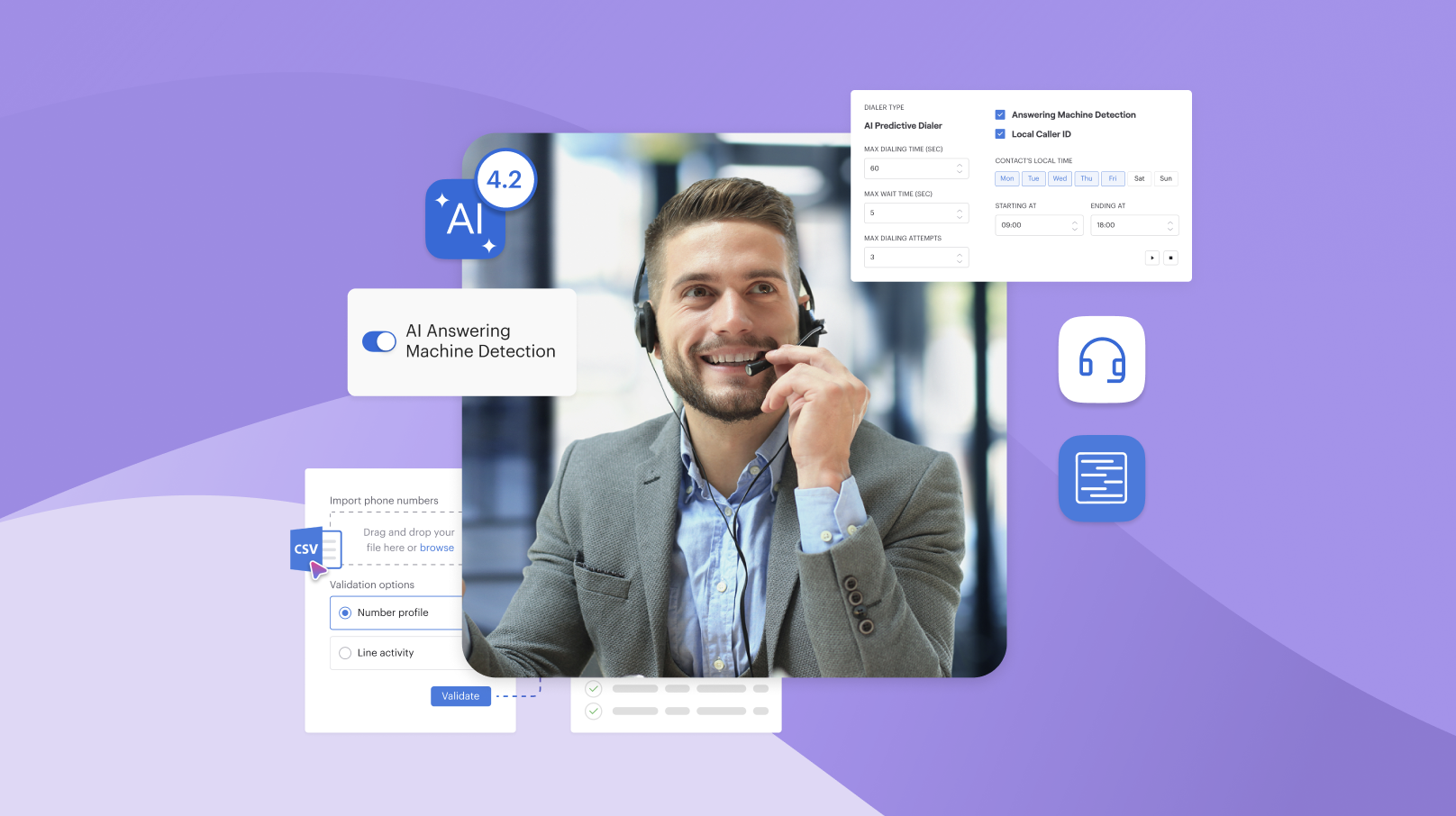
- Answering machine detection for outbound, so agents connect to people, not voicemail.
Voiso pairs several of these in its outbound stack, including answering machine detection on the predictive dialer, and its chatbot builder for digital channels.
Benefits of an AI call center
The gains cluster around speed, consistency, and freeing people for work that needs them. The honest framing is that AI removes friction from parts of the operation, rather than transforming all of it at once.
- Faster resolution for simple requests, since routine tasks do not wait in a queue.
- Consistent quality, because scoring and prompts apply to every call, not a lucky sample.
- Round-the-clock coverage for basic questions, without overnight staffing for every query.
- More agent time for complex, high-value conversations that reward a human touch.
- Better insight, as transcription and analytics turn thousands of calls into readable patterns.
AI call center versus human agents: what AI can and cannot do
AI handles volume, structure, and repetition well; humans still lead on empathy, judgment, and messy or high-stakes situations. The strongest operations pair the two rather than choosing one, and knowing the split is what makes an AI call center work.
Where AI performs best
AI shines on high-volume, well-defined tasks: answering the same questions, capturing details, checking a status, routing accurately, and handling after-call work. It does this at any hour and never tires, which makes it a good fit for the predictable majority of contacts.
Where humans stay essential
When a call is emotional, complex, or carries real consequence, a person is still the right answer. Empathy, negotiation, and the ability to improvise beyond a script remain human strengths, and customers can tell the difference. Rather than replacing agents, AI in most operations moves the human role toward the conversations that matter most. Voiso’s guide to measuring AI agent performance helps teams draw that line with data.
How much does an AI call center cost?
Pricing for AI call center capability varies with the model, the volume, and how much automation you deploy, so a flat figure would mislead. Costs usually combine a platform subscription with usage-based charges for AI features such as minutes transcribed or conversations handled by a voice agent.
The better way to think about cost is against the work AI absorbs. If automation clears a large share of routine contacts and shortens after-call work, the spend offsets against time that would otherwise need staffing. Compare providers on what is included versus billed as an add-on, and model your own call mix rather than trusting a headline price.
Is AI calling legal? Rules that vary by market
AI calling is legal in most markets when done with consent and disclosure, but the specific rules differ sharply by country, and getting them wrong carries real penalties. Two obligations recur: telling people they are dealing with AI, and holding consent before an automated call goes out.
In the United States, the FCC ruled in February 2024 that AI-generated voices count as “artificial” under the TCPA, so calls using them need the called party’s prior express consent, and state attorneys general can pursue violators. That places AI voice squarely inside existing robocall law rather than in a gray zone.
In the European Union, the EU AI Act requires that people be told when they are interacting with a machine, with transparency duties for chatbots and AI-generated content that took effect in August 2026. An operator running a bot for EU customers has to disclose it, not disguise it.
Elsewhere, the direction is similar even where the letter differs. Operators in other markets may reasonably expect disclosure and consent rules to tighten, so building transparency in from the start is safer than retrofitting it. Whatever the market, the duty to disclose and to hold consent sits with the business running the campaign, and regulated industries complete a country-by-country compliance step before going live.
How to adopt an AI call center
Moving to an AI call center works best in stages, starting where the value is clearest and the risk is lowest. A rushed, all-at-once rollout tends to erode the trust of both customers and agents.
Start with agent assist. Add transcription, live suggestions, and automated summaries before handing AI any customer-facing autonomy.
Automate the clearest tasks. Pick a few high-volume, low-complexity intents for a voice agent or bot, and measure resolution honestly.
Set the handoff rules. Decide exactly when AI passes a call to a human, and make that transition smooth for the caller.
Build in disclosure and consent. Match the rules of every market you serve before a single automated call goes out.
Review and expand. Use analytics to see what worked, then widen the scope where results hold up.
AI call center use cases by industry
The value of an AI call center looks different depending on what a business sells and which rules bind it. A few sectors show the range clearly.
Fintech and lending: AI verifies identity prompts, answers balance and status questions, and routes disputes to trained agents, while every interaction is transcribed for the audit trail these regulated firms must keep.
iGaming: high outbound volumes across many countries make answering machine detection and intent routing valuable, provided disclosure and consent rules are met in each market.
Healthcare and insurance: AI handles appointment reminders, coverage questions, and triage-style routing, while sensitive records stay in the clinical or policy system, not the calling platform.
Travel and retail: seasonal spikes suit AI that absorbs routine questions about bookings, orders, and delivery, freeing agents for exceptions during peak.
The common thread is that AI takes the predictable volume, while people and the systems of record handle what needs judgment or holds sensitive data. That division keeps an AI call center both useful and defensible.
How Voiso brings AI to the contact center
Voiso puts AI to work across the conversation rather than as a bolt-on, combining voice agents, analytics, and automation in one cloud platform. Its AI contact center tools span the routine work that slows a team down, from routing and dialing to transcription and scoring.
On voice, AI answering machine detection connects outbound agents to real people, while AI voice agents handle defined conversations end to end. On quality, speech analytics transcribes calls in several languages, scores them automatically, and writes summaries so supervisors review evidence rather than guesswork. On routing, the flow builder blends IVR, chatbots, and text-to-speech so callers reach the right place quickly.
Because Voiso is the communication layer, it passes data to the CRM or system of record that owns the customer account, rather than trying to be that system. It states its certifications and data handling on the Trust and Compliance Center, which matters when AI touches customer conversations. The result is an AI call center a team can adopt in stages, keeping humans on the calls that need them.
Frequently asked questions
How is AI used in call centers?
AI is used in call centers to understand callers, route them, automate simple requests, and support human agents. Common uses include conversational AI and voice agents that handle full interactions, intent-based routing that replaces phone menus, real-time transcription and sentiment analysis, automated call scoring across every interaction, AI-written summaries that cut after-call work, and answering machine detection for outbound dialing. Most operations blend these, letting AI clear routine volume while agents focus on complex, high-value conversations.
Is AI calling legal?
AI calling is legal in most markets when it follows local consent and disclosure rules, which differ by country. In the United States, the FCC confirmed in 2024 that AI-generated voices are “artificial” under the TCPA, so automated calls using them need the called party’s prior express consent. The European Union’s AI Act requires people to be told they are interacting with a machine. The duty to disclose and obtain consent rests with the business running the calls, not the software provider.
Will AI replace call center agents?
AI is unlikely to fully replace call center agents, though it is changing the role. AI handles high-volume, repetitive, well-defined tasks around the clock, which reduces the number of routine calls reaching people. Complex, emotional, and high-stakes conversations still need human judgment, empathy, and improvisation that AI cannot match. In most operations the effect is a rebalancing rather than a cut: agents spend more time on the conversations that matter and less on repetitive work that software now absorbs.
What is the difference between an AI call center and a traditional call center?
A traditional call center relies on fixed menus and human agents for every interaction, while an AI call center adds software that understands natural speech, predicts caller intent, and automates routine requests. Callers can explain what they need instead of pressing numbers, simple tasks are resolved without a queue, and agents receive live support and automated summaries. The practical result is shorter waits for easy requests and more human attention for the difficult ones.
How do you measure the success of an AI call center?
Success is measured by whether AI improves outcomes without harming experience. Useful measures include automated resolution rate for the tasks AI handles, containment before a human is needed, first contact resolution, average handle time, customer satisfaction, and the accuracy of AI transcription and scoring. It also helps to track how cleanly AI hands calls to agents. The goal is honest improvement across both efficiency and quality, not automation for its own sake, so review experience metrics alongside efficiency ones.
How much does an AI call center cost?
An AI call center has no single price, because cost depends on the platform, the call volume, and how much automation you deploy. Most providers combine a subscription with usage-based charges for AI features, such as minutes transcribed or conversations a voice agent handles. The clearer way to judge value is against the work AI absorbs: automation that clears routine contacts and shortens after-call work offsets time that would otherwise need staffing. Compare what each provider includes versus bills separately, then model your own call mix instead of a headline figure.
See what AI can do in your contact center
An AI call center is not a single switch to flip; it is a set of capabilities you adopt where they earn their place, keeping people on the conversations that need them. Voiso brings voice agents, speech analytics, intelligent routing, and outbound automation into one cloud platform, with the integrations to pass data to the systems that own the rest. To see how AI fits your call types and markets, book a demo with the Voiso team, or start a free trial and test the AI tools against your own calls.