All Products

.svg)





Quick answer: Handle time, deflection, and containment were built to measure live agents, and they mislead badly when applied to AI. A fast bad call isn’t a win. A deflected customer who churns a week later isn’t a save. Better yardsticks for judging an AI agent are resolution quality, escalation appropriateness, downstream contact rate, and customer effort, measured through unified reporting that puts AI and live-agent interactions in the same dashboards.
I’ll say this plainly, since this is one of those topics where hedging just muddies the point: most contact centers are measuring their AI agents with the wrong instruments entirely, and the numbers coming back look great specifically because they’re measuring the wrong thing well.
This isn’t a small technical quibble. It’s a genuine measurement problem, and it’s costing teams real money, because a dashboard full of green numbers is actively discouraging anyone from noticing an AI agent that’s quietly making customers worse off. Learn to spot the gap between a metric looking good and a customer actually being helped, and most of what follows here starts to make sense on its own.
None of this is an argument against automation itself, worth saying clearly upfront since that’s an easy misread. It’s an argument against grading a fundamentally different kind of system with the same ruler used for people, then acting surprised when the grade doesn’t predict what actually happens to customers afterward.
Why Old Contact Center Metrics Don’t Work for AI
Handle time, deflection rate, and containment rate all share one assumption: that a person is the one on the call, working within a person’s natural constraints. Speaking speed, thinking time, the cost of a transfer, the awkwardness of asking a customer to repeat themselves. Every one of these metrics was tuned, deliberately or not, around what a person is capable of and what a business wants that person to optimize for.
An AI agent doesn’t share those constraints. It can talk fast without sounding rushed, and end a call cleanly regardless of whether the underlying problem is actually solved. It never gets tired, never sounds annoyed, and never has an incentive to secretly pad a call because it’s tired of the ninth angry customer of the day. Which sounds like it should make old metrics more trustworthy, not less. It’s actually the opposite: the very things that made these metrics decent proxies for a person’s effort make them useless, or worse, actively misleading, once effort isn’t the constraint anymore.
It’s worth sitting with that for a second, since it’s the whole argument in miniature: a measurement system built around what’s hard for a person to do says almost nothing useful about a system for which none of those things are hard at all.
The Problem With Handle Time
Handle time measures how long an interaction takes. For a live agent, a short handle time usually correlates loosely with competence, since experienced staff tend to solve things faster than newer ones. That correlation was never perfect, but it was real enough to be a useful signal among several.
There’s a reason this correlation held for so long without anyone questioning it too hard: for decades, the only thing answering a phone was a person, so speed genuinely tracked something real about how well they knew their job. That assumption quietly stopped applying the moment something other than a person started answering, and most reporting stacks haven’t caught up yet.
A Fast Bad Call Isn’t a Win
An AI agent can end a call in ninety seconds by giving a confident, wrong answer, or by talking a customer out of pursuing a legitimate complaint, and handle time will register that as a triumph. Speed and quality aren’t the same axis for a system that has no natural upper limit on how fast it can talk or how quickly it can decide a conversation is finished. Optimizing an AI agent for short handle time, without anything else in the picture, tends to produce exactly what you’d expect: a system that’s very good at ending calls quickly and only incidentally good at solving problems.
None of this means speed is irrelevant, to be fair. A system that takes ten minutes to resolve something a person could handle in two has its own problem. But speed only becomes meaningful once quality is already accounted for, not as a standalone target competing against it.
The Problem With Deflection
Deflection counts a contact as successfully redirected away from a live agent, usually treated as inherently positive, since it implies the automated path resolved things well enough that a person never had to get involved.
A Deflected Customer Who Churns Isn’t a Save
The trouble is that deflection only measures whether the immediate contact avoided a transfer. It says nothing about whether the underlying issue actually got resolved. A customer who gets talked in circles by an AI agent, gives up, and quietly cancels their account a week later shows up in the data as a clean deflection. The metric looks great right up until churn numbers arrive and nobody connects the two, because they’re sitting in entirely different reports, reviewed by entirely different teams, on entirely different schedules.
Worth asking directly: who actually checks whether a deflected contact stayed resolved. In most operations, nobody does, at least not systematically, because the team that owns deflection numbers and the team that owns churn numbers rarely sit in the same meeting. That organizational gap is arguably as much the problem as the number itself.
Everything your team needs in one platform
The Problem With Containment
Containment is close cousin to deflection: the share of interactions the AI agent handled start to finish without any live-agent involvement at all. Higher containment is treated as the AI system doing its job.
That’s true only if what’s being contained is actually resolved. High containment paired with high downstream contact volume, the same customer calling back three days later about the same issue, is a warning sign dressed up as an achievement. Containment answers “did a human get involved,” not “did the problem go away.” Those are genuinely different questions, and conflating them is where a lot of AI agent programs quietly go wrong.
There’s an uncomfortable version of this worth naming: a system can learn, intentionally or not, to avoid escalating even when escalation is genuinely warranted, simply because escalations get counted against it. Nobody designs a reward function to punish honesty about its own limits on purpose, but that’s often the practical effect when containment sits at the center of how success gets defined.
Why This Keeps Happening
None of this is because anyone’s being careless on purpose. These metrics were already sitting in the reporting stack, already familiar to leadership, already tied to dashboards everyone knows how to read. Reusing them for AI agents feels efficient. It’s the wrong kind of efficient.
There’s also a simpler explanation worth admitting: building new reporting takes real effort, and reusing what’s already there is genuinely the path of least resistance. That’s not a moral failing. It’s just a reason to be honest that convenience, not correctness, is often what’s actually driving the choice of what gets tracked.
The Optimization Trap
Whatever gets measured gets optimized, and an AI agent, unlike a person on staff, will optimize toward whatever the actual reward signal is with zero self-consciousness about it. If short handle time is the target, prompts and behavior tend to drift toward ending calls fast, sometimes at the direct expense of actually helping. This isn’t a hypothetical risk. It’s close to the default outcome of measuring the wrong thing and then acting on what the numbers say.
Four Better Yardsticks for Judging AI Agents
None of these are perfect, worth admitting upfront, but each one measures something closer to what actually matters: whether the customer’s problem got solved, and whether the system handled the moments it shouldn’t have handled alone.
Resolution Quality
Did the actual issue get resolved, not just did the call end. This usually requires some form of conversation scoring, whether through structured review or automated evaluation, since resolution isn’t always obvious from call length or sentiment alone. A call can sound pleasant and still fail to fix anything.
Escalation Appropriateness
Not every call should be escalated, and not every call should be contained. The better question is whether the AI agent escalated the right calls, the genuinely complex ones, the emotionally charged ones, and resolved the rest. An AI agent that escalates too little looks efficient and frustrates people. One that escalates too much looks cautious and wastes the entire point of automating in the first place.
Downstream Contact Rate
This is the single most honest metric on this list: did the customer have to reach out again about the same issue within a set window, say seven or fourteen days. A low downstream contact rate is real evidence of resolution. A high one, even alongside a clean deflection number, tells you the earlier metric was lying.
Customer Effort
How much work did the customer have to do to get an answer. Repeating themselves, rephrasing a question the system didn’t catch the first time, getting routed in circles before landing somewhere useful. Effort is harder to quantify than handle time, admittedly, but it correlates far more closely with whether someone would actually recommend the service to another person.
A quick reference for what each new yardstick actually measures:
| Yardstick | What It Captures | What It Replaces |
| Resolution quality | Whether the issue was genuinely fixed | Handle time |
| Escalation appropriateness | Whether the right calls reached a person | Containment |
| Downstream contact rate | Whether the customer had to come back | Deflection |
| Customer effort | How hard the customer had to work for an answer | Sentiment alone |
Notice what these four have in common: none of them can be gamed by simply talking faster or ending a call sooner. That’s not an accident. A number that a system can improve purely by changing its own behavior, without the underlying outcome for the customer actually changing, was never a good number to begin with.
Picture two automated setups handling similar volume. The first shows a 90 percent containment rate and looks fantastic on a monthly report. The second shows 70 percent containment but a downstream contact rate half as high as the first. Anyone judging purely on containment picks the first setup. Anyone who actually checked whether problems stayed solved would pick the second without much hesitation.
Building a Measurement Framework
Swapping metrics on paper is the easy part. Making the new ones actually usable day to day takes a bit more structure.
Set a Baseline Before Changing Anything
Before adjusting how an AI agent behaves, measure resolution quality and downstream contact rate on the current production setup first. Without a baseline, it’s impossible to tell whether a later change actually helped or just moved the numbers sideways.
Mix Automated and Manual Review
Automated scoring can flag patterns at scale, unusual call lengths, repeated phrases, sentiment swings, but manual review still catches nuance automation misses, particularly around whether an answer was technically correct but tonally off. Neither replaces the other; they cover different blind spots.
Review on a Real Cadence, Not Just at Launch
A measurement framework built once at launch and never revisited quietly goes stale as call patterns shift and prompts get adjusted. Reviewing a sample regularly, not just when something visibly breaks, catches drift while it’s still small.
A quarterly review, in particular, tends to feel responsible while actually being far too slow. Prompts get adjusted, call volume shifts seasonally, and a genuine regression can sit unnoticed for two and a half months before the next scheduled look catches it, by which point real damage has already accumulated.
Old Metrics vs New: A Side-by-Side Look
Where the old metrics still have a place, and where they mislead:
| Still Useful For | Where It Misleads on AI | |
| Handle time | Capacity planning, cost estimates | Confuses fast with good |
| Deflection | Volume tracking | Ignores whether the issue actually got fixed |
| Containment | Staffing forecasts | Treats avoiding a person as success by itself |
None of the old numbers are useless, worth saying clearly. They’re just incomplete on their own, and treating them as a full picture of AI agent quality is where teams get burned.
Common Mistakes in AI Agent Evaluation
A few patterns show up repeatedly once teams start taking this seriously:
- Measuring AI agents against a different scale than live agents: If resolution quality matters for a person, it matters exactly as much for a system, arguably more, since a bot at scale can create a lot more downstream contact volume than any single person ever could.
- Treating a good demo as evidence of good production performance: A handful of clean example calls says very little about how a system behaves across thousands of real, messy interactions with real accents, real background noise, real frustration.
- Reviewing only the calls that get flagged: Sampling only escalated or complained-about interactions misses the quieter failure mode: calls that seemed fine, ended politely, and solved nothing.
- Never closing the loop back to prompt or behavior changes: Collecting better numbers without acting on them is just a more expensive way of not fixing the underlying problem.
The thread running through all four of these: it’s much easier to collect numbers than to actually use them to change anything. A team that reviews diligently but never adjusts prompts or escalation rules based on what the review found is, functionally, no better off than a team that never reviewed at all.
How Often to Actually Measure This
There’s no single right cadence, but a mix tends to work better than picking just one. Automated scoring can run continuously, flagging outliers daily. Manually reviewed samples work better on a weekly or biweekly rhythm, enough to catch drift without burning excessive review time on every single call. A deeper look at downstream contact rate, since it requires a window of time to actually observe, makes more sense monthly. Treating all of this as a single “check it once a quarter” task tends to mean problems sit unnoticed far longer than they should.
None of these windows are fixed rules, worth saying, since the right rhythm depends on call volume and how quickly a specific business’s issues typically resurface. A subscription business might need a longer downstream window than one handling same-day logistics problems. The principle matters more than the exact number of days chosen.
What This Looks Like in Practice
Comparing AI and live-agent performance honestly requires seeing them in the same place, calculated the same way, which is harder than it sounds if the two live in separate systems.
None of these three pieces does much alone. Unified reporting without consistent scoring just means clean data measuring the wrong thing. Consistent scoring without scalable review means good intentions nobody has time to act on. Put together, they cover collection, evaluation, and the actual bandwidth to review what gets found.
Unified Reporting Across AI and Live-Agent Interactions
Voiso keeps AI and live-agent interactions in the same call detail records and dashboards, so resolution quality, escalation patterns, and downstream contact rate can be compared like-for-like rather than pulled from two disconnected exports that never quite agree with each other.
Speech Analytics Scoring Applied to AI Calls
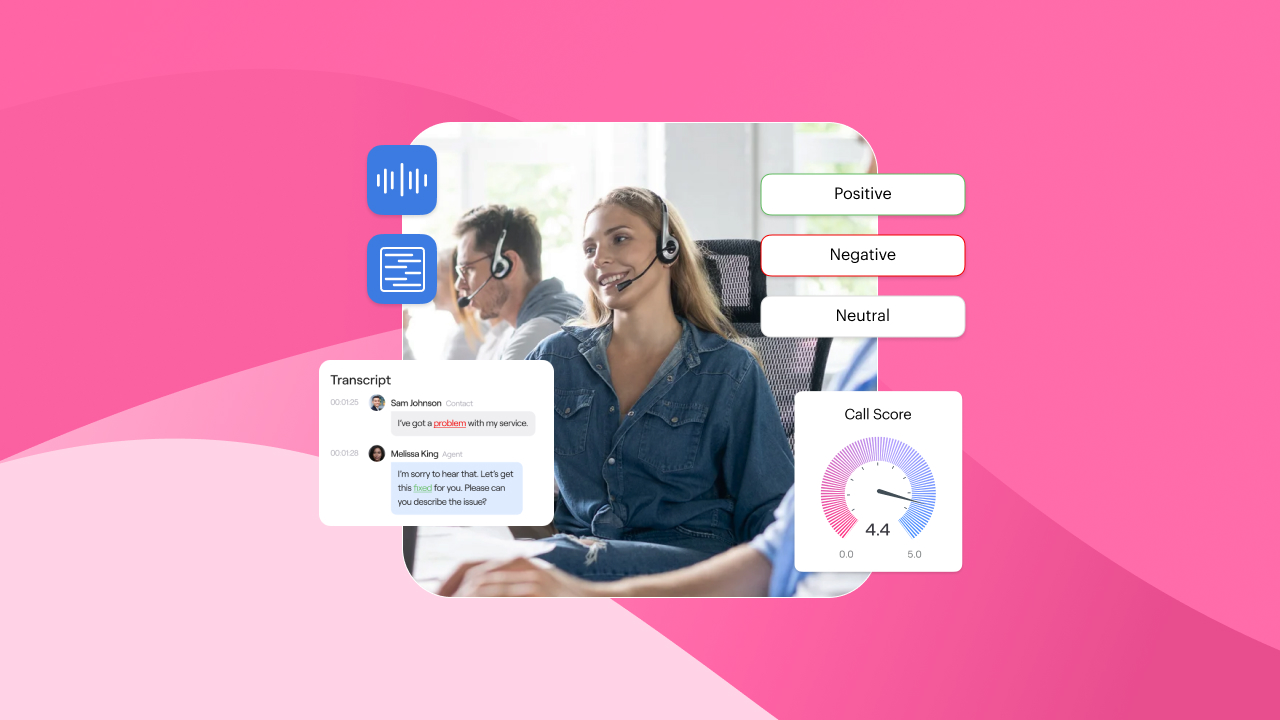
The same conversation scoring used to evaluate live-agent calls applies directly to AI-handled ones. That consistency matters: it means an AI agent isn’t graded on an easier rubric just because a person didn’t handle the call, which is exactly the kind of quiet double standard that lets a mediocre system look better than it actually is.
AI Call Summaries for QA Review at Scale
Reviewing every AI-handled call individually doesn’t scale, but AI-generated call summaries let a QA reviewer scan far more interactions per hour than listening to full recordings would allow, flagging the ones that actually need a closer manual look rather than treating every call as equally worth a reviewer’s time.
FAQs
That’s the core argument: the metrics built for measuring a person’s effort measure the wrong thing entirely once effort stops being the constraint, and resolution quality, escalation appropriateness, downstream contact rate, and customer effort get much closer to what actually matters. A few sharper questions tend to come up once teams start applying this.
Should AI agents and human agents be measured on completely separate scorecards?
Not entirely separate, though some metrics genuinely don’t transfer well in either direction. Resolution quality and customer effort should apply to both, since the underlying question, did this interaction actually help the customer, doesn’t change based on who or what handled it. Metrics tied specifically to staffing capacity, like handle time for scheduling math, remain useful for people but shouldn’t be forced onto AI performance reviews.
How do you measure resolution quality without listening to every call?
A mix of automated scoring and targeted manual sampling. Automated scoring, often using an LLM to review transcripts against a rubric, can flag likely failures or ambiguous outcomes across a large volume quickly. Reviewers then focus their limited time on the flagged calls and a random sample of the rest, rather than attempting full coverage, which rarely scales once call volume moves beyond a few hundred a day.
What’s a reasonable downstream contact rate to expect from a new AI deployment?
There’s no universal number, since it depends heavily on the complexity of the issues being handled and the industry involved. What matters more than any specific benchmark is the trend: a downstream contact rate that’s stable or improving over time, measured against your own baseline, tells you more than comparing against another company’s published figure, which likely reflects a completely different mix of call types. A useful habit: revisit that baseline every few months rather than treating it as fixed forever, since what counts as a reasonable figure for a given business can genuinely shift as call mix, product complexity, or customer expectations change over time.
Does better AI agent measurement require investing in agent observability tools?
Not necessarily as a separate purchase, though the underlying idea, being able to trace what an AI agent actually did during a call and why, matters a great deal. Some contact center platforms build this into reporting directly. Others require pairing a conversational system with dedicated evaluation tooling built for that purpose. The requirement is visibility into behavior, not any specific product category. Whichever route a team takes, the underlying goal is the same: being able to explain, after the fact, why a specific call went the way it did, rather than treating the whole interaction as an unexplainable black box that either worked or didn’t.
How does RAG affect how AI agents should be evaluated?
When an AI agent pulls answers from a knowledge base rather than reasoning purely from a prompt, resolution quality depends partly on retrieval accuracy, whether the system found the right source material, not just how it phrased the response. Evaluation frameworks for this kind of setup often need a retrieval-specific check layered on top of the usual resolution and effort measures, since a confidently wrong answer built on a poorly retrieved source looks identical to a good one until someone actually checks the underlying facts. This is a growing area of eval engineering specifically, worth knowing the term even if a team isn’t building this depth in-house yet: separating whether a system reasoned correctly from whether it started with correct information in the first place.