


That’s not just a technical change. It affects how teams scale, how you hire, how you monitor performance, and how you keep costs under control.
The short version: a cloud phone system for business moves call routing, configuration, and management into a hosted environment. Instead of maintaining physical PBX hardware, you manage users, queues, and routing logic through a web interface.
This guide covers how these systems work, how they differ from legacy setups, and how to figure out whether one fits your operation.
What is a cloud based office phone system, technically and operationally?
The infrastructure behind a cloud phone system for business
A cloud based office phone system runs on provider-managed infrastructure rather than hardware sitting in your office.
In a traditional setup, you install a private branch exchange (PBX) on-site. That hardware handles call routing, extensions, and connectivity to the public telephone network.
With a cloud PBX, that control layer lives in distributed data centers. Calls route over IP networks instead of copper lines, and you handle configuration through a secure web interface rather than physical switches.
Here’s how the two models compare:
| Component | On-Prem PBX | Cloud PBX |
| Hardware | Installed locally | No on-site PBX hardware |
| Maintenance | Internal IT or vendor contract | Managed by provider |
| Scaling | Physical expansion required | User-based configuration |
| Geographic expansion | Telecom provisioning per location | Centralized configuration |
The bottom line: infrastructure complexity moves off your IT team’s plate and into a managed environment.
How it differs from traditional business VoIP phone setups
Not every business VoIP phone system is fully cloud-native.
Some companies use SIP trunking to connect a legacy PBX to the internet. The hardware stays on-site in that model. Only the call transport changes.
A hosted VoIP system, by contrast, removes the PBX layer from your premises entirely. Routing logic, queue rules, and extensions all live in the provider’s platform.
That distinction matters because maintenance responsibility, scalability, upgrade cycles, and geographic deployment all work differently depending on which model you’re running.
When you’re evaluating an internet-based phone system, the real question isn’t whether it uses VoIP. It’s whether the control architecture is still tied to hardware.
The financial model: where businesses actually save (and where they don’t)
CapEx vs OpEx breakdown
On-premise telephony requires upfront capital investment: PBX hardware, installation, telecom provisioning, and ongoing maintenance contracts.
A cloud business phone model shifts that to operational expenditure. Pricing is typically per-user or usage-based, depending on the provider.
That said, cost savings aren’t automatic.
They usually show up in hardware avoidance, reduced IT overhead, faster deployment, and lower friction when you expand.
Here’s an example: say you’ve got a 50-agent team planning to grow to 120 over two years. Traditionally, you’d need to provision hardware capacity upfront. With a cloud system, expansion typically happens at the user level, no infrastructure swap required.
The financial win is flexibility, not necessarily a lower per-minute call cost.
Productivity in high-volume teams
For outbound-heavy environments like fintech sales teams, collections departments, or outsourced telemarketing centers, the infrastructure model has a direct effect on productivity.
A centralized cloud phone system for business gives you user provisioning without physical setup, centralized monitoring through dashboards, and consistent routing logic across locations.
In outbound operations, features like Answering Machine Detection can cut time wasted on voicemail connections. Voiso markets AI-powered Answering Machine Detection and reports around 95% voicemail detection accuracy.
That won’t guarantee higher revenue on its own. But it can reduce time agents spend on non-live connections, which tends to improve talk-time efficiency depending on how the campaign is structured.
Scalability: the real advantage of a cloud phone system for business
Global expansion without telecom hardware
Expanding into new markets with a traditional PBX usually means local telecom contracts, physical infrastructure, and on-site configuration.
With a cloud based office phone system, you can typically manage new numbers and routing rules from one place.
For outbound teams working internationally, local caller ID options are commonly used to support regional presence. Voiso’s outbound dialer supports local caller ID configuration for campaigns.
The payoff is operational control. Expansion becomes a configuration decision, not an infrastructure project.
Seasonal and rapid hiring scenarios
Travel, collections, and campaign-based sales all deal with volume spikes. In a hardware-based environment, scaling means forecasting capacity months ahead of time.
In a hosted VoIP system, scaling typically means adding user accounts, adjusting routing logic, and rebalancing queues.
This model handles workforce variability well. It won’t eliminate staffing challenges, but it takes physical constraints out of your scaling decisions.
Must-have capabilities in a modern cloud PBX
Intelligent call routing and IVR
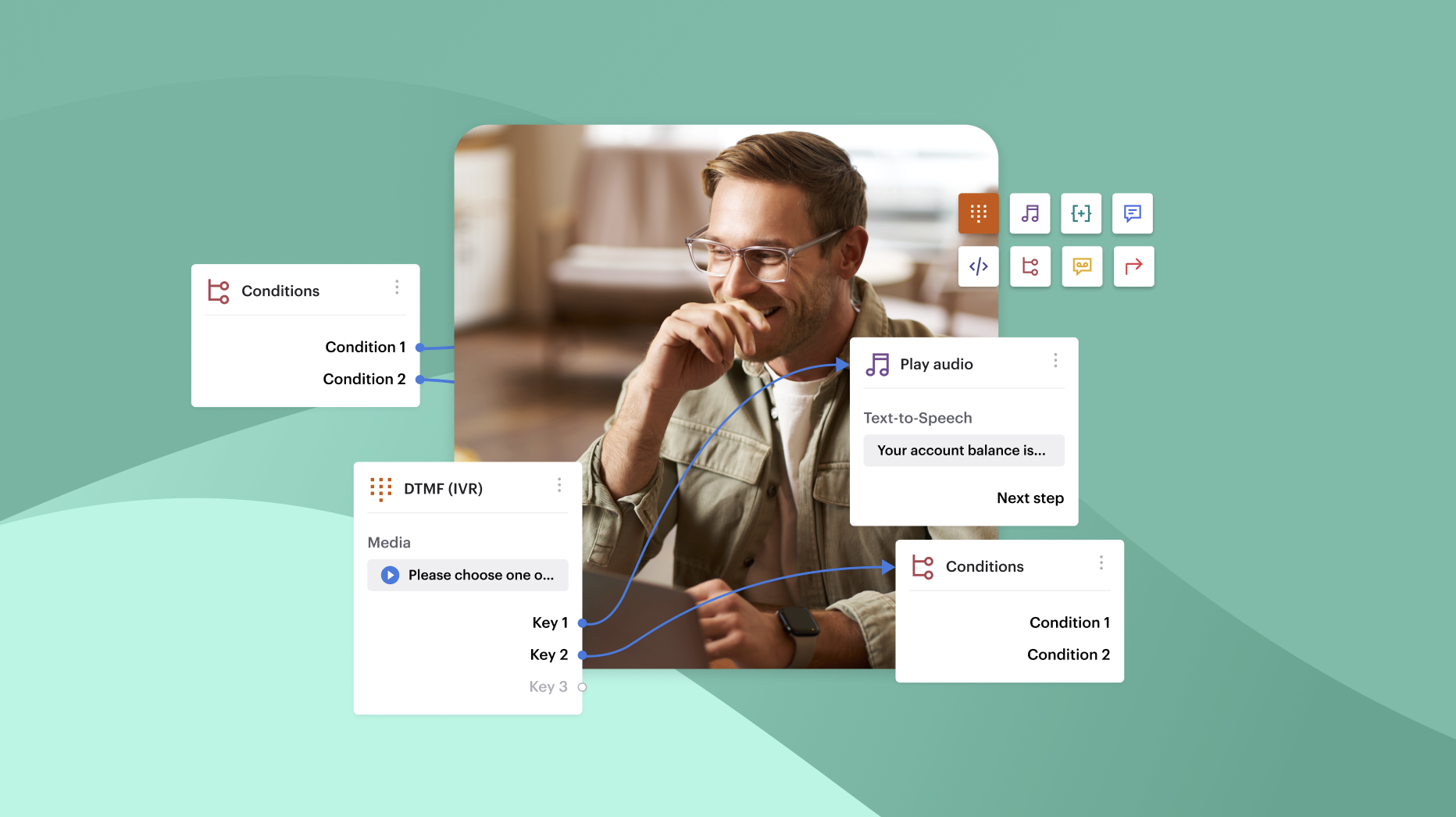
Legacy IVR systems often require manual configuration through telecom vendors. Modern cloud platforms let you build rule-based flows through visual interfaces instead.
Voiso’s Flow Builder is a visual editor for configuring call flows and routing paths, including IVR-style menu handling. You can route calls using rule-based conditions like caller number, dialed number, and time-based logic, then send them to queues or other defined targets.
Worth noting: this is rule-based logic. It doesn’t interpret live speech or make autonomous decisions.
The value is in control and visibility. Your operations team can tweak routing without touching infrastructure.
Post-call analysis and call review
Call recordings by themselves don’t give you structured insight.
Speech Analytics tools analyze call recording transcripts, label them by keyword usage and topic, and score them based on conversation quality. Voiso’s Speech Analytics is positioned for that kind of post-call review.
Supervisors can spot trends and patterns across large call volumes, which is hard to do by listening to recordings one at a time.
This analysis is based on recorded conversations. It doesn’t intervene in live calls or make automated decisions.
CRM and helpdesk integration
A cloud based office phone system gets more useful when it’s connected to your CRM and support platforms.
Voiso’s Salesforce integration supports click-to-call, screen pops, and call logging. Its Freshdesk integration supports click-to-call, inbound screen pop, and automatic ticket creation with call details and notes.
You get contact data lookup, activity logging, and less switching between apps. These integrations don’t replace your CRM or helpdesk; they sync calling activity into your existing workflows.
AI Answering Machine Detection for outbound operations
Outbound teams hit voicemail constantly. A large share of outbound calls never reach a live person.
Voiso markets AI-powered Answering Machine Detection designed to classify human versus machine answers so teams can spend less time connected to voicemail. Voiso reports around 95% detection accuracy.
The benefit is filtering. Your results will still depend on list quality, dialing strategy, and how your campaigns are configured.
SMS follow-up
Voice is often the first touchpoint, but follow-up channels matter too.
Voiso supports SMS in the agent experience, including templates and access to SMS during calls or from call history. That gives teams a structured follow-up channel alongside voice.
SMS doesn’t replace voice. It complements it, especially when you need confirmation, reminders, or post-call next steps in writing.
Security, access control, and operational risk
What to check before choosing a hosted VoIP system
When you’re evaluating a cloud business phone platform, look at data storage practices, access controls, recording management, and SLA structures.
Voiso states it’s certified for ISO 27001 and ISO 9001 and that it supports GDPR compliance requirements. That’s not a blanket guarantee of compliance for every customer use case, but it does point to a structured security framework.
Risk management comes down to operational clarity, not marketing language.
Is a cloud based office phone system right for your business?
Likely a strong fit if:
- You manage distributed or remote teams
- You run inbound and outbound workflows
- You need CRM-connected call logging
- You want routing control without hardware dependency
- You expect to scale up or down
Probably less urgent if:
- You have fewer than five users
- Call volume is low
- You recently invested in on-premise PBX infrastructure
The decision should be operational, not trend-driven.
Why Voiso fits structured, growing teams
Voiso is a cloud-based contact center platform built around operational configuration.
In product terms, that includes rule-based call flow configuration through Flow Builder, Speech Analytics that analyzes call recording transcripts, CRM and helpdesk integrations for embedded calling and activity sync, AI Answering Machine Detection for outbound filtering, and an omnichannel offering covering voice and SMS.
It’s not trying to be a fully autonomous system. It’s configurable infrastructure that your operations team manages directly.
FAQs about cloud based office phone systems
Is a cloud phone system the same as VoIP?
Not exactly. VoIP refers to transmitting calls over IP networks. A cloud based office phone system refers to where the call control and routing infrastructure are hosted. Most cloud systems use VoIP, but not all VoIP systems are fully cloud-hosted.
Can I keep my existing business number?
Usually, yes. Most cloud providers support number porting. The specifics depend on local telecom regulations and your current carrier agreement.
What’s the difference between hosted PBX and cloud PBX?
The terms are often used interchangeably. Both refer to PBX functionality delivered from provider-managed infrastructure rather than on-site hardware.
Final thoughts
Investing in a cloud based office phone system is an infrastructure decision that affects scalability, cost structure, workflow visibility, and how much control you actually have over your operations.
For teams managing structured inbound and outbound communication, cloud architecture reduces hardware dependency and centralizes configuration.
The right call depends on your volume, your growth plans, and how complex your workflows are.
If you’re looking at cloud telephony for operational scale, look for defensible capabilities like configurable rule-based routing, integration-driven activity sync, and post-call analytics based on recorded conversations, then evaluate how Voiso brings those together in a single contact center platform.