

Many IVR setups fail for a predictable reason: they’re built around internal structures rather than actual caller intent. The result is often longer navigation paths, repeated calls, and unnecessary load on agents.
Well-designed IVR systems operate differently. They use structured call flows, clear routing logic, and continuous feedback from call data to guide callers to the right outcome with minimal friction.
This guide focuses on the practical side of IVR design: how to structure flows, use call insights to refine them, and apply routing logic that improves both customer experience and operational performance.
Why IVR systems might fail (and what high-performing ones do differently)
Most IVR systems don’t fail because of missing features. Instead, the IVR structure doesn’t match how customers actually behave.
Callers want to resolve a specific issue quickly. But many IVR flows are built around internal teams, not real call reasons. That mismatch creates friction from the first interaction.
High-performing IVR systems take a different approach. They focus on clear routing logic, shorter paths to resolution, and continuous adjustment based on call data.
Where traditional IVR breaks down in real call flows
Most IVR menus follow internal categories like sales, support, or billing. That structure makes sense internally, but not to the caller.
Customers don’t think in departments. They think in problems. When options don’t match their situation, they guess. This often leads to the wrong queue.
Once misrouted, the impact is immediate. Calls get transferred, repeated, or dropped. This increases handling time and lowers first-contact resolution.
Another issue is how rarely IVR flows are reviewed. Teams often set them up once and leave them unchanged. Meanwhile, call logs and recordings already show where callers struggle.
High-performing teams treat IVR as an evolving system. They review call patterns, identify friction points, and adjust flows to remove unnecessary steps.
The shift from menu navigation to intent recognition
Traditional IVR relies on keypad input. Callers listen to options and press a number to continue. This works, but it often leads to long menu paths.
A more effective approach is to capture intent earlier. Instead of forcing callers through multiple layers, you allow them to describe their reason for calling.
It’s important to be precise here. IVR doesn’t interpret intent on its own. Routing still depends on predefined rules. But speech input can help collect clearer signals earlier in the call.
These inputs can then be mapped to routing logic. For example, certain words or phrases can direct the call to the right queue without multiple menu steps.
IVR design principles that impact call center metrics
IVR design decisions show up directly in operational metrics. Routing logic, menu structure, and entry points all influence how quickly calls are resolved and how often they need to be repeated.
The goal is to move callers to the right outcome with fewer steps and fewer errors. That requires designing IVR flows around measurable outcomes, not assumptions.
Designing for first-contact resolution, not call deflection
Many IVR systems are designed to reduce agent involvement. This often leads to more steps, more menus, and more frustration.
Call deflection can help in specific cases, but it’s not a reliable indicator of success. If callers return later or escalate through another channel, the workload doesn’t disappear; it shifts.
A more effective approach is to design IVR flows around resolution. Each path should lead clearly to an outcome, whether that’s self-service or the right agent.
This means avoiding dead ends, unclear options, or loops that force the caller to restart. When flows are aligned with likely resolution paths, first-contact resolution may improve.
Structuring call flows around real customer intent data
IVR design should be based on actual call patterns, not assumptions about why customers call.
Call recordings, transcripts, and wrap-up codes provide a clear view of common issues. Over time, patterns emerge: billing questions, account access issues, service requests.
These patterns should shape the IVR structure. High-volume call reasons should have the shortest and most direct paths.
Speech Analytics can support this process by organizing transcripts and highlighting recurring topics. Supervisors can review this data and adjust routing logic accordingly.
This keeps IVR aligned with real demand, not static categories.
Reducing IVR time without sacrificing resolution quality
Shorter IVR flows are often seen as better, but removing steps without adjusting logic can create new problems.
If routing becomes too broad, calls may reach the wrong queue more often. This increases transfers and handling time.
The focus should be on removing unnecessary steps while keeping routing accurate. That might mean:
- Where caller context is available through predefined rules, teams may choose to shorten menu paths for certain known scenarios
- Prioritizing high-frequency requests
- Limiting options where they don’t add clarity
The balance is simple: reduce time spent navigating, but keep enough structure to route calls correctly.
When done well, callers move through the IVR quickly and reach the right destination on the first attempt.
Advanced IVR best practices that improve routing accuracy and reduce friction
Once the fundamentals are in place, the biggest gains come from how IVR connects with the rest of the contact center.
At this stage, the focus shifts from structure to context, channel choice, and practical automation. These elements determine whether calls are resolved quickly or pushed into longer handling cycles.
Using CRM data to make routing decisions more precise
Basic IVR routes calls based on menu selection. More effective setups use available customer data to guide routing decisions.
When a caller is matched to a CRM record, routing logic can take simple attributes into account. For example:
- Customer type (new vs existing)
- Account status
- Previous interaction history
This doesn’t require complex automation. It relies on predefined rules that reference available data.
In practice, this helps reduce unnecessary transfers. Calls are directed to the most relevant queue from the start, rather than being corrected later.
CRM integrations also allow agents to see context through screen pop and call history, which reduces the need to repeat information during the conversation.
Offering alternative channels at the right moment
Not every request needs to stay on a voice call. In some cases, switching channels leads to faster resolution.
IVR can offer simple options to continue the interaction elsewhere. For example:
- Moving to messaging for follow-up
- Receiving a link via SMS
This should be used selectively. It works best when the next step involves sharing information, confirming details, or completing a simple action.
The key is timing. Offering an alternative too early can confuse callers. Offering it at the right step can reduce call duration and improve completion rates.
Using SMS to reduce repetition during and after calls
In many calls, agents need to repeat information like links, instructions, or reference numbers. This increases handling time and introduces errors.
Sending this information via SMS can be more practical in some cases. The caller receives clear, usable details without needing to remember or write anything down.
SMS can be triggered during or after the call using predefined templates. This keeps the process consistent and avoids manual effort.
It also supports resolution. When customers have the correct information in front of them, they are less likely to call back for clarification.
Designing self-service options that match real usage patterns
Self-service is useful, but only when it reflects what customers actually need.
A common mistake is offering too many automated options without clear demand. This increases complexity without improving outcomes.
A small number of high-frequency requests are often better suited to predefined self-service flows.
IVR flows should make these options easy to access, while keeping a clear path to a live agent when needed.
How to build IVR flows that adapt over time
IVR flows shouldn’t stay fixed. Call patterns change, new issues appear, and customer expectations shift.
The teams that get consistent results treat IVR as something they adjust regularly, not something they configure once. This means identifying where friction appears and updating the flow before it affects performance at scale.
Using no-code tools to iterate IVR logic quickly
Updating IVR logic shouldn’t require long development cycles. When changes take too long, teams delay improvements and small issues persist.
A visual, rule-based builder allows teams to adjust flows directly. This includes:
- Modifying routing paths
- Updating menu options
- Testing different call flows
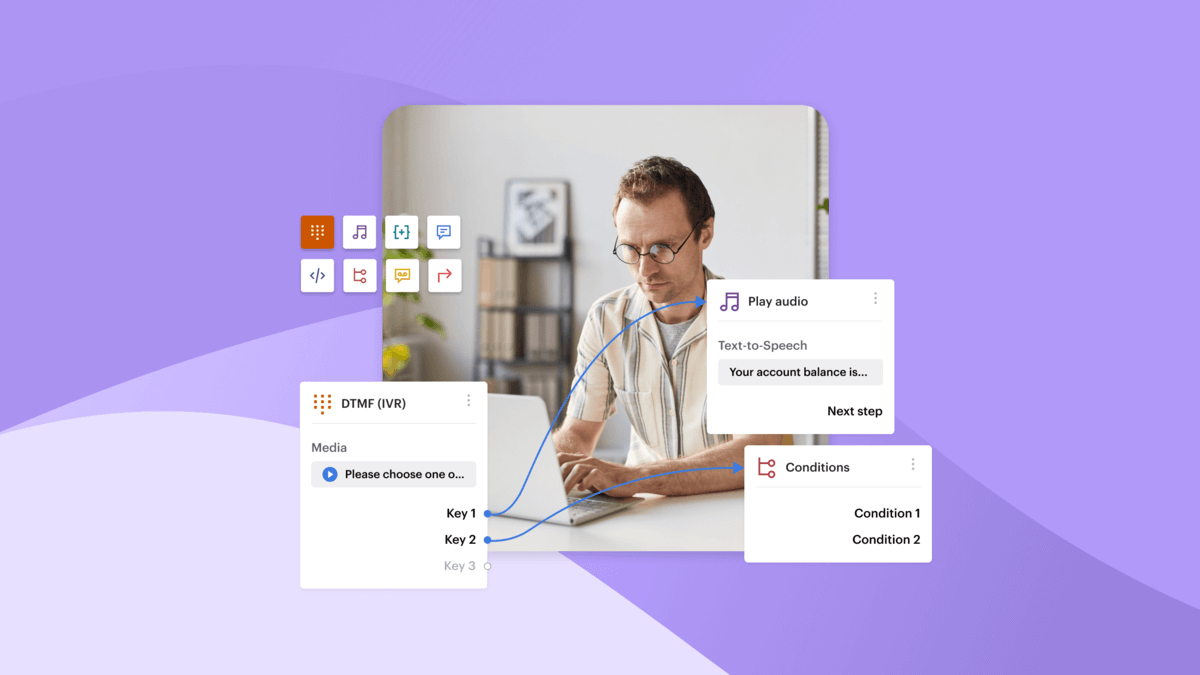
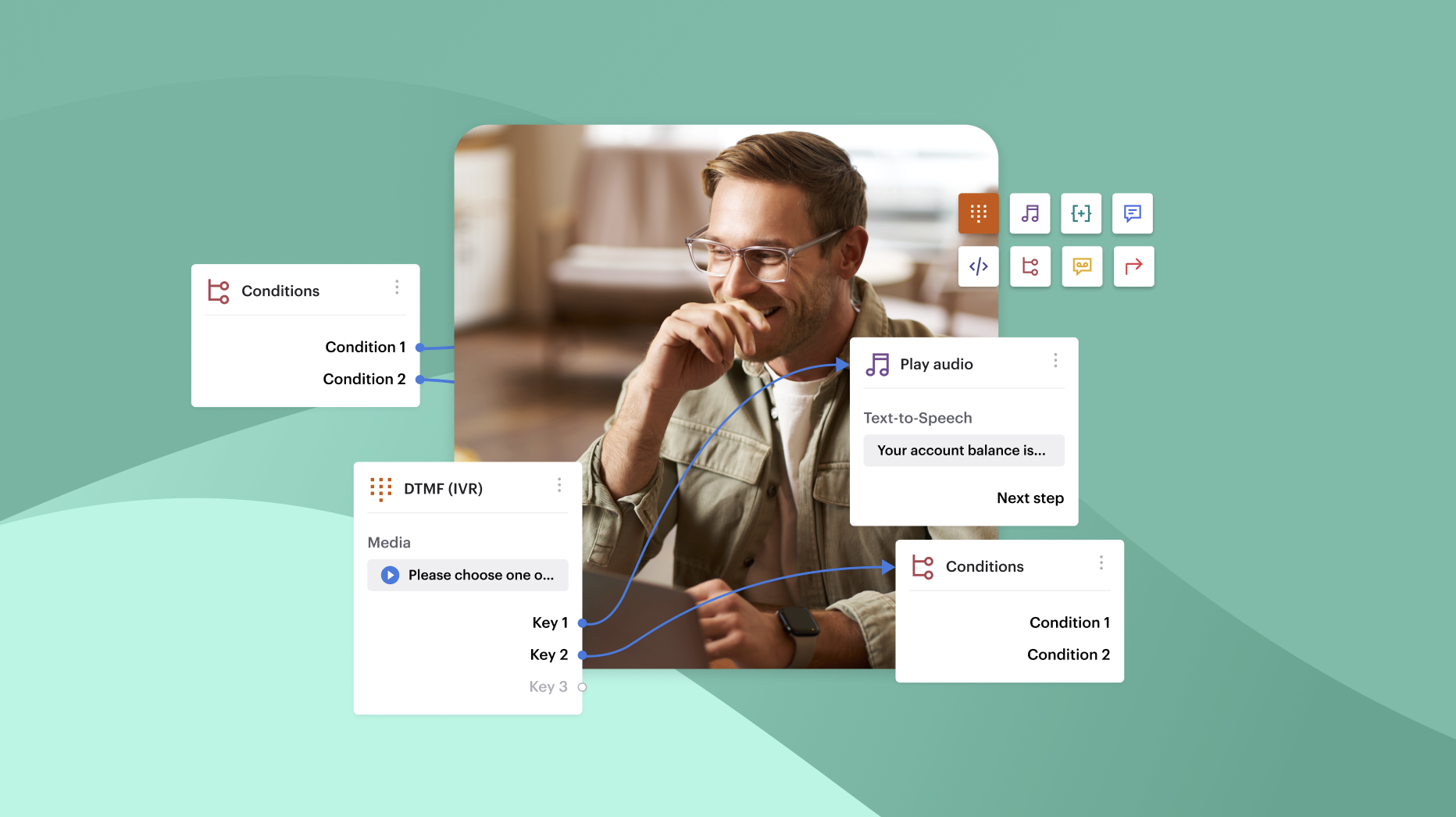
Voiso’s Flow Builder follows this approach. It uses predefined logic and a drag-and-drop interface to configure IVR paths and routing rules without code.
This makes iteration practical. This can reduce the need for engineering involvement in routine flow changes.
Creating feedback loops using call data
Most contact centers already collect the data needed to improve IVR. The challenge is using it consistently.
Call logs, recordings, and outcomes show where issues occur:
- High drop-off points in the IVR
- Repeated transfers between queues
- Calls that return for the same issue
These signals help identify where the flow needs adjustment.
Speech Analytics can support this process by organizing transcripts and highlighting recurring topics. Supervisors can review patterns and connect them to specific parts of the IVR.
The key is to close the loop. Insights should lead to small, regular updates in routing logic. Over time, this reduces friction and keeps the IVR aligned with real usage.
IVR metrics that actually matter (and how to use them)
Tracking IVR performance isn’t the challenge here. Most contact centers already have access to detailed call data.
The real issue is interpretation. Metrics are often reviewed in isolation, without connecting them to specific problems in the call flow.
To improve IVR, metrics need to answer one question: where are callers struggling, and why?
Identifying friction points through IVR drop-off patterns
Call abandonment is often treated as a general indicator. On its own, it doesn’t explain much.
The useful insight comes from where callers drop off.
For example:
- High abandonment at the first menu may indicate unclear options
- Drop-offs deeper in the flow may point to long paths or incorrect routing
- Repeated inputs can signal that options are confusing or poorly labeled
These patterns help pinpoint exact problem areas. Instead of redesigning the entire IVR, teams can focus on specific steps that cause friction.
Measuring self-service success beyond containment rate
Containment rate is widely used, but it can be misleading.
A contained call doesn’t always mean a resolved issue. If the caller needs to contact support again later, the problem remains.
A more useful approach is to look at outcomes:
- Whether the issue was resolved on the first attempt
- Whether the caller needed to follow up
- Whether the call moved efficiently to the right queue
This shifts the focus from reducing agent involvement to improving resolution quality.
Using conversation data to continuously refine IVR
Call data contains detailed information about customer needs, but it’s often underused in IVR design.
Transcripts and call summaries help identify recurring topics and common issues. This can help teams build a more informed view of why customers are calling.
Speech Analytics can organize this information by grouping keywords and surfacing patterns across calls. Supervisors can review these insights and connect them to specific routing decisions.
Where IVR is heading next (and what to implement now)
Instead of acting as a gatekeeper, IVR is becoming a coordination layer between channels, data, and routing logic. The focus is shifting toward reducing friction across the entire interaction, not just within the call itself.
For most teams, the priority is applying these new concepts in a controlled, practical way.
Conversational IVR and natural language input
More IVR systems now allow callers to speak instead of navigating menus.
This can reduce the number of steps in simple scenarios, especially when the caller’s request is easy to describe.
However, it’s important to stay realistic. Spoken input still needs to be mapped to predefined routing logic. Without clear structure behind it, it can introduce ambiguity instead of reducing it.
The most effective use cases are narrow and well-defined. For example, capturing a short reason for the call and mapping that input to predefined routing rules.
Predictable routing based on existing customer data
Routing rules can be made more context-aware when structured customer data is available, but not in a fully automated sense.
Most improvements come from using data that already exists:
- Previous interactions
- Account attributes
- Known customer status
This information can be referenced in routing rules to make better decisions earlier in the call.
The impact is practical. Possible outcomes include fewer transfers, shorter handling time, and less repeated information for the caller.
Extending IVR beyond voice with structured handoffs
IVR is increasingly used to guide customers toward the most appropriate channel, not just the right queue.
For example, a caller may start on voice but continue through messaging if the task involves links, documents, or follow-up steps.
This requires structured handoffs. The transition should be clear and relevant interaction context should be made available across the workflow where the system configuration supports it.
Platforms with a multi-channel workspace can make these interactions easier to manage operationally from one interface.
Keeping IVR logic maintainable as complexity grows
As IVR systems evolve, complexity increases. More conditions, more routing paths, and more exceptions.
Without structure, this leads to fragile flows that are difficult to manage.
The priority isn’t necessarily adding more logic, but keeping it organized:
- Clear routing rules
- Defined entry points
- Regular review cycles
Tools that allow teams to visualize and adjust flows help maintain this structure over time.
Explore how Voiso helps teams build, adjust, and manage routing logic with clarity.
FAQs
What is the ideal IVR structure for high call volumes?
There is no single structure that fits every contact center. The most effective IVR systems are built around the most common call reasons. High-volume requests should have the shortest paths, with minimal steps before routing. Instead of deep menu trees, use clear entry points and direct routing logic. It’s also important to review call patterns regularly and adjust flows as demand changes. A structure that works today may become inefficient as call drivers evolve.
How can IVR reduce call transfers between agents?
Transfers usually happen when calls are routed incorrectly at the start. Improving routing accuracy requires aligning IVR options with common customer call reasons. This can be done by analyzing call logs, transcripts, and outcomes to understand why customers call. Based on this data, routing rules can be refined to direct calls to the most appropriate queue. Reducing ambiguity in menu options and avoiding overly broad categories also helps minimize unnecessary transfers.
When should IVR route a call to a live agent?
IVR should route to a live agent when the issue is complex, sensitive, or unlikely to be resolved through predefined options. This includes cases where the caller needs clarification, has multiple requests, or doesn’t fit standard categories. It’s important to provide a clear path to an agent without forcing the caller through unnecessary steps. Over-reliance on automation can increase frustration and lead to repeat calls if issues remain unresolved.
How often should IVR flows be updated?
IVR flows should be reviewed regularly, not only when issues become obvious. Many teams assess performance monthly or quarterly, depending on call volume. However, smaller adjustments can be made more frequently based on clear signals such as drop-off rates, repeated transfers, or recurring call reasons. Continuous improvement is more effective than large, infrequent redesigns. Regular updates help keep the IVR aligned with current customer needs and operational priorities.
What data should be used to improve IVR performance?
The most useful data comes directly from customer interactions. This includes call logs, recordings, transcripts, and wrap-up codes. These sources reveal common call reasons, friction points, and routing issues. Over time, patterns emerge that can guide IVR adjustments. Tools that organize conversation data, such as keyword grouping or topic identification, can make this analysis more efficient. The goal is to base IVR decisions on actual usage rather than assumptions.