All Products




NLP in customer service is the use of natural language processing, the branch of AI that lets software understand and generate human language, to read, make sense of, and respond to what customers say and write. It powers the chatbot that answers a question, the routing that reads intent from a sentence, the sentiment score that flags a frustrated caller, and the transcript that turns a call into searchable text. In 2026, NLP sits behind most of the AI a contact center touches.
This guide explains what NLP is in a customer service context, how it works, the practical ways teams use it, and its limits. It draws on academic research where useful, and it keeps a clear line between what NLP does with conversations and the systems that own the customer record.
Key points at a glance
- NLP lets software understand and generate human language, turning conversations into data a contact center can act on.
- Common uses include chatbots, intent routing, sentiment analysis, transcription, summaries, and multilingual support.
- NLP works best on high-volume, well-defined language tasks, with people handling nuance and high-stakes cases.
- Automated agents built on NLP face transparency and data-protection rules that differ by market.
What is NLP in customer service?
NLP in customer service is the application of natural language processing to customer interactions, so that software can grasp meaning from speech and text and respond usefully. A survey of the field by Mashaabi and colleagues (2022) notes that NLP is increasingly used in customer service “to interact with users and answer their questions,” which captures the core idea: machines handling language that once needed a person.
NLP, conversational AI, and large language models
These terms overlap and get muddled. NLP is the broad discipline of processing language. Conversational AI is the application of NLP to hold back-and-forth dialogue, as in a chatbot or voice agent. Large language models are a newer, powerful engine that has pushed all of this forward. Voiso’s overview of conversational AI for call centers sits alongside this piece as the applied companion.
How does NLP work in customer service?
NLP works by breaking language into parts a machine can process: recognizing intent, extracting key details, reading sentiment, and generating a response. Several steps run together, often in under a second, to turn a customer’s words into an action.
| NLP task | What it does | Customer service use |
| Intent recognition | Identifies what the customer wants | Routing and chatbots |
| Entity extraction | Pulls out key details like dates and amounts | Acting on a request, filling data |
| Sentiment analysis | Reads emotional tone | Flagging frustrated or at-risk customers |
| Text classification | Sorts messages into categories | Tagging, triage, reporting |
| Language generation | Produces natural, human-like responses | Assistants, summaries, drafts |
| Machine translation | Converts between languages | Multilingual support |
Intent recognition
The first job is working out what the customer wants. This step maps a free-form sentence, “I was charged twice this month,” to a defined intent, a billing dispute, so the system can route or respond correctly. This is more flexible than a keyword match, because it reads meaning rather than exact words.
Entity extraction
Alongside intent, NLP pulls out the specifics: dates, amounts, order numbers, product names. Extracting these entities lets the system act on the request, not just categorize it, filling in the details an agent or downstream system needs.
Sentiment analysis
NLP can read the emotional tone of a message, flagging when a customer is frustrated or at risk of leaving. Feeding conversations into sentiment analysis lets a team spot trouble in the moment rather than in a survey days later.
Language generation
The newest layer generates a natural response rather than picking from fixed replies. This is what lets a modern assistant sound human, draft a summary, or suggest the next best action, and it is where large language models have changed the game.
Everything your team needs in one platform
Ways NLP is used in customer service
NLP shows up across the contact center, often invisibly. These are the uses that deliver the most value in practice.
- Chatbots and virtual assistants that understand free-form questions and answer or route them.
- Intent-based routing that sends a caller to the right place from what they say, not a menu choice.
- Sentiment analysis that flags frustrated or at-risk customers in real time.
- Call transcription that turns every conversation into searchable text.
- Automated summaries that write up a call so agents skip the manual notes.
- Multilingual support that understands and responds across languages.
- Knowledge search that finds the right answer from a large help base by meaning.
- Quality scoring that reviews conversations against a rubric at scale.
Voiso’s chatbot builder and call transcription put several of these to work within one platform.
Benefits of NLP in customer service
The gains cluster around speed, scale, and insight. Academic and industry work alike point to faster resolution and better efficiency when NLP is applied well.
- Faster responses, since routine questions get answered without a queue.
- Consistency, because analysis and scoring apply to every interaction, not a sample.
- Insight at scale, as transcription and analytics turn thousands of conversations into patterns.
- Round-the-clock coverage for basic queries, without staffing every hour.
- More agent time for complex work, as NLP absorbs the repetitive language tasks.
The research supports the direction: the same body of work on NLP in customer service associates it with quicker resolutions and improved efficiency for support teams, provided the technology is matched to the right tasks.
NLP and speech analytics
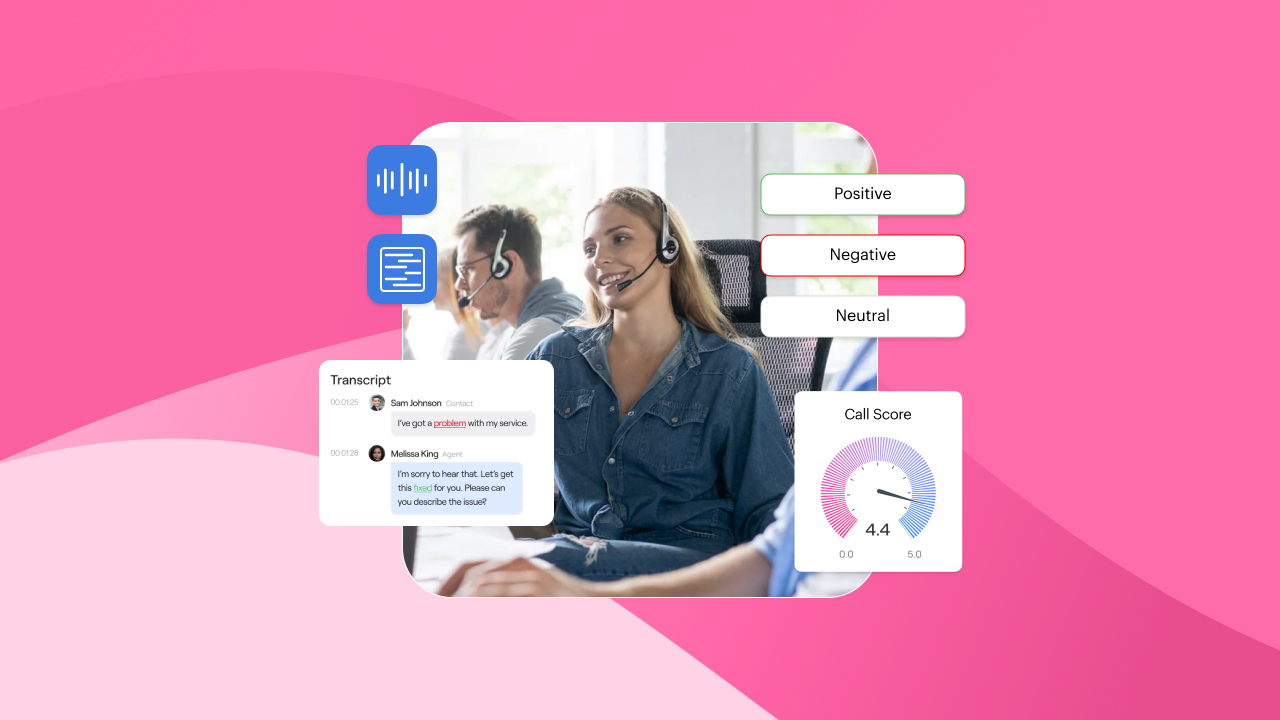
Speech analytics is one of the clearest applications of NLP in a contact center, and one of the most useful for managers. It transcribes calls, then applies NLP to score them, detect sentiment, and surface the conversations worth a human review.
Voiso’s AI speech analytics transcribes conversations in several languages, scores them automatically, and writes summaries, so a supervisor reviews evidence rather than a lucky sample of calls. Instead of listening to a handful by hand, a manager can see which topics drive frustration, where scripts break down, and which agents need coaching, all read from the language of the calls themselves.
Multilingual support with NLP
NLP makes it practical to serve customers in many languages without a native speaker for every one. It can detect a customer’s language, route to a suitable agent or bot, and, increasingly, translate or respond directly across languages.
For a business operating across markets, this matters. Voiso’s text-to-speech supports more than 20 languages, and its transcription covers several, so a caller in Lisbon and one in Riyadh can each be understood and served. Language should not be the barrier that decides who gets good service, and NLP is what removes it at scale.
NLP use cases across industries
The value of NLP changes with what a business does and which rules bind it, though the underlying techniques stay the same. A few sectors show the range.
In fintech and lending, NLP reads and routes account and payment queries, flags compliance-sensitive language for review, and keeps a searchable record of what was said, which matters when a dispute arises. In iGaming and other high-volume operations, it handles routine multilingual questions at scale across many markets. In healthcare and insurance, NLP can triage and route inquiries and draft summaries, while the sensitive record stays in the clinical or policy system rather than the conversation tool. In travel and retail, it absorbs seasonal spikes of routine questions about bookings and orders, freeing agents for exceptions.
Across all of them, the same pattern holds: NLP takes the high-volume language work, people take the nuance and the high-stakes cases, and the systems of record keep the sensitive data. Matching the technique to the task, rather than deploying NLP everywhere at once, is what separates a useful rollout from a frustrating one.
Limitations and challenges of NLP
NLP is powerful but not flawless, and going in aware of the limits prevents disappointment. A few deserve honest attention.
- Nuance is hard: sarcasm, idiom, and ambiguous phrasing still trip up even strong models.
- Accuracy depends on data, so a model trained on poor or narrow data gives poor results.
- High-stakes and emotional cases still need people, whatever the model can technically do.
- Errors carry risk, since a confident wrong answer can mislead a customer or break a rule.
The practical response is to point NLP at the tasks it handles well, keep humans on the rest, and monitor output rather than assuming it is right. Bias is another concern worth naming: a model trained mostly on one dialect or customer profile can serve others less well, which shows up as worse accuracy for some accents or languages. Testing across the actual range of your customers, not just the majority, is how you catch that before it quietly degrades service for part of your base.
NLP compliance and data considerations
NLP touches customer conversations, which are personal data, so it sits squarely inside data-protection and AI-transparency rules that differ by market. Two duties recur: telling people when they are dealing with a machine, and handling the conversation data lawfully.
In the European Union, the EU AI Act requires that people be told when they are interacting with an AI system, with transparency duties effective from August 2026, alongside GDPR obligations for the underlying data. Operators in other markets should expect similar disclosure and data rules, whether or not they exist yet. Recording and analyzing conversations also brings consent duties that vary by jurisdiction. Voiso sets out its certifications and data handling on its Trust and Compliance Center, and the responsibility for meeting local rules sits with the business running the system.
The future of NLP in customer service
NLP in customer service is moving fast, and the direction is clear even if the pace surprises people. Large language models have already made assistants sound far more natural and capable than the rigid bots of a few years ago, and that trend continues.
Three changes stand out. Generation is improving, so automated responses read less like a script and more like a helpful colleague. Reasoning is improving, so systems handle multi-step requests that once needed a person. Oversight is tightening, as regulators respond to more capable automated agents with clearer transparency rules. The likely result is not the disappearance of human agents but a steady move of routine language work to machines, leaving people the complex, emotional, and high-value conversations. Teams that build the habit of measuring NLP output honestly, and keeping humans on the right cases, will get the most from whatever the technology does next.
What to look for in NLP customer service tools
Not all NLP is equal, and the label alone tells you little. A few questions separate genuinely useful tools from demos that impress but disappoint in production.
- Language coverage: does it handle the specific languages your markets need, and how accurate is it in each rather than in English alone?
- Accuracy on your data: strong performance on a vendor demo means little; test it on your own calls and messages.
- Real-time capability: can it transcribe, route, and flag sentiment live, or only after the fact?
- Integration: does it pass what it learns to your CRM and systems of record, or trap it in a separate tool?
- Governance: does it support disclosure, consent, and the data-handling rules of the markets you serve?
- Human handoff: does it recognize its limits and pass to a person cleanly, with context attached?
The honest test is to run a pilot on your own conversations, in your own languages, and measure both accuracy and customer reaction before scaling. A tool that shines in a scripted demo can stumble on the messy, accented, interrupted speech of real calls, so the proof is always in your own data rather than the sales deck.
How to get started with NLP in customer service
Adopting NLP works best in stages, starting where the value is clear and the risk is low. A measured rollout builds trust and avoids the disappointment of over-promising.
- Start with analysis. Use NLP to transcribe and analyze existing calls before it touches a live customer, which is low-risk and immediately useful.
- Add agent assist. Give agents real-time suggestions, summaries, and sentiment cues while a person still leads.
- Automate the clearest tasks. Hand a well-defined intent to a chatbot or voice agent, and measure resolution honestly.
- Build in disclosure and consent. Match transparency and data rules to every market you serve.
- Review and expand. Track accuracy and satisfaction, then widen the scope where results hold.
The reason to start with analysis rather than a customer-facing bot is risk. Transcribing and scoring your own calls carries almost none, and it teaches you where NLP is already accurate on your data before you let it speak to anyone. Many teams find the analysis stage alone pays for itself, surfacing coaching gaps and recurring issues that no one had time to spot by hand. Only once you trust the technology on your own conversations does it make sense to hand it a live interaction, and even then the first candidates should be your highest-volume, lowest-complexity requests, where a mistake is cheap and the volume makes the saving real.
How Voiso uses NLP in the contact center
Voiso applies NLP across the conversation rather than as a single feature. Its speech analytics transcribes and scores calls, its flow builder powers chatbots and intent-based routing, and its text-to-speech and transcription work across languages, so the platform reads and responds to customer language throughout an interaction.
Because Voiso is the communication layer, the insight NLP produces, transcripts, sentiment, summaries, flows to the CRM and systems that own the customer record, rather than sitting in a separate tool. Its AI voice agents use the same language understanding to handle defined conversations and hand off to people when needed. The result is NLP put to practical work, measured honestly, with humans kept on the cases that need them.
Frequently asked questions
What does NLP stand for in customer service?
NLP stands for natural language processing, the branch of artificial intelligence that enables software to understand, process, and generate human language. In customer service, it is the technology behind chatbots, intent-based routing, sentiment analysis, call transcription, and automated summaries. Rather than matching exact keywords, NLP reads the meaning of what a customer says or writes, which lets it handle free-form language. It is the foundation for most AI a contact center uses, from a simple FAQ bot to a full voice agent that holds a conversation.
What is an example of NLP in customer service?
A clear example is a chatbot that reads “I was charged twice this month,” recognizes it as a billing dispute, extracts the amount and date, and either resolves it or routes the customer to the right team. Other examples include sentiment analysis that flags a frustrated caller in real time, transcription that turns a call into searchable text, and automated summaries that write up an interaction. Each takes free-form human language and turns it into something the contact center can act on quickly.
Is ChatGPT an example of NLP?
Yes, ChatGPT is built on natural language processing, specifically on large language models, which are an advanced form of NLP that generate human-like text. In customer service, the same underlying technology powers assistants that understand free-form questions and draft natural responses, rather than picking from fixed replies. That said, NLP is broader than any single tool: it also covers intent recognition, entity extraction, and sentiment analysis, which work behind the scenes in routing and analytics as well as in conversational assistants.
Does NLP improve customer satisfaction?
NLP can improve customer satisfaction when applied to the right tasks, mainly by speeding up responses and freeing agents for complex work. Research on NLP in customer service associates it with faster resolution times and greater efficiency for support teams. The benefit is conditional, though: NLP pointed at nuanced or emotional cases it cannot handle well can frustrate customers instead. The strongest results come from using it for high-volume, well-defined language tasks while keeping people on the interactions that need judgment and empathy.
What languages can NLP handle in customer service?
Modern NLP can handle many languages, though quality varies by how much data a model has for each. In a contact center, this supports detecting a customer’s language, routing accordingly, transcribing across languages, and generating responses in several. Voiso’s text-to-speech works in more than 20 languages and its transcription covers several, which lets a business serve markets without a native speaker for every one. For less common languages, accuracy can be lower, so it is worth testing performance for the specific markets you operate in.
Put customer language to work
NLP turns the words customers use into something your team can act on: the intent behind a call, the sentiment in a message, the summary of an interaction. Voiso builds that capability into one cloud platform, from speech analytics and transcription to chatbots and multilingual support, then feeds the insight to the systems that own the relationship, so nothing useful stays trapped in a separate tool. To see how NLP fits your own contact center and your markets, book a demo with the Voiso team, or start a free trial and run it against your own conversations.