All Products

.svg)






Customer service scripts are pre-written guides that help agents open a call, work through a problem, and close it well, without missing a step or a required disclosure. Used lightly, they give a new agent confidence and keep a whole team consistent. Used badly, they turn a person into a robot reading from a card. This guide sits on the useful side of that line, with example dialogues for the calls that come up every day.
The scenarios below travel well across markets. A refund conversation in Sydney follows the same shape as one in Toronto, even though the recording disclosure and the consumer law behind it differ. Treat the wording as a starting point, adapt it to your brand voice, and let agents depart from it when a customer needs something the script did not predict.
Key points at a glance
- Scripts work best as flexible frameworks that carry the required phrases and disclosures, not word-for-word lines read aloud.
- The four stages of a strong call are the opening, discovery, resolution, and close.
- Recording disclosure and consent rules change by country and, in the United States, by state, so scripts need a local check.
- Software that puts scripts on screen and scores calls keeps a team consistent without making agents sound scripted.
What is a customer service call script?
A customer service call script is a structured outline of what an agent might say during a call, covering the greeting, the questions that uncover the issue, the resolution, and the close. It is a map, not a cage. The best scripts leave room for the agent to listen and respond as a human being rather than recite lines in order.
A script is a guide, not a word-for-word rule
Rigid, read-aloud scripts are easy to spot and quick to annoy. A flexible framework gives agents the key phrases and the required steps, then trusts them to fill the gaps in their own words. Voiso’s take on agent scripting for efficiency makes the case that structure and natural conversation can coexist.
When scripts help most
Scripts earn their keep in three places: onboarding new hires, handling sensitive or regulated calls where wording matters, and steadying tricky moments like an angry caller or a refund refusal. For routine chats with an experienced agent, a light checklist often beats a full script.
How to use these scripts without sounding robotic
The trick is to treat the script as scaffolding you remove once the building stands. Read the intent behind each line, not the words, and say it the way you would to a person in front of you. Three habits keep it human.
Personalize every interaction
Use the customer’s name, refer back to what they said, and drop any phrase that sounds like a form letter. A small nod to their specific situation signals that a person, not a machine, is on the line.
Listen more than you talk
A script can tempt an agent to steer toward the next line instead of hearing the customer out. Pause. Let them finish. Reflect back what you heard before moving on. Active listening turns a scripted call into a real conversation.
Match tone to the moment
A cheerful opener suits a product question and grates on a billing complaint. Read the customer’s mood in their first sentence and adjust. Warmth for the worried, brevity for the busy, patience for the confused.
The anatomy of a strong customer service phone call
Most good calls share four stages: a warm opening, a discovery phase, a clear resolution, and a clean close. Knowing the shape lets an agent move through a call with purpose, even when the topic is new.
The opening
The first ten seconds set the tone. Greet the caller, give your name and company, and signal that you are ready to help. If the call is recorded, this is where the disclosure belongs.
Discovery
Ask open questions, then narrow. Confirm your understanding before you act, so you solve the real problem rather than the one you assumed. A single clarifying question here saves a callback later.
Resolution and close
State what you will do, do it or set the expectation for what happens next, then summarize and check the customer is satisfied. A tidy close, with a clear next step, is what people remember.
Everything your team needs in one platform
Opening and greeting scripts
A strong greeting is warm, brief, and clear about who the customer reached. It should confirm the company, the agent, and a willingness to help, and it should handle the recording disclosure where local rules call for one. Voiso keeps a fuller set of business phone greetings for teams building a house style.
Agent: “Thank you for calling Northwind Support, this is Maya. This call may be recorded for quality and training. How can I help you today?”
Customer: “Hi, I’m having trouble logging into my account.”
Agent: “I’m sorry to hear that, and I can help you get back in. May I start with your name and the email on the account?”
For a returning customer whose details are already on screen, the opener can shorten:
Agent: “Hello Mr. Okafor, thanks for calling back, this is Daniel. I can see your case from Tuesday here in front of me. Shall we pick up where we left off?”
New customer and product question scripts
For a first-time caller weighing a purchase, the goal is to answer clearly and build trust, not to push. Lead with the answer, add one relevant benefit, and offer a next step the customer controls. Curiosity, not pressure, moves these calls forward.
Customer: “I’m thinking about your Pro plan but I’m not sure it fits a small team.”
Agent: “Happy to help you work that out. Roughly how many people would use it, and what’s the main task you’d want it for? … For a team that size, the Pro plan covers what you described, and you can add seats one at a time as you grow. Would it help if I walked you through a short demo, or sent a summary you can share with your colleagues?”
When the honest answer is that the product may not suit them, saying so builds more trust than a sale would:
Agent: “Based on what you’ve told me, our Starter plan would cover you for now, and you can move up later if the volume grows. There’s no need to pay for Pro yet.”
Scripts for handling an angry or frustrated customer
With an upset caller, acknowledge the feeling first and solve the problem second. Skipping straight to logistics reads as cold and usually makes things worse. The pattern that works is simple: listen, empathize, take ownership, then act. For deeper technique, Voiso covers de-escalation for customer service in its own guide.
Customer: “This is the third time I’ve called about the same charge. Nobody has fixed it.”
Agent: “I understand why you’re frustrated, and I’m sorry you’ve had to call back this many times. Let me take ownership of this now so it ends here. Can you confirm the charge amount and the date you first saw it?”
Customer: “It was 49 dollars on the second.”
Agent: “Thank you. I can see it, and I agree it should not be there. I’m reversing it now and adding a note so no one asks you to explain this again. You’ll see the refund within a few business days. Is there anything else I can put right while we’re on the call?”
What to avoid with an angry caller
Do not argue, do not blame another department, and do not promise what you cannot deliver. If policy blocks the outcome the customer wants, say so plainly and offer the nearest alternative. Voiso’s guide to conflict resolution in customer service goes further on holding the line with grace.
Refund, return, and billing dispute scripts
For money conversations, be clear, be quick, and confirm every number out loud. Ambiguity about amounts or timing is what turns a simple refund into a complaint. State the outcome, the amount, and the timeline in one breath.
Customer: “I want a refund for the plan I never used.”
Agent: “I can look into that for you. May I confirm the plan and the billing date? … Thank you. I can see the charge from the fifteenth. I’ll process a full refund of 120 dollars to the card ending 4471, and you’ll see it in three to five business days. I’m sending a confirmation email now. Does that work for you?”
When a refund cannot be granted, the honest version still respects the customer:
Agent: “I’ve checked, and this purchase falls outside our refund window, so I’m not able to reverse it in full. What I can do is offer a credit toward your next month. Would that help?”
Order status and delivery scripts
Status calls are quick wins when handled well. Give the customer the concrete fact they want, a date or a location, then set the expectation for what happens next. Vagueness is the only way to lose one of these.
Customer: “Where is my order? It was supposed to arrive yesterday.”
Agent: “I’m sorry it’s running late, let me find it right now. May I have your order number? … Thank you. I can see it’s with the courier and out for delivery today before 6pm. I’ll send you the live tracking link by text now so you can watch it in real time. If it doesn’t arrive today, call us back and I’ll arrange a replacement straight away.”
Technical support and troubleshooting scripts
Good technical calls pair plain language with patience. Name each step, check the result before moving on, and never make the customer feel foolish for not knowing. Confirm the problem is solved before you close.
Customer: “The app keeps crashing when I open my messages.”
Agent: “Let’s fix that together. First, could you tell me which phone and which app version you’re on? … Great. Let’s try closing the app fully and reopening it. Tell me what you see when it loads.”
Customer: “Okay, it opened this time.”
Agent: “Good sign. To stop it happening again, let’s update to the latest version while we’re here. I’ll stay on the line. Once it’s done, open your messages so we can confirm it holds.”
Placing a customer on hold and warm transfer scripts
Ask permission before a hold, give a reason, and thank the customer when you return. For a transfer, brief the next agent so the customer never repeats themselves. A warm transfer done well is nearly invisible to the caller.
Agent: “To sort this properly, I need to check one thing with our billing team. May I place you on a brief hold, no longer than two minutes?”
Customer: “Sure.”
Agent: “Thank you for holding. I’ve spoken with billing and confirmed the adjustment. Here is what happens next.”
For the transfer itself:
Agent: “I’m going to connect you with Priya in technical support, who handles this directly. I’ve explained your issue and shared your case number, so you won’t need to start over. Please stay on the line while I introduce you.”
Escalation scripts
Escalate when the issue sits beyond your authority or the customer asks for a manager, and do it without sounding defensive. Frame the handover as getting the customer to the right person, not passing the problem along. Voiso outlines when and how in its piece on contact center escalation.
Customer: “I’d like to speak to a supervisor.”
Agent: “Of course. I want to make sure the right person helps you. So I can brief my supervisor fully, may I confirm what outcome you’re hoping for? … Thank you. I’m connecting you with Sofia, my team lead, and I’ve passed her the details. She’ll be with you shortly.”
Follow-up and callback scripts
A follow-up call shows the customer the matter did not end when they hung up. Reference the earlier contact, confirm the fix held, and ask whether anything is outstanding. Keep it short unless the customer wants to talk.
Agent: “Hello Ms. Alvarez, this is Tom from Northwind. I’m calling to check that the refund we discussed on Monday reached your account. Did it come through as expected?”
Customer: “Yes, it did, thank you.”
Agent: “That’s what I wanted to hear. I’ll close the case now. If anything else comes up, you can reach us any time, and there’s nothing further you need to do.”
Closing the call scripts
A good close confirms the outcome, checks for anything else, and thanks the customer by name. It leaves them clear on what happens next and who to contact if the issue returns.
Agent: “So to confirm, I’ve reset your password and emailed the steps to secure your account. Is there anything else I can help with today? … Thank you for calling, Mr. Okafor. Have a good afternoon.”
Cancellation and retention scripts
When a customer wants to cancel, resist the urge to fight it. Ask why, listen, and offer a genuine fix only if one exists. A respectful cancellation keeps the door open; a pushy save closes it for good.
Customer: “I want to cancel my subscription.”
Agent: “I can take care of that for you. So I can make sure I’m not missing anything, may I ask what prompted the decision? … Thanks for telling me. It sounds like the plan was more than you needed. I can switch you to a smaller plan that costs less, or cancel outright, whichever suits you. Which would you prefer?”
When to stop offering and simply help
If the customer says no twice, honor it. Confirm the cancellation, tell them exactly when access ends and whether a final charge applies, and thank them. A clean exit is worth more than a reluctant save, because people remember how you treated them on the way out.
Payment reminder and collections scripts
Calls about overdue payments carry the heaviest compliance load of any on this list, and the rules differ sharply by market. Keep the tone respectful, confirm you are speaking to the right person, and follow the local rulebook on timing, frequency, and what you may say.
Agent: “Hello, may I speak with Ms. Grant? … Hello Ms. Grant, this is Leah from Northwind’s accounts team, on a recorded line. I’m calling about the balance on your account, and I’d like to help you settle it in a way that works for you. Is now a good time?”
Customer: “I can’t pay the full amount right now.”
Agent: “That’s alright, thank you for telling me. We can set up a short plan to spread it out. Would a first smaller payment this week and the rest next month work for you?”
Collections compliance by market
Collections scripts must respect the market’s rules on who may be contacted, when, and how often. In the United States those calls fall under federal and state debt-collection and calling rules; in the United Kingdom, FCA expectations on treating customers fairly apply where the debt is regulated. Confirm the current rules for each country before a campaign goes live.
Compliance: what your phone scripts must include by market
Phone scripts are not only a service tool; in many places they carry legal duties, and those duties change by country. The clearest example is the recording disclosure. Where and how you announce that a call is recorded depends on where the customer sits, so a single global line will not always cover you.
In the United States, recording consent is set at state level. Some states accept one-party consent, while others require every party to agree, so a disclosure at the top of the call is the safe default. Outbound teams also screen against the FTC National Do Not Call Registry.
In the United Kingdom and the European Union, recording brings data protection duties under the UK GDPR and the GDPR, including a clear purpose and a retention limit, overseen by bodies such as the UK’s Information Commissioner’s Office.
In Australia, recording and telemarketing rules sit under federal law, and permitted calling windows are defined by the industry standard.
Voiso sets out its own certifications and data handling on its Trust and Compliance Center, and regulated industries complete a country-by-country compliance step before going live. The platform records and routes the conversation; the obligation to disclose and to hold data correctly stays with the operator running the campaign.
How to build and improve your own scripts
The examples here are a starting point; the strongest scripts are the ones a team refines from its own calls. A short, repeatable process keeps them sharp.
Start from real recordings. Pull a handful of calls that went well and a handful that went badly, and note the exact phrases that helped or hurt.
Write the framework, not the monologue. Capture the opening, the discovery questions, the resolution line, and the close, plus any legal disclosure. Leave the connective tissue to the agent.
Test with the people who use it. Ask agents where the wording feels unnatural, then fix those lines first, because those are the ones that get abandoned mid-call.
Add the required disclosures per market. Confirm recording and consent language for each country before the script ships.
Review on a schedule. Revisit scripts each quarter, or sooner when a product or policy changes, so they never drift from reality.
Done this way, a script library grows into a living asset rather than a document nobody opens. Agents trust it because it reflects the calls they actually take.
How Voiso helps teams deliver consistent calls
Voiso turns scripts from a document into part of the live call. Agents see the right prompts at the right moment, and managers can check that the important lines actually get said. It removes the gap between the script on paper and the words on the call.
Scripts on screen during the call
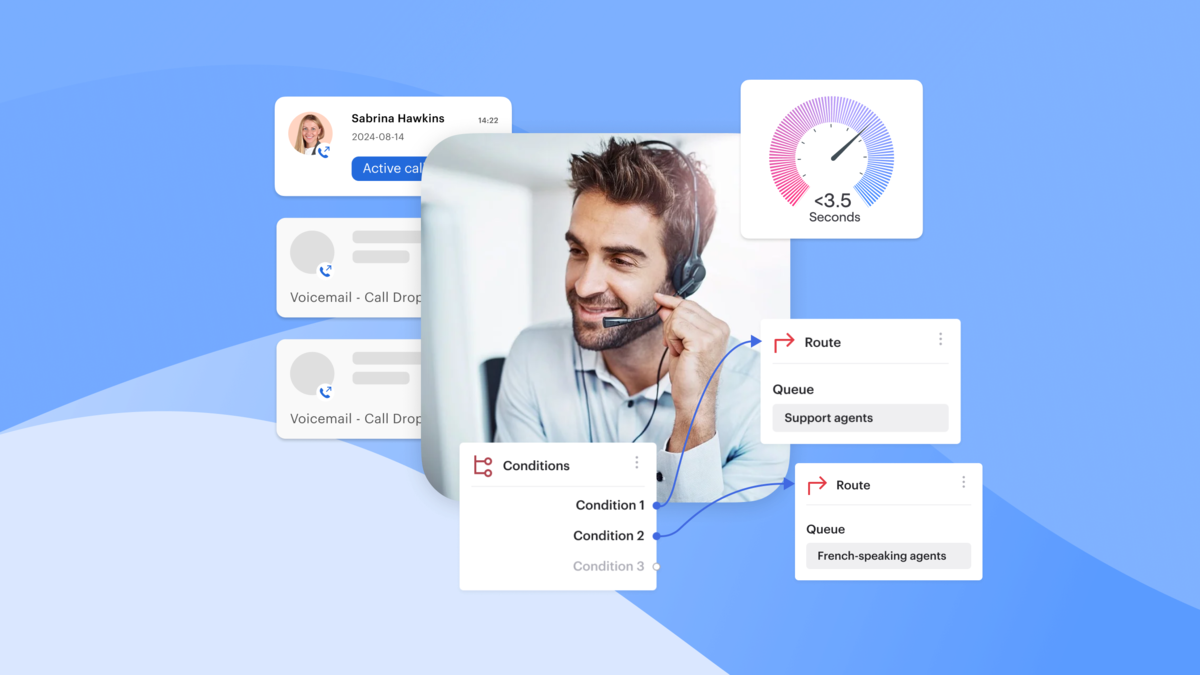
With call center scripting software, the relevant script appears in the agent panel as the call connects, matched to the campaign or queue. New agents lean on it heavily; experienced ones glance and move on. Either way, the required disclosures are never left to memory.
Checking that scripts work
AI speech analytics transcribes and scores calls, so a manager can see whether agents follow the framework and where customers push back. If a refund line consistently sparks frustration, the script gets rewritten from evidence rather than guesswork.
Consistency across channels
Customers switch from a call to chat mid-issue, and the wording should hold. An omnichannel setup lets the same phrasing carry across voice, chat, and messaging, so the brand sounds like itself wherever the conversation lands.
Frequently asked questions
What are some good scripts for customer service?
Good customer service scripts cover the calls a team handles daily: greetings, angry or frustrated customers, refunds and billing, technical troubleshooting, holds and transfers, escalations, and closings. Each should open by acknowledging the customer, move through discovery before action, and end with a clear next step. The strongest scripts read as flexible frameworks rather than word-for-word lines, giving agents the required phrases and disclosures while leaving room to sound like themselves on the call.
What are some good phrases to use in customer service?
Reliable phrases include “I understand why you’re frustrated, and I’m sorry,” “let’s get that sorted for you,” “I’m taking ownership of this now,” and “is there anything else I can help with today?” These work because they acknowledge feeling, signal ownership, and check for unfinished business. Pair them with the customer’s name and a reference to their specific situation, and avoid anything that sounds like a form letter, which is what makes scripted phrases feel cold.
How do you handle an angry customer on the phone?
Acknowledge the emotion first, then solve the problem. Let the customer finish without interruption, say plainly that you understand and are sorry, and take visible ownership rather than blaming another team. Confirm the facts, state exactly what you will do and by when, and check for anything else before closing. If policy prevents the outcome they want, say so honestly and offer the nearest alternative. De-escalation rests on the customer feeling heard before they feel processed.
Should customer service calls be recorded, and do you need consent?
Recording is common for quality and training, but consent rules vary by country and, in the United States, by state. Some US states require all parties to agree, while others accept one-party consent, so announcing the recording at the start of the call is the safe approach. In the UK and EU, recording carries GDPR duties around purpose and retention. The obligation to disclose sits with the business running the call, not the software vendor.
How long should a customer service script be?
A phone script should be long enough to cover the required steps and short enough that an agent can hold it in their head. In practice that means a compact framework: an opening, two or three discovery questions, a resolution line, and a close, plus any legal disclosure. Anything longer tends to be read aloud, which customers notice. Detailed branches for rare situations belong in a knowledge base the agent can reach mid-call, not in the core script.
What are the five C’s of customer service?
The five C’s are commonly listed as clear communication, consistency, convenience, customization, and care. Together they describe what customers notice across every interaction: an answer they understand, the same treatment whatever the channel, low effort to reach help, a response fitted to their situation, and a sense that someone genuinely cares. Scripts support the five C’s when they standardize the clear, consistent parts while leaving room for the customization and care that only a listening agent can add.
What is the first rule of customer service?
The first rule of customer service is to be customer-focused, which starts with greeting and acknowledging the person promptly and giving them your full attention. Everything else, from problem-solving to product knowledge, rests on that foundation. On the phone it means opening warmly, listening before you act, and treating the caller as a person with a problem rather than a ticket to close. Scripts help only when they reinforce that focus instead of replacing it.
Give your agents scripts that actually help on the call
Great phone conversations come from agents who feel supported, not scripted into a corner. Voiso puts the right prompts on screen as each call connects, checks that the important lines land through speech analytics, and keeps the wording consistent across voice and chat. If you want your team reading from one confident playbook across every market, book a demo with the Voiso team, or start a free trial to test the scripting tools against your own calls.