

That’s the gap. And it’s where most phone systems disappoint.
What used to be a simple “press 1 for sales” menu has turned into something more ambitious. Better platforms use predefined routing logic, caller inputs, and connected-system data to direct interactions and log activity in CRM or helpdesk tools. On the surface, the difference is subtle. Operationally, it matters.
If you’re handling inbound support, outbound sales, or both, the question isn’t whether to automate. It’s how to pick a system that improves performance instead of just cutting manual work.
This guide focuses on that. Not feature lists, but what actually matters when you’re comparing systems: how they handle real calls, what they cost once you’re using them, and where they start holding you back.
What businesses get wrong when choosing a phone system
Treating IVR as the finish line
A lot of businesses still treat automation as a routing problem. Set up an IVR, add some menu options, done.
That worked when expectations were lower. Now it creates friction.
Static menus force callers to adapt to the system. The result: longer navigation, higher drop-off, unnecessary transfers. What looks like automation on paper often feels like a bad experience on the phone.
IVR is a starting point. The real gains come from systems that let teams build conditional call flows based on caller input, queue logic, and structured data from connected systems.
Obsessing over routing, ignoring outcomes
Getting calls to an agent fast doesn’t mean they’re handled well.
Most systems optimize for speed: how quickly a call reaches someone. But that misses what actually matters. Did the issue get resolved? Did the sale happen? Did the customer hang up frustrated?
Basic automation has no visibility into conversation quality, customer sentiment, or resolution rates. Better systems treat each call as data and use it to improve what happens next, not just where the call lands.
Underestimating how hard integrations are
Automation doesn’t work in a vacuum. It needs data from your CRM, helpdesk, and other tools.
In practice, these systems are often loosely connected or not connected at all. Agents flip between tabs, log data by hand, and the “automation” ends up fragmented.
The problem goes beyond inefficiency. Without synced data, routing decisions lack context, customer history has gaps, and reporting falls apart. Even sophisticated features won’t deliver much if the plumbing isn’t right.
What a good automated phone system actually does
Intelligent routing
Basic routing follows fixed rules. It works when things are predictable.
Better systems route calls based on context: who the customer is, which agents are available and what they’re good at, language preferences, and what the queue looks like right now. This cuts unnecessary transfers and gets callers to someone who can actually help, not just whoever’s next in line.
Conversational IVR
Traditional IVR uses keypad input, which limits how people can interact and shoves them into rigid paths.
Conversational IVR lets callers speak normally. The system routes callers based on the inputs and conditions configured by the team. In practice, this means fewer menu layers, faster navigation, and fewer people hanging up mid-call. It also handles more complex requests without escalating everything to a person.
Automation before, during, and after the call
Most systems only care about what happens when a call starts. The better ones cover the full cycle.
Before: identify the caller, prioritize routing, pull up relevant data. During: capture inputs and support the configured call flow. After: log the interaction, generate a summary, update the CRM.
This keeps data consistent and makes reporting actually reliable.
Analytics that explain performance, not just count calls
Call volume and duration are easy to measure but don’t tell you much.
More useful systems track conversation outcomes, sentiment, talk-to-listen ratios, and resolution rates. These turn calls into usable data so teams can spot patterns and adjust workflows based on what’s actually happening, not gut feel.
Over time, this is the difference between automation that saves time and automation that improves results.
Types of automated phone systems (and where they break down)
Traditional IVR
Predefined menus, keypad inputs. Still everywhere because they’re simple and handle basic queries fine.
They work when call reasons are predictable, options are few, and customers already know what they want. The trouble starts when interactions get more varied. Callers get stuck, pick wrong options, or just hang up. As complexity increases, traditional IVR creates more friction than it removes.
Auto-attendants
These answer calls and route them to the right department. Think of them as a digital front desk.
Good for small teams, simple call flows, and businesses that want a professional first impression. But that’s about all they do. No intent recognition, no adaptability, no learning. They hit their ceiling fast as volumes grow or workflows get more complicated.
AI-powered voice systems
These use natural language processing and intent recognition. Callers describe what they need instead of pressing buttons.
They use predefined branching logic and collected inputs to route calls through configured paths with less manual intervention. Especially useful when call reasons vary widely or speed is a priority.
The catch, of course, is the implementation. Without proper training data, good integrations, and someone keeping an eye on things, even advanced AI systems produce inconsistent results.
Cloud contact center platforms
These bundle routing, automation, analytics, and integrations into one system. Built for teams doing both inbound and outbound at scale.
Best for high-volume support teams, outbound sales operations, and multi-region businesses. The upside is consolidation: one environment instead of a patchwork of tools. The downside is complexity. Without solid setup and ongoing tuning, teams end up paying for capabilities they never actually use.
How to choose based on your situation
High-volume support
You need more than routing. The priority is holding service levels without burning out agents.
Look for dynamic queue management, skill-based routing, and real-time visibility into wait times. Self-service options should deflect simple questions so agents handle the harder stuff. Without that balance, scaling support just means hiring more people.
Sales and outbound
Different game entirely. Speed, connection rates, and timing directly affect revenue.
The system needs automated dialing (predictive or power), lead prioritization, and minimal dead time between calls. It’s about maximizing productive talk time. A system that handles inbound well but neglects outbound efficiency will cap your growth.
Multi-region operations
Language, time zones, and local presence all complicate things.
You need local caller IDs and numbers, multi-language routing, and infrastructure distributed enough to maintain call quality everywhere. Without these, the experience varies wildly by region.
Small teams growing fast
The priority is speed: fast deployment, easy setup, minimal overhead.
No-code or low-code configuration, quick onboarding, and simple integrations with whatever tools you already use. Systems that need heavy configuration or dedicated technical support will slow you down. At this stage, flexibility beats feature depth.
What you’ll actually pay
Pricing models
There are three common approaches:
- Per-user: fixed monthly fee per agent. Predictable, but gets expensive as you grow.
- Usage-based: charges by the minute, call, or action. Flexible, but costs spike with high volumes.
- Hybrid: base subscription plus usage. Common on platforms that handle both inbound and outbound.
Cost vs. capability
Cheaper systems cover routing and simple automation but skip advanced analytics and AI features. Pricier systems offer better call handling, higher resolution rates, and less manual work. The difference shows up in outcomes, not just features. A cheap system might save money upfront and cost more in wasted time later.
Typical ranges
| Segment | Typical pricing | What you get |
| Small teams | $15-$30/user/month | Basic IVR, routing, limited integrations |
| Mid-sized | $30-$80/user/month | Better routing, analytics, CRM integrations |
| Advanced | Custom | AI automation, predictive dialing, full analytics |
Factor in the stuff that’s not in the headline price: international calling rates, integration setup, premium support, and extra channels like SMS or WhatsApp. The sticker price rarely matches what you’ll actually spend.
Automated phone systems compared by use case
The right system depends on your workflow, not feature counts.
| Provider | Best for | Strength | Weakness | Pricing |
| Voiso | SMEs, outbound teams, contact centers | Strong inbound/outbound automation, AI analytics, predictive dialing | Takes setup to get the most from advanced features | Custom |
| Dialpad | Remote/distributed teams | Built-in voice intelligence, easy deployment | Limited for complex outbound | From ~$23/user/month |
| RingCentral | Enterprise comms | Reliable UCaaS, broad integrations | Costs add up with add-ons | From ~$30/user/month |
| 8×8 | Global teams | Strong international calling infrastructure | Interface and setup feel complex | From ~$24/user/month |
| Smith.ai | Small businesses | Live receptionist + automation | Expensive at scale, less automation control | From ~$285/month |
| Lindy.ai | Mid-sized teams exploring AI | Conversational AI, smart routing | Still maturing, less proven at scale | Custom |
| GetBreezy | Startups | AI chat + calling workflows | Limited telephony features | Custom |
There’s no universal winner. It comes down to call complexity, how deep the automation goes, integration flexibility, and how well the system holds up as you grow. A five-person team and a 200-seat sales floor have completely different needs. Comparing tools without accounting for that usually leads to a bad pick.
Where Voiso fits
Beyond routing to full interaction control
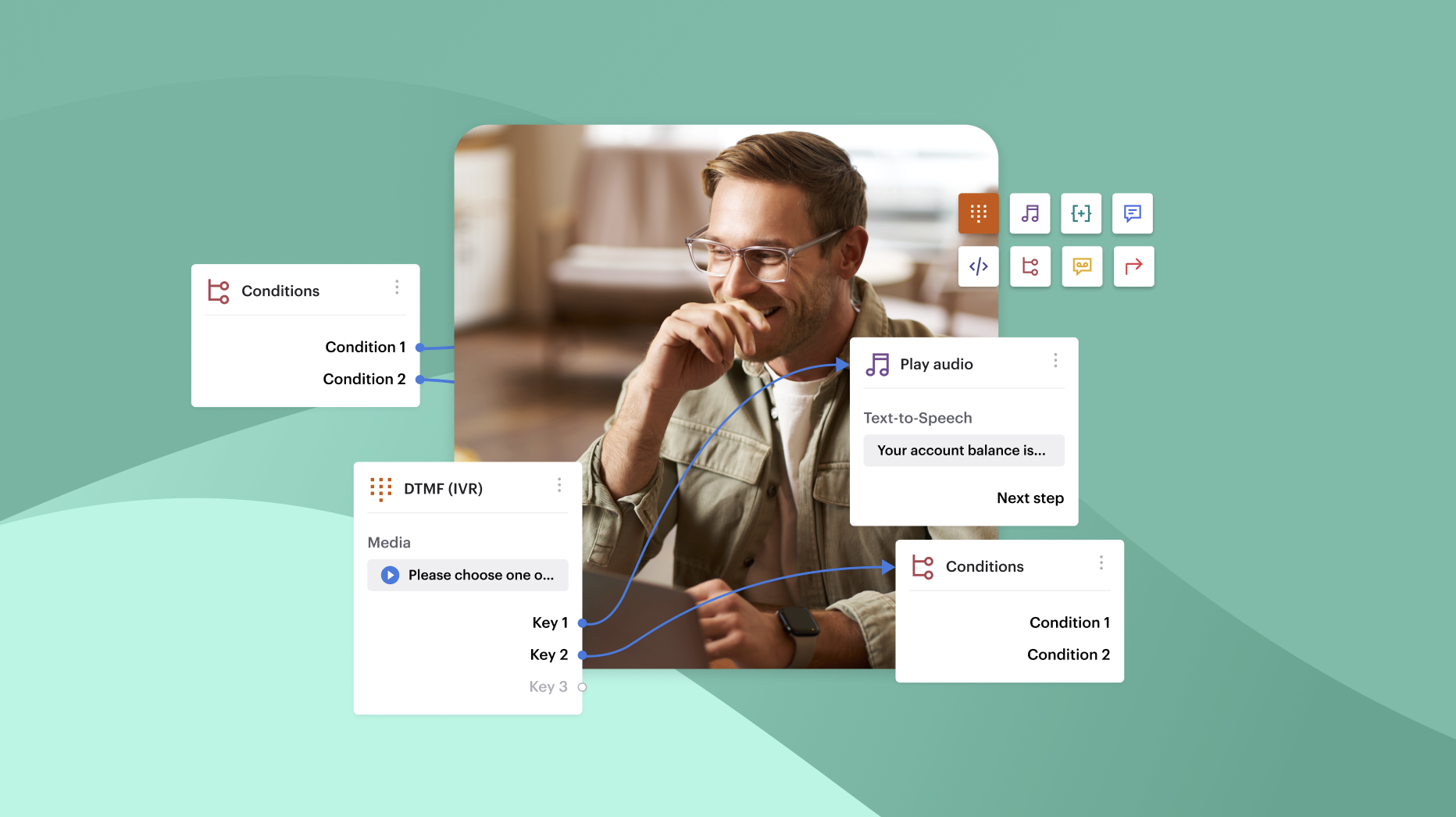
Voiso’s no-code Flow Builder lets teams design dynamic call journeys without engineering support. Flows adapt based on caller input, external data, or preset conditions, so you can handle complex scenarios without piling more work on agents.
AI analytics on every call
Calls processed through Speech Analytics can be transcribed, summarized, and reviewed for sentiment, topics, and conversation scoring. Teams can spot patterns and reduce the need to manually review every recording.
Voice and messaging in one place
Voiso combines voice, SMS, and messaging apps in a single workspace. Agents handle everything without switching tools, and interaction history remains visible across supported channel handovers. Useful when you’re juggling high volumes across multiple platforms.
Built for growing teams
Global calling with local presence, real-time monitoring, and support for both inbound and outbound. It fits businesses expanding into new markets or managing teams across locations.
Trends worth watching
Menus giving way to conversations
IVR menus are slowly being replaced by conversational interfaces. Callers say what they want instead of navigating options. Less friction, shorter calls, and the ability to handle requests that don’t fit neatly into a menu.
Automation moving into sales, not just support
Outbound workflows, lead qualification, and follow-ups are all getting automated. This ties phone systems to revenue, not just cost savings.
Voice and messaging merging
Customers switch between calls, texts, and messaging apps. Systems that combine these into one workflow let businesses continue conversations across channels and shift simpler interactions to messaging to reduce call volume.
Bottom line
The right automated phone system handles real interactions well. Better platforms interpret intent, adapt workflows, and turn conversations into data you can act on.
The payoff is in outcomes: faster resolutions, better customer experiences, more efficient teams. If you’re evaluating options, focus on what the system actually does with calls, not how long its feature list is.
FAQs
What’s the difference between IVR and AI-powered phone systems?
IVR uses predefined menus and keypad input. It follows fixed paths and doesn’t adapt. AI-powered systems use natural language processing so callers can speak normally. The system follows predefined logic during interactions and provides post-call data that supervisors can review to improve future workflows.
How much does an automated phone system cost?
It depends on what you need. Basic systems run $15-$30 per user per month. Mid-range platforms with analytics and CRM integrations cost $30-$80 per user per month. Advanced AI-driven systems are usually custom-priced. Budget for extras too: call usage, integrations, and support tiers all add up.
What works best for high call volumes?
You need intelligent routing, queue management, and real-time analytics at minimum. Cloud contact center platforms with AI capabilities tend to be the best fit. They handle large volumes while giving you visibility into what’s actually happening.
Can these systems improve conversion rates?
Yes, particularly for outbound and sales teams. Predictive dialing, lead prioritization, and automated follow-ups put agents into more conversations. Add analytics, and teams can refine their approach over time. In sales contexts, automation can support higher activity levels and more consistent follow-up.