All Products





Bad customer service is any interaction that leaves a customer more frustrated than when they started, whether through a long wait, a cold response, or a problem left unsolved. Everyone has a story: the hour on hold, the fourth transfer, the agent who read a policy instead of helping. This guide collects the most common bad customer service examples, explains why each one drives customers away, and shows how to fix the cause rather than the symptom.
The point is not to name and shame. Most bad service is not caused by bad people; it is caused by broken processes, missing context, and tools that make it hard to help. Fix those, and the examples below stop happening.
Key points at a glance
- Bad customer service is any interaction that fails to meet a customer’s expectations and leaves them frustrated.
- The most common examples are long waits, endless transfers, lack of empathy, rigid policies, and unhelpful automation.
- Most bad service traces to broken processes and missing context, not bad agents.
- Fixing the root causes, through better routing, visibility, and tooling, prevents the examples rather than apologizing for them.
What is bad customer service?
Bad customer service is a support interaction that does not meet the customer’s reasonable expectations, leaving them feeling ignored, frustrated, or worse off than before. It is defined by the customer’s experience, not the company’s intent: an agent can follow every rule and still deliver bad service if the customer walks away unhelped.
It shows up across channels, on a phone call that goes nowhere, a chat that ends without an answer, an email that is never returned. What unites the examples is a gap between what the customer needed and what they got, and that gap is where loyalty is lost.
Good versus bad customer service
The line between good and bad service often comes down to the same situation handled two ways. A customer calls about a double charge. Bad service puts them on hold for twenty minutes, transfers them twice, and quotes a refund policy. Good service acknowledges the frustration, confirms the charge, reverses it on the spot, and follows up to make sure it landed.
The difference is rarely the problem itself; it is the response. Good service is fast, empathetic, and resolved in one contact wherever possible, with the customer feeling heard. Bad service is slow, impersonal, and passes the customer around without solving anything. Studying the two side by side is useful precisely because the raw material, a customer with a problem, is identical; only the handling changes, and the handling is what a business can control. It is a strangely hopeful idea: since the difference lies in the response rather than the problem, better service is almost always within reach, provided the team has the context, the authority, and the tools to deliver it.
Everything your team needs in one platform
Why bad customer service costs more than you think
Bad customer service is expensive because it drives customers to competitors, and winning them back costs far more than keeping them. Research from Bain & Company, cited by Harvard Business Review, found that a 5 percent increase in retention can lift profits by 25 to 95 percent; the reverse is just as true, since each customer lost to poor service takes that value away.
Satisfaction is also harder to earn than many assume. The American Customer Satisfaction Index put the US national score at 76.9 out of 100 in late 2025, a level that has barely moved in years, which suggests companies are not, on average, getting better at this. Add the modern multiplier of social media and review sites, where one bad experience can reach thousands, and the cost of poor service compounds well beyond the single customer in front of you. Voiso’s look at customer churn and poor service traces how the damage spreads.
Common bad customer service examples and how to fix them
The examples below come up again and again across industries. For each, the fix addresses the cause, not just the moment.
Long wait times
Making customers wait on hold for ages, or days for an email reply, is the most cited complaint of all. Long waits signal that the company values its own convenience over the customer’s time. The fix is better forecasting and routing so staffing matches demand, plus callback options so customers are not trapped on hold. Watching call abandonment rate tells you when waits are pushing people to give up. Picture a customer holding for forty minutes about a billing error, only to be cut off at the end of the day: that single experience can end a relationship built over years.
Endless transfers and repeating yourself
Being passed from agent to agent, retelling the same story each time, is uniquely maddening. It happens when systems do not share context and routing is poor. The fix is an omnichannel setup that carries the customer’s history across agents and channels, and skills-based routing that gets them to the right person the first time, so they never start over. Few things erode goodwill faster than explaining a complex problem for the third time to a third stranger who has none of the earlier context.
Lack of empathy
Treating an upset customer as an inconvenience, or responding with cold, scripted indifference, breaks trust fast. Customers forgive problems more readily than they forgive feeling dismissed. The fix is training and coaching that put acknowledgment before logistics, a habit Voiso covers in its guide to de-escalation techniques.
Rude or dismissive staff
Arguing, blaming the customer, or using a hostile tone turns a solvable issue into a lost account and, often, a public review. This usually reflects burnout or poor training rather than character. The fix is realistic workloads, clear coaching from real recordings, and a culture that supports agents so they can support customers.
Hiding behind rigid policy
“That’s our policy” is the phrase that launches a thousand complaints. Inflexible rules applied without judgment tell customers the company cares more about its process than their problem. The fix is giving agents the authority and the guidelines to make sensible exceptions, so common sense is not against the rules.
Unhelpful automation and IVR traps
Trapping customers in endless phone menus, or a chatbot that will not connect them to a human, is bad service dressed up as efficiency. Automation should speed help, not block it. The fix is intent-based routing and an easy path to a person, a balance Voiso examines in AI voice agents versus IVR. Automation that helps is welcome; automation whose main purpose is to keep customers away from staff is simply bad service with a friendlier voice.
Not solving the real problem
Answering the question asked while missing the problem underneath leaves customers technically helped and actually stuck. It comes from rushing past discovery. The fix is better questioning and a focus on first contact resolution, which measures whether the issue was truly solved, not just closed.
Being hard to reach
Limited hours, one channel, buried contact details, all tell customers you would rather not hear from them. In a world where people expect to reach a business the way that suits them, scarcity of access is itself bad service. The fix is offering the channels customers actually use and making contact easy to find.
Slow or no response
A question that goes unanswered for days, or a promised callback that never comes, erodes trust as surely as rudeness. The fix is clear ownership of every open issue, tracked against a response target, so nothing falls through the cracks and every promise is kept.
Broken promises and no follow-up
Telling a customer you will call back, escalate, or fix something, then not doing it, is among the fastest ways to lose them. The fix is a system that logs commitments and follows up, and a culture that treats a promise to a customer as a debt to be paid.
Passing the blame
Blaming another department, the customer, or “the system” leaves the person with the problem exactly where they started. Customers do not care whose fault it is; they care that someone owns it. The fix is a culture of ownership, where the agent who picks up the issue sees it through or hands it off cleanly with full context. A customer does not want to hear that billing blames shipping and shipping blames the system; they want one person to say, I’ve got this, and mean it.
Ignoring feedback
Asking for feedback and then doing nothing, or disregarding complaints and reviews, tells customers their voice does not matter. The fix is closing the loop: acting on what customers say and telling them when their feedback led to a change, which turns a critic into a supporter.
Bad customer service by channel
Poor service takes a different shape on each channel, though the underlying failures rhyme. Recognizing the channel-specific version helps a team spot it.
On the phone, bad service is long holds, dropped calls, endless transfers, and IVR menus with no way to reach a person. On live chat, it is slow replies, canned responses that miss the question, and sessions that time out before an answer arrives. Over email, it is days of silence, replies that ignore half the message, or a ticket that closes without a resolution. On social media and messaging apps, it is public complaints left unanswered, or a brand that deletes criticism instead of addressing it.
The through-line is the same gap between expectation and delivery, but the fix has a channel flavor. A customer who chose chat for speed judges you on speed; one who emailed a detailed problem judges you on thoroughness. Serving each channel on its own terms, while keeping the history connected across them, is how a business avoids the channel-specific versions of bad service at once.
The root causes behind bad customer service
Most bad service examples share a handful of underlying causes, and fixing those prevents the symptoms in bulk. Naming them helps a manager see the pattern rather than firefighting each incident.
Fragmented tools are the most common culprit: when routing, records, and history live in separate systems, agents lack the context to help and customers end up repeating themselves. Thin visibility is another, since a manager who cannot see live queues and performance cannot fix a backlog before it becomes a complaint. Understaffing and poor forecasting create the waits, and weak training and coaching create the empathy and knowledge gaps. Finally, a culture that measures only speed pushes agents to rush past the real problem. Almost every example above is a symptom of one of these. The useful implication is that you do not have to fix a dozen separate problems; fixing the handful of root causes, giving agents context, giving managers visibility, staffing to demand, and coaching well, removes most of the symptoms at once. That is why the strongest response to a list of bad service examples is not a list of a dozen scripted apologies but a short list of structural fixes.
Bad customer service examples by industry
The same failures wear different clothes depending on the sector, and the cost lands differently too. A few industries show how.
In retail and ecommerce, bad service is a wrong or late order met with a chatbot loop and no human to fix it, or a returns process designed to exhaust the customer into giving up. In telecom and utilities, it is the hours on hold, the disconnected calls, and the sense that leaving is harder than staying. In financial services and fintech, it is being unable to reach a person about money that is missing, where anxiety makes slow or scripted responses feel far worse. In travel and hospitality, it is a disrupted trip and a support line that cannot or will not help while the customer is stranded. In B2B and SaaS, it is a critical outage handled by a ticket that bounces between teams while the client’s own operations stall.
The pattern holds across all of them: the higher the stakes and the more urgent the moment, the more a poor response costs. Sectors where problems are stressful or time-sensitive have the least room for bad service, because the customer is already on edge when they reach out.
Phrases that make bad service worse
Sometimes it is not the policy but the wording that turns an interaction sour. Certain phrases signal indifference, and swapping them for better ones changes the whole tone.
- “That’s our policy” tells the customer the rulebook matters more than their problem. Better: “Here’s what I can do for you.”
- “There’s nothing I can do” ends the conversation with the issue unsolved. Better: “Let me find out who can help.”
- “You should have…” blames the customer for the situation. Better: “Let’s sort this out from here.”
- “Calm down” escalates rather than soothes. Better: “I understand why you’re frustrated, and I’m on it.”
- “That’s not my department” passes the problem along. Better: “I’ll connect you with the right person and brief them.”
The words are a symptom of mindset, so the fix is not a banned-phrase list alone but coaching that helps agents see the customer’s side. Still, retiring the worst phrases is a quick, visible win, and speech analytics can flag when they crop up so coaching targets the real moments rather than a hypothetical one.
How to prevent bad customer service
Preventing bad service means fixing causes, not scripting apologies. Most of the examples in this guide share a small set of roots, so a handful of structural changes removes many symptoms at once.
| Bad service example | Root cause | The fix |
| Long wait times | Poor forecasting and staffing | Demand-based scheduling, callbacks |
| Endless transfers | Fragmented systems, weak routing | Omnichannel context, skills-based routing |
| Lack of empathy | Weak training, burnout | Coaching from real calls, realistic workloads |
| Rigid policy | No agent authority | Give agents authority to make sensible exceptions |
| Unhelpful automation | Automation built to deflect | Intent routing plus an easy path to a human |
| Unsolved problems | Rushed discovery | Focus on first contact resolution |
| Slow or no response | No clear ownership | Track every issue against a response target |
| Ignored feedback | No closed loop | Act on feedback and tell customers you did |
Warning signs your customer service is slipping
Bad service rarely appears overnight; it creeps in, and the early signals are visible if you watch for them. Catching the drift early is far cheaper than recovering from a reputation hit.
- Rising wait times and abandonment, as customers give up before reaching an agent.
- Falling first contact resolution, meaning more issues need a second or third contact.
- More repeat contacts about the same problems, a sign fixes are not sticking.
- Slipping satisfaction and effort scores, especially a run of low ratings on one topic.
- A rise in negative reviews or social complaints mentioning support.
- Agent burnout and turnover, since unhappy agents and unhappy customers travel together.
Any one of these can be noise; together, or trending the wrong way, they are a warning. The teams that avoid serious service failures are usually the ones watching these signals weekly rather than discovering a problem in a quarterly review, by which point customers have already left.
The effects of poor customer service
The damage from bad service reaches further than the single unhappy customer, and it compounds over time. It helps to see the full chain of effects.
- Customer churn: unhappy customers leave, often without complaining first, so the loss is silent.
- Lost revenue: each departed customer takes their lifetime value and any referrals with them.
- Reputation damage: reviews and social posts spread a bad experience to people who never dealt with you.
- Higher acquisition cost: replacing churned customers costs far more than keeping them would have.
- Lower morale: agents dislike delivering service they know is poor, which feeds turnover.
- Wasted effort: sales and success teams spend time rescuing accounts that better support would have kept.
None of these shows up as a single dramatic line on a report, which is what makes poor service so insidious. It leaks value quietly, through customers who simply do not return and prospects who quietly choose a competitor after reading a review. By the time the numbers make the problem obvious, a good deal of the damage is already done, which is why the effects are best headed off early rather than tallied after the fact.
How to recover when service goes wrong
Even good teams have bad moments, and how you recover often matters more than the slip itself. Handled well, a service failure can leave a customer more loyal than before, a pattern sometimes called the service recovery paradox.
The recovery playbook is straightforward. Acknowledge the problem and apologize without excuses. Take ownership rather than passing the customer along. Fix the issue quickly, and where the failure was real, offer something that fits the inconvenience. Then follow up to confirm the fix held and to show the customer they were not forgotten. Finally, feed the failure back into the process, so the same problem does not recur for the next customer. What customers remember is not that something went wrong, but whether the company made it right, which is why recovery deserves as much attention as prevention. A customer whose serious problem is handled with speed and genuine care will often speak more warmly of the brand afterward than one who never had a problem at all, because they have seen what the company does when it counts.
How the right tools prevent bad customer service
Good tooling does not replace good people, but it removes the conditions that make bad service almost inevitable. When agents can see the whole customer, route intelligently, and act on what they learn, most of the examples above simply stop happening.
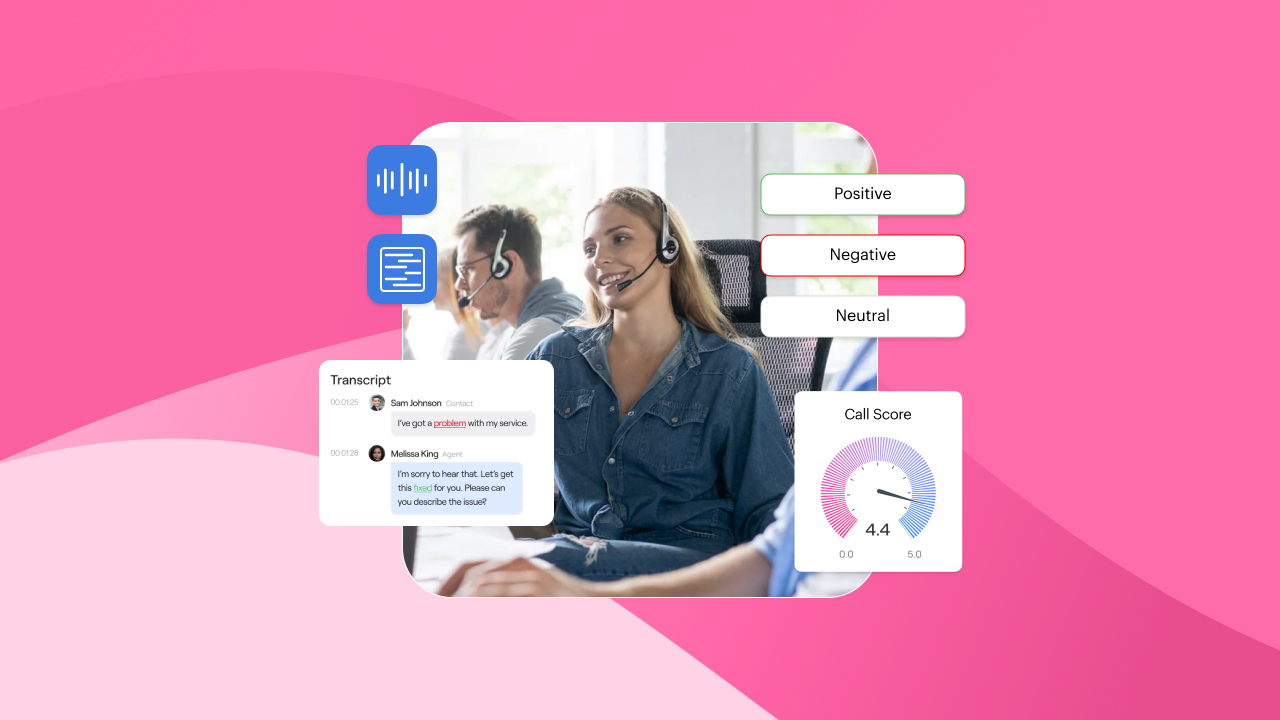
Voiso’s AI speech analytics is a direct antidote to bad service you cannot see: it transcribes and scores every call, flags frustration and rising sentiment, and surfaces the interactions that went wrong, so a manager coaches from evidence rather than the occasional complaint that reaches them. Around it, omnichannel context stops customers repeating themselves, real-time dashboards let supervisors fix a backlog before it becomes a wait, and intelligent routing gets people to the right agent the first time. Voiso stays the communication layer throughout, passing data to the CRM that owns the account, so agents answer already knowing the customer. The result is fewer of the moments that send customers to a competitor, caught and corrected rather than quietly repeated.
The change worth noting is from reactive to preventive. Most teams learn about bad service from the complaint that reaches a manager, which is a fraction of what actually happens and arrives too late to save the customer. When every interaction is transcribed, scored, and monitored for sentiment, the bad moments surface on their own, ranked by severity, while there is still time to call the customer back, fix the process, and coach the agent. That is the difference between a team that apologizes for bad service and one that quietly stops producing it.
Frequently asked questions
How do you describe terrible customer service?
Terrible customer service is any interaction that leaves a customer feeling ignored, frustrated, or worse off than before they reached out. It is usually marked by long waits, repeated transfers, a lack of empathy, unhelpful or rude staff, rigid policies applied without judgment, and problems left unsolved. The defining feature is the gap between what the customer reasonably expected and what they received. Because it is judged by the customer’s experience, an agent can follow every rule and still deliver terrible service if the person walks away unhelped.
What are the most common examples of bad customer service?
The most common examples are long wait times, being transferred repeatedly and having to repeat yourself, a lack of empathy, rude or dismissive staff, hiding behind rigid policy, unhelpful automation that blocks access to a human, slow or no response, broken promises with no follow-up, passing the blame, and ignoring customer feedback. Most trace back to a few root causes: fragmented systems, thin visibility, understaffing, and weak training. Fixing those causes prevents the examples far more effectively than apologizing for them after the fact.
What are the consequences of bad customer service?
Bad customer service drives customers to competitors, and losing them is costly, since research shows even small changes in retention move profits significantly. Beyond the individual lost, poor service spreads through reviews and social media, where a single bad experience can reach thousands and deter future buyers. It also raises costs internally, as sales and success teams are pulled in to rescue accounts, and it damages employee morale, since agents dislike delivering service they know is poor. The reputational damage, in particular, is slow and expensive to reverse.
How can businesses avoid bad customer service?
Businesses avoid bad customer service by fixing the causes rather than scripting apologies. That means forecasting and staffing to keep waits short, connecting systems so agents have full context and customers never repeat themselves, empowering agents to use judgment instead of hiding behind policy, and offering an easy path to a human when automation cannot help. Coaching from real conversations builds empathy and knowledge, and acting on feedback closes the loop. Tools that give visibility and context make good service the default rather than a matter of luck.
Is bad customer service worse than no service at all?
Bad customer service can be worse than no service, because it actively damages trust rather than simply leaving a gap. A customer who cannot reach you is disappointed; a customer who reaches you and is treated poorly, transferred endlessly, or dismissed, is angry, and anger drives churn and negative reviews. A rude or unhelpful interaction often leaves a stronger negative impression than silence would. That said, being unreachable is also a form of poor service, so the goal is neither, achieved through accessible, well-supported, well-tooled support.
Turn bad service moments into loyalty
The bad customer service examples in this guide are not inevitable; they are symptoms of causes you can fix. Voiso gives your team the context, routing, and analytics to catch the moments that frustrate customers and correct them before they cost you an account. To see how the platform helps you spot and prevent poor service across every channel and market, book a demo with the Voiso team, or start a free trial and listen to your own calls with fresh ears.