All Products

.svg)





B2B customer service is the support, relationship management, and post-sale engagement a business provides to other businesses that use its products or services. It differs from consumer support in almost every dimension that matters: the customer is an account rather than a person, the decisions involve several stakeholders, the problems are more technical, and the stakes at renewal are far higher. Lose one B2B account and you can lose a year of revenue in a single email.
This guide sets out what B2B customer service is, how it differs from B2C, the characteristics and channels that define it, and the practices that keep business clients loyal. It also covers the metrics worth tracking, the compliance rules that apply when you reach out, and where a communication platform fits in an account-centric support operation.
Key points at a glance
- B2B customer service supports business accounts, not individual consumers, so relationships and account context sit at the center.
- A single B2B account often involves many stakeholders and represents large, recurring revenue.
- Proactive, personalized service and fast resolution matter more in B2B, where churn is expensive.
- Account context from the CRM, delivered to the agent on every interaction, is what makes B2B support feel informed rather than generic.
What is B2B customer service?
B2B customer service is the assistance one company gives to another that buys its products or services, spanning technical support, account management, and ongoing engagement after the sale. Unlike a one-off consumer transaction, it is an ongoing relationship with an organization, where the goal is not just to resolve a ticket but to keep the account healthy, renewing, and growing.
Who is a B2B customer?
A B2B customer is a business, but in practice it is a set of people within that business, each with different needs. The day-to-day user wants the product to work; the administrator wants control and reporting; the budget holder wants value and rarely contacts support until renewal. Good B2B service recognizes that “the customer” is really several roles, and that satisfying all of them is what secures the account.
B2B customer service versus B2B customer support
The two terms overlap, with a useful distinction. Support tends to mean reactive help with problems, while service is the broader relationship, including proactive outreach, account reviews, and guidance. In B2B, the service layer matters as much as the support layer, because the relationship, not a single fix, drives retention. Voiso draws the wider line between service and experience in its piece on customer experience versus customer service.
B2B versus B2C customer service
The core difference is that B2B serves organizations in ongoing relationships, while B2C serves individuals in mostly transactional ones. That single distinction cascades into how you staff, measure, and equip a support team. The table sets out the main contrasts.
| Dimension | B2B customer service | B2C customer service |
| Customer | An account with many stakeholders | An individual consumer |
| Relationship | Ongoing, contract-based | Often one-off or transactional |
| Complexity | High, technical, account-specific | Usually simpler, standardized |
| Volume | Lower volume, higher value per case | High volume, lower value per case |
| Stakes | A lost account can mean large revenue | A lost customer is one sale |
| Success metric | Retention, renewal, expansion | Speed, satisfaction, resolution |
Relationships over transactions
B2C support can succeed with a fast, friendly fix and a goodbye. B2B cannot, because the same account comes back for years and expects the provider to know its history. Continuity of relationship, not just resolution, is the measure of B2B service.
Complexity and technical depth
B2B products tend to be more complex, and the people using them are often technical themselves. Agents need deeper product knowledge and the ability to reach specialists quickly, since a shallow answer to an expert user erodes trust fast.
Multiple stakeholders
Where a consumer speaks for themselves, a B2B account speaks through several voices that may not agree. Serving the account well means keeping all of them reasonably happy, and knowing which one holds the renewal.
Everything your team needs in one platform
Why B2B customer service matters
B2B customer service matters because retention, renewal, and expansion, the engines of B2B revenue, all run through it. A business customer that feels supported renews and often buys more; one that feels neglected churns and takes a large contract with it. Service is not a cost center in B2B; it is where recurring revenue is protected.
The relationship also shapes reputation in a small market. B2B buyers talk to each other, check references, and read reviews before signing, so the quality of your support becomes a sales argument for the next deal. Poor service does not just lose the account in front of you; it quietly costs the ones you have not won yet. Voiso’s look at how stronger customer relationships drive success develops this point.
The cost of poor B2B customer service
If good B2B service protects revenue, poor service drains it, often quietly and at scale. Because each account is large and contract-based, a single bad experience can trigger a non-renewal worth far more than the interaction that caused it. The loss rarely shows up as a dramatic complaint; more often an account simply goes quiet, uses the product less, and declines to renew when the term ends.
The damage spreads beyond the lost account. B2B markets are small and well-connected, so a client who leaves unhappy tells peers, leaves a review, and declines to act as a reference, all of which raise the cost of winning the next deal. Internally, poor service also burns the time of sales and success teams pulled in to rescue accounts that better support would have kept healthy. Measured honestly, the cost of weak B2B service is not the occasional refund of consumer support; it is compounding lost revenue and a slow erosion of reputation that is hard to rebuild once it starts.
Key characteristics of B2B customer service
Several traits set B2B service apart and shape how a team should operate. Each has a practical consequence for staffing and tooling.
Account-based, not ticket-based
B2B service is organized around accounts, not isolated tickets. An agent needs to see the whole relationship, past issues, contract terms, key contacts, before responding, so the answer fits the account rather than the individual query.
Multiple stakeholders per account
Because several people represent one customer, service has to track who is who and keep interactions consistent across them. A promise made to the admin should be known to the agent who later speaks with the user.
Higher technical complexity
B2B problems often require specialist knowledge and cross-team coordination to resolve. Fast, accurate escalation to the right expert matters more than in B2C, where issues are more standardized.
Service level agreements
B2B contracts frequently include SLAs that commit to response and resolution times. Missing them is not just a bad experience; it can be a contractual breach with financial consequences, so tracking against SLAs is central.
A proactive posture
The best B2B service does not wait for problems. Regular check-ins, usage reviews, and early warnings about issues keep accounts healthy, an approach Voiso covers in its guide to proactive customer service.
B2B customer service channels
B2B customers expect to reach support the way that suits the moment, and to have the thread follow them across channels. A fragmented, channel-by-channel setup is a common source of frustration for business clients.
- Phone remains vital for urgent, complex, or high-stakes issues where a conversation beats typing.
- Email and ticketing suit detailed, trackable requests that need a record.
- Live chat handles quick questions during the working day.
- Dedicated account management gives key accounts a named contact.
- Self-service and knowledge bases let technical users solve routine issues themselves.
An omnichannel contact center keeps these channels connected, so a client who starts on chat and moves to a call does not repeat themselves. For B2B, that continuity is not a nicety; it is what makes a complex relationship manageable.
The channel mix also skews differently than in consumer support. B2B clients lean on phone and dedicated account contacts more heavily, because a stalled integration or a billing dispute on a large contract is not something they want to work through a chatbot. At the same time, technical users often prefer to self-serve for routine questions, so a strong knowledge base reduces load without hurting the relationship. Getting the balance right, human depth for the hard cases and self-service for the routine, is part of designing B2B service well.
B2B customer service best practices
The practices below separate B2B service that retains accounts from service that quietly loses them. Treat them together, since they reinforce one another.
Give agents full account context
An agent who can see the account’s history, contract, and key contacts responds with relevance rather than generic scripts. This depends on tight integration with the CRM, so the record travels to the agent the moment a client makes contact.
Be proactive, not just reactive
Reaching out before a renewal, flagging a usage problem, or checking in after a rough patch shows the account you are paying attention. Proactive service is where B2B retention is quietly won.
Meet your SLAs, and be honest when you cannot
Track response and resolution against contractual commitments, and communicate early if something will slip. B2B clients forgive a delay they were warned about far more readily than a silent missed deadline.
Personalize to the account and the role
Tailor the response to both the organization and the specific person: a technical user needs detail, an executive needs the summary. Personalization at this level is what makes B2B service feel like a partnership.
Invest in knowledge management
A strong internal knowledge base lets agents answer technical questions consistently and lets clients self-serve. In B2B, where questions are complex and precision matters, shared knowledge is a competitive asset.
Align support with customer success and sales
Support, customer success, and sales should share a view of each account, since a support issue can signal a churn risk or an expansion opportunity. Siloed teams miss both.
The role of CRM and account context
B2B customer service depends on knowing the account, and that knowledge lives in the CRM. When an agent answers a call already seeing the client’s contract, past tickets, and key contacts, the interaction is faster, warmer, and more accurate. Without that context, even a skilled agent starts every conversation half-blind.
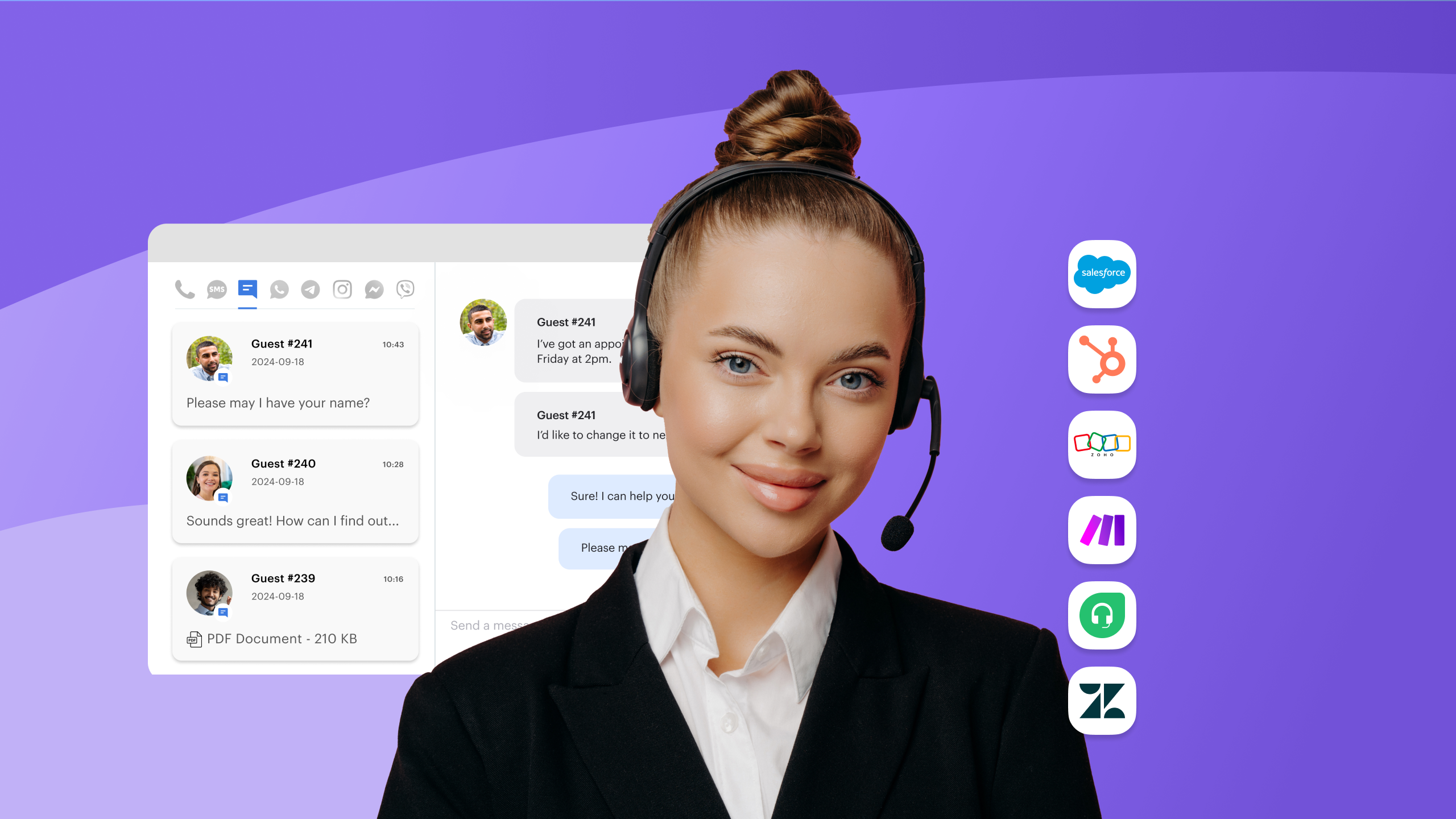
This is where the contact center platform earns its keep as the communication layer. Voiso connects to CRMs including Salesforce and HubSpot, so account data flows to the agent on every interaction and outcomes flow back to the record. Voiso does not try to be the CRM; it feeds and reads from the system that owns the account, which is exactly the right division of labor for B2B.
B2B customer service metrics
You manage B2B service with a mix of experience and relationship metrics, since a single number cannot capture a long account relationship. Track experience measures alongside the outcomes that matter to the business.
Experience metrics include customer satisfaction, customer effort, and first contact resolution, which show the quality of individual interactions. Relationship metrics include retention rate, renewal rate, net revenue retention, and customer lifetime value, which show whether the account is healthy over time. SLA adherence sits across both, since meeting commitments is both an experience and a contractual measure. Reading these together tells you not just whether a ticket went well, but whether the account is likely to stay and grow.
Building a B2B customer service team
B2B service asks more of its people than a consumer help desk, so the team is structured differently. Roles tend to specialize around the account rather than the ticket queue.
Support agents handle incoming issues and need deeper product knowledge than their B2C counterparts, since the users they help are often technical. Account managers or customer success managers own the relationship, checking in proactively and spotting renewal and expansion signals. Technical specialists or solution engineers take the hardest problems, and fast, clean escalation to them is what keeps complex issues from stalling. A team lead watches SLA adherence and coordinates across support, success, and sales so an account is not served by three teams that never talk.
Hiring for B2B service means valuing patience, technical aptitude, and relationship skills over raw call speed. The metrics that suit a high-volume consumer desk, such as calls per hour, can actively harm a B2B team, where a longer, thorough conversation often protects a large account. Training should lean on real recordings and account scenarios, so agents learn the product and the relationship together rather than a script in isolation.
B2B customer service across the account lifecycle
B2B service is not one activity but a series that changes across the relationship. Each stage asks something different of the support team.
Onboarding sets the tone, and a rough start is a leading cause of early churn, so early service should be attentive and hands-on. Through adoption, service helps the client get value, answering questions and removing friction. Before renewal, proactive outreach and a healthy support record make the decision easy. Expansion often begins in a support conversation, when a client’s need reveals an opportunity. Escalation, handled well, can turn a serious problem into a moment that deepens trust. Mapping service to the lifecycle, rather than treating every contact the same, is what keeps accounts moving in the right direction.
Compliance in B2B outreach and support
B2B communication is regulated, and the common belief that business-to-business calls are exempt is a costly myth. The rules differ by market, and they apply to outreach as much as to support.
In the United States, B2B calls face fewer restrictions than consumer calls but must still honor company-specific do-not-call requests, and outbound teams screen against the National Do Not Call Registry where relevant. The United Kingdom brings calls to corporate subscribers under PECR, and organizations can register with the Corporate Telephone Preference Service to opt out. Data protection applies throughout: handling the personal data of an EU contact brings GDPR duties wherever your team sits. Confirm each market’s rules before a campaign, and remember that the obligation rests with the business making contact, not the platform it uses.
How AI is changing B2B customer service
Artificial intelligence is reshaping B2B service, though it lands differently than in high-volume consumer support. Because B2B problems are complex and accounts are valuable, the strongest use of AI is to assist people rather than to replace the human relationship a business client expects.
On the assist side, AI transcribes and summarizes calls, drafts replies, and surfaces the account context an agent needs before a conversation, cutting the busywork that pulls specialists away from clients. AI can also read sentiment across conversations to flag an account trending toward churn, giving success teams time to act. For routine, low-complexity requests, an AI agent can handle first contact and pass anything account-specific or sensitive to a human, keeping fast response without losing the personal touch on the cases that matter.
The line to hold is that a business client with a serious, high-stakes problem still wants a knowledgeable person, and often a named contact. AI that removes friction from the routine and frees experts for the complex tends to strengthen B2B service; AI deployed to keep clients away from people tends to erode the relationship that B2B depends on. The judgment about where that line sits is itself a service decision, not just a technical one.
Common B2B customer service challenges
Even well-run B2B teams hit recurring difficulties. Naming them helps a manager spot which one is biting.
Fragmented context is the classic problem: when account history lives in one system and conversations in another, agents piece together the picture on the fly and clients feel it. Balancing depth with speed is another, since technical accuracy takes time that SLAs pressure. Coordinating across teams, support, success, sales, product, is hard when they do not share a view of the account. Scaling personalized service as the client base grows tests any team, which is where automation and good tooling start to matter. Voiso’s guide to scaling customer support addresses that last challenge directly.
B2B customer service by industry
The fundamentals hold across sectors, but the emphasis shifts by what the business sells and which rules bind it. A few examples show the range.
In IT and technology, service is deeply technical, and clients expect fast access to specialists who understand their setup; Voiso’s IT and technology solution speaks to that need. In fintech and financial services, B2B support carries heavy compliance and record-keeping duties, since conversations may need to be produced during a dispute. In BPO, one team serves many business clients at once, each with its own SLAs and reporting, so clean separation per client is essential. In recruitment and staffing, B2B service means managing relationships with hiring companies whose needs change with each role, where responsiveness can decide whether they use you again. Speed and clear communication matter enormously here, since a slow response can cost a placement and, with it, the client. In manufacturing and distribution, it often centers on order accuracy, delivery timing, and technical product support for trade buyers. Across all of them, the account-centric, relationship-first approach is what distinguishes B2B service from consumer support, and the emphasis simply moves to whatever the client values most.
How to improve B2B customer service
Improving B2B service works best as a sequence of practical moves rather than a single overhaul. The steps below build on one another.
- Unify account context. Connect the contact center to the CRM so agents see the full account on every interaction, ending the piecing-together that slows responses.
- Map service to the lifecycle. Define what good service looks like at onboarding, adoption, renewal, and escalation, rather than treating every contact the same.
- Set and track SLAs honestly. Commit to response and resolution times you can meet, measure against them, and warn clients early when something will slip.
- Make proactive outreach routine. Schedule check-ins and usage reviews for key accounts instead of waiting for problems to surface.
- Align the teams. Give support, success, and sales a shared view of each account so risks and opportunities are not missed.
- Use AI to remove busywork. Automate summaries, routing, and routine requests so specialists spend their time on the accounts that need them.
Done in order, these moves compound: unified context makes proactive outreach possible, which makes SLAs easier to meet, which makes renewals easier to win. A B2B team that treats improvement as a system rather than a slogan tends to see retention climb within a few review cycles.
B2B customer service examples
Concrete examples make the difference from consumer support clear. Each shows the account-centric, relationship-first approach in action.
A SaaS provider notices, through usage data and a support ticket, that a client’s team has stopped using a key feature. Rather than waiting, the customer success manager reaches out, runs a short training session, and heads off a renewal risk months before the contract is up. That is proactive B2B service: acting on a signal, not a complaint.
A logistics firm’s client hits an integration problem that threatens their own operations. The support agent, seeing the full account and its SLA, escalates immediately to a solution engineer, keeps the client updated at each step, and confirms the fix held the next day. The speed and the follow-through, not just the fix, are what protect the account.
A fintech platform’s client calls with a dispute that must be documented for compliance. The agent handles it on a recorded line, logs it against the account, and passes the case to the team that owns the resolution, while the conversation record stays available for any later audit. Here, service and compliance are the same job.
Across these, the pattern repeats: the agent sees the account, acts before or fast, coordinates across teams, and leaves a clean record. That is what B2B clients mean when they say they want a partner rather than a vendor.
How Voiso supports B2B customer service
Voiso gives B2B teams the communication layer to run account-centric support across every channel, backed by the account context that makes it feel informed. Its omnichannel platform keeps phone, chat, and messaging connected, so a client never repeats themselves, and its CRM integrations bring the account record to the agent on every interaction.
Around that, speech analytics surfaces churn signals and coaching opportunities across conversations, routing gets complex issues to the right specialist quickly, and the open API connects the contact center to the systems that own the account. Because Voiso is the communication layer rather than the system of record, it strengthens the interactions that hold a B2B relationship together while leaving the CRM to manage the account. The result is B2B service that feels like a partnership, delivered at the scale a growing client base demands, without asking agents to work blind or clients to repeat themselves across a dozen disconnected tools.
Frequently asked questions
What is B2B customer service?
B2B customer service is the support and relationship management a company provides to other businesses that use its products or services. It covers technical support, account management, and proactive engagement after the sale, with the goal of keeping business accounts healthy, renewing, and growing. Unlike consumer support, it centers on an ongoing relationship with an organization made up of several stakeholders, so account context and continuity matter as much as resolving any single issue. Success is measured by retention and expansion, not just speed.
How is B2B customer service different from B2C?
B2B customer service supports business accounts in ongoing, often contract-based relationships, while B2C serves individual consumers in mostly transactional ones. B2B involves multiple stakeholders per account, more technical and complex problems, lower volume but far higher value per case, and service level agreements with contractual weight. A lost B2B account can mean a year of revenue, so retention and expansion drive the work, whereas B2C leans more on speed and high-volume efficiency. The tools and skills each requires differ accordingly.
Is B2B cold calling illegal?
B2B cold calling is legal in most markets but is still regulated, and the rules differ by country. In the United States, business calls face fewer restrictions than consumer calls but must respect company-specific do-not-call requests and any AI voice rules. The United Kingdom brings calls to corporate subscribers under PECR, and firms can register with the Corporate Telephone Preference Service. Data protection also applies to any personal data involved. Assuming B2B is exempt is a common and costly mistake, so confirm each market before dialing.
What metrics matter most in B2B customer service?
The most useful B2B metrics combine experience and relationship measures. Experience metrics like customer satisfaction, customer effort score, and first contact resolution show the quality of individual interactions. Relationship metrics like retention rate, renewal rate, net revenue retention, and customer lifetime value show whether the account is healthy over time. SLA adherence spans both, since meeting contractual commitments is central to B2B. Reading them together reveals not just whether a ticket went well, but whether the account is likely to stay and grow.
Why is account context important in B2B customer service?
Account context is important because B2B service is organized around accounts, not isolated tickets, and a relevant answer depends on knowing the client’s history, contract, and key contacts. When an agent sees that context the moment a client makes contact, the interaction is faster, warmer, and more accurate. Without it, even a skilled agent starts half-blind and the client feels it. This is why integrating the contact center with the CRM, so account data reaches the agent on every interaction, is foundational to good B2B service.
Build B2B service that keeps accounts for years
B2B customer service is where recurring revenue is protected or lost, one informed, proactive interaction at a time, long after the deal is signed. Voiso gives your team the omnichannel platform, CRM integrations, and analytics to serve business accounts with the context and continuity they expect, then feeds every outcome back to the system that owns the relationship. To see how Voiso supports account-centric B2B service across all of your markets, book a demo with the Voiso team, or start a free trial and test it against your own accounts.