All Products

.svg)




Contact center software features are the capabilities used to manage customer interactions across voice and digital channels: routing contacts, automating workflows, connecting customer data, monitoring performance, and supporting agents and supervisors while they work.
That covers a lot of ground, which is part of the problem when you’re buying. A platform sold as one product is really eight or nine distinct capability groups, and most teams need maybe half of them on day one. Most of what follows applies whether you’re replacing a system, upgrading one, or standing up an operation from scratch. What changes is the order you care about things in.
One caveat before the list. Nearly every feature below gets sold as essential, and quite a few genuinely aren’t for a given team. A six-person support desk handling forty tickets a day does not need predictive dialing or speech analytics, and I’d be a little suspicious of anyone who told them otherwise.
Quick Answers
| Question | Short answer |
| What are contact center software features? | Capabilities for handling, routing, automating, recording and measuring customer interactions |
| How many are there? | Depends how you group them. Eight functional categories covers most platforms |
| Which are core for almost everyone? | Routing, reporting, and some form of contact history |
| Which are situational? | Predictive dialing, speech analytics, voice biometrics, advanced automation |
| Does every team need omnichannel? | No. Only teams actually serving more than one channel |
| What separates contact center from call center software? | Channel scope. Contact center covers digital alongside voice |
| Where do buyers usually overspend? | Advanced analytics bought before there’s enough volume to analyze |
| What’s the most common gap? | Integration with the CRM the team already lives in |
The Eight Categories of Contact Center Software Features
| Category | Features it covers |
| Channel management | Voice, email, web chat, SMS, messaging apps |
| Routing and self-service | ACD, IVR, queues, skills-based routing, callback |
| Agent productivity | CRM integration, screen pop, notes, disposition, summaries |
| Quality and compliance | Recording, live monitoring, scoring, speech analytics |
| Reporting and management | Real-time dashboards, historical reporting, KPI tracking |
| Outbound | Predictive dialing, local caller ID, campaign management |
| AI and automation | Summaries, sentiment, keyword detection, chatbots, TTS |
| Integration and platform | APIs, webhooks, CRM connectors, cloud deployment |
Which Features Are Core, and Which Depend on Your Setup
| Feature | Core for most teams? | Best fit |
| ACD and routing | Yes | Any inbound operation |
| Reporting | Yes | All operations |
| CRM integration | Usually | Customer-facing teams of any size |
| IVR | Often | Higher call volume, or clear self-service demand |
| Call recording | Often | QA programs and regulated sectors |
| Omnichannel | Depends | Teams genuinely serving digital channels |
| Text-to-speech | Depends | Dynamic IVR prompts, multilingual coverage |
| AI summaries | Depends | High interaction volume, heavy after-call work |
| Predictive dialer | No | Outbound sales, collections, appointment setting |
| Speech analytics | No | Larger QA or compliance functions |
“No” in that middle column doesn’t mean the feature is weak. It means buying it early tends to produce a line item nobody uses. Speech analytics in particular needs enough conversation volume before the categories it surfaces mean anything.
Everything your team needs in one platform
Essential Features to Look for in Call Center Software
#1 Omnichannel support
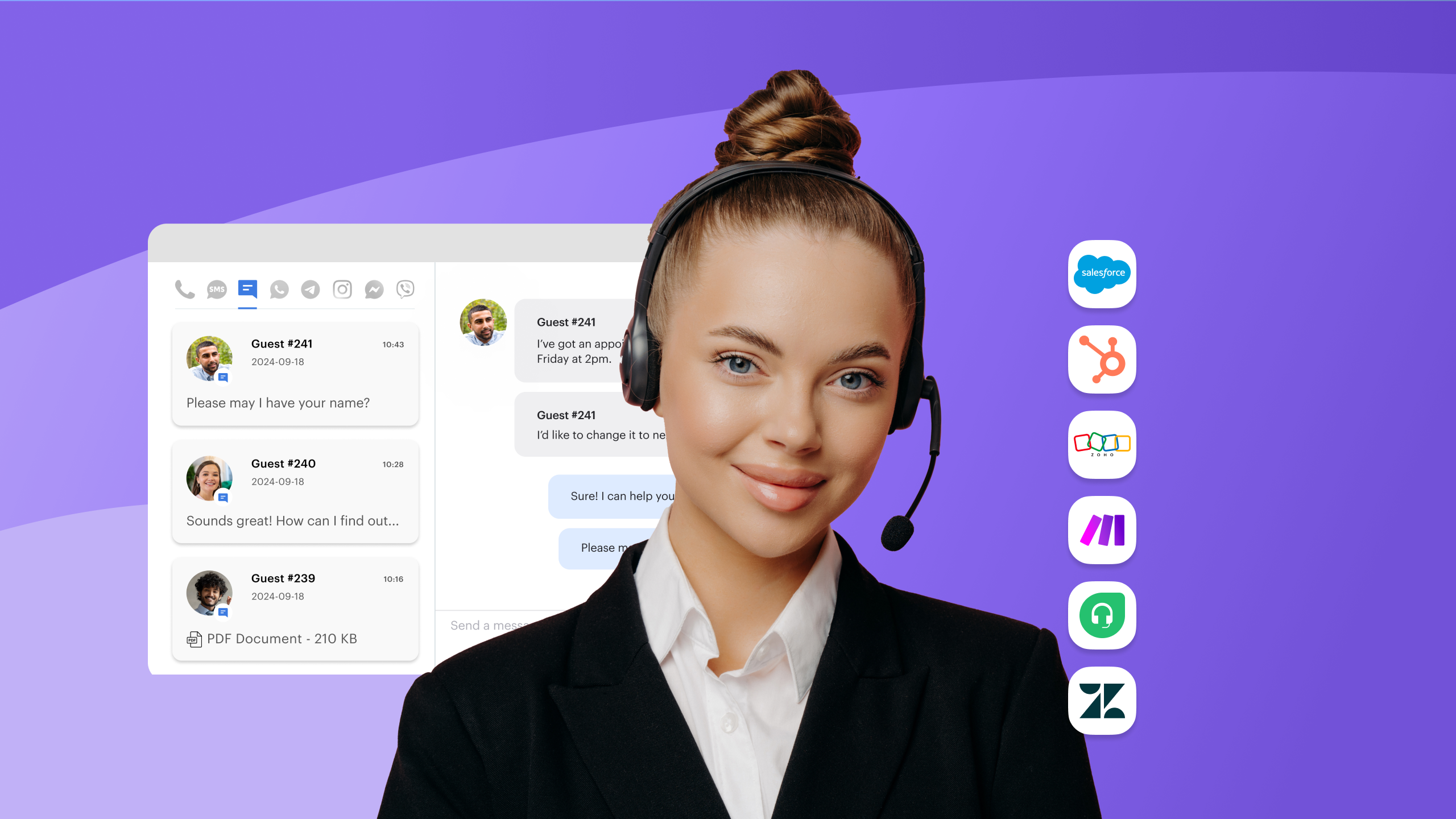
Omnichannel support allows communication to be streamlined across multiple channels and platforms. It enables customer communication over WhatsApp, Telegram, Instagram, email, phone and text.
Agents handle all customer interactions in a single interface, saving them from switching back and forth between multiple windows. And the centralized view provides consistency and efficiency for both customer and agent.
With Voiso, Omnichannel support makes it easy to track all customer interactions. Managers can easily monitor agent performance across all communication channels with real-time analytics, flagging and addressing potential issues before they escalate.
#2 Smart call routing and ACD
Gone are the days of long phone queues, being transferred from department to department and hoping to connect with the right person: smart call routing is here to stay.
Two things get bundled together here, and separating them makes vendor demos much easier to read.
ACD is the distribution mechanism. It assigns incoming contacts to queues or agents, and every platform has one.
Routing logic is the set of rules the ACD follows: skills, availability, priority, language, business hours, customer history, time already spent waiting. This is where platforms genuinely differ. Ask what conditions the rules can read and how many can be chained, rather than whether “smart routing” is supported.
By applying relevant data such as customer history, issue type and even time spent in the queue, it makes more intelligent decisions about where to send each call. The result? Quicker call resolutions and happier customers.
Using tools like Flow Builders can not only enhance your customer experience, but simplify it. Voiso leverages IVR technology to allow customers to navigate self-service easily, routing them to the best available agent based on their menu choices. Pretty handy, right?
#3 APIs and Integration capabilities
CRM Integrations
A solid CRM integration bridges the gap between customer data and call records. Agents have access to real-time customer information during calls; this means no switching between windows or leaving the customer on hold.
Voiso integrates with many of the leading CRM providers, letting you automatically log interactions and update CRM records with specific call details in one interface. You can keep track of customer connections across various platforms, all while syncing with your CRM to ensure full visibility across the board.
Messaging APIs (WhatsApp, Viber, Telegram, Instagram etc)
Without APIs, different platforms couldn’t communicate with each other.
A messaging API connects the dots from one platform to another, enabling information to pass freely. It allows businesses to integrate text messaging and chat mediums, such as WhatsApp, Telegram, Viber and Instagram, into their existing systems.
At Voiso, we use APIs to enable better customer engagement across all platforms. So you can keep your CX consistent and efficient without sacrificing quality.
#4 IVR
IVR is an automated voice interaction system that lets callers work through menus, supply information, reach self-service, or land in the right queue. Whether it’s the first thing a caller meets depends entirely on how the flow is built; plenty of operations put it behind a greeting or after hours only.
Realistic expectations help here. Gartner found that just 14% of customer service issues are fully resolved in self-service, climbing to 36% for issues customers themselves called very simple. A menu that routes accurately is worth a great deal. One that promises full deflection usually disappoints.
IVR helps callers navigate self-service options seamlessly. With personalized call flow instructions, customers can easily understand what to do next. It cuts down on long wait times and can even determine the customer’s reason for calling by obtaining basic information like account numbers and names. Which in turn, reduces call handling time.
Getting your customers to the right department is easy with Voiso: simply sync with your CRM, craft your own IVR menu, and you’re good to go.
#5 Analytics and reporting tools
Real-time metrics
Metrics and KPIs are the driving force behind any call center. Having a clear view of agent performance and customer behavior is make-or-break for a highly functioning call center.
And not just overall KPIs, but real-time metrics: call volume, average wait time, abandonment rate, first call resolution and agent efficiency. Continuously assessing your metrics means quick changes are easy and feasible.
Post-call metrics
Acting quickly also means catching emerging trends. Post-call metrics measure factors like customer sentiment and satisfaction rate. If your scores are consistently low, you can act fast before the problem escalates.
Call scoring can also highlight compliance issues and rate the overall call interaction. While repeat calling metrics can paint a vivid picture of how effective your agents are at resolving issues by emphasizing areas for improvement.
Reporting and analytics
Having these metrics is just the start: knowing how to analyze them is the foundation upon which your business is built.
Consistent reporting outlines any potential gaps in your support coverage by bringing common issues to the fore. But without solid analytics, reliable insights are near impossible.
Having a powerful and reliable tool in place can bring both of them together. Not only can it help managers recognize possible training opportunities for employees, it fosters data-driven decision making. Voiso’s real-time dashboard can provide full visibility over all call center interactions across 60+ different KPIs.
#6 AI features
Call Summaries
After-call notes are where a surprising amount of handling time disappears. AI-generated summaries can reduce that manual work by pulling out key points and suggested next steps from the transcript.
They’re an aid rather than a replacement, though. A summary is an interpretation, and its omissions aren’t visible from reading it, so teams in regulated work tend to keep the full transcript alongside.
It can even list next steps or tasks to be completed based on the content of your calls.
By highlighting the important information, AI ensures that customer interactions are accurately recorded without having to listen back through the entire conversation (which any agent will thank you for).
Sentiment Analysis
Sentiment analysis delves deeper into the tone of the conversation. It sheds light on the customer’s mood based on their tone of voice, giving insight into their overall satisfaction.
Natural language processing (NLP) techniques make it possible to assess positive or negative emotion indicators, providing a sentiment score for different parts of the conversation. This way, managers can see in which areas of the call the customer experiences positive reactions. They can also use any negative points to work on possible areas for improvement.
Keyword Detection
Certain phrases can convey different emotions. With keyword detection, language patterns, phrases and keywords can be highlighted to allow for the quick scanning of calls. Any potential compliance issues are flagged, recurring statements pointed out and key topics like complaints or product mentions easily identified.
Speech Analytics
Speech analytics can identify topics, keywords, acoustic patterns and sentiment indicators across large volumes of conversation. Accuracy varies, and it varies for reasons worth knowing before you buy: model quality, language, accent, audio conditions, and how well your category taxonomy matches how customers actually talk.
Sentiment in particular is softer than the dashboards suggest. Human annotators disagree with each other regularly on the same recording, so treat the score as a signal for finding conversations to listen to rather than as a measurement.
It improves service, data-driven decision making, quality assurance and compliance. Plus, it can even spotlight emerging trends, recurring issues or common queries. Speech analytics also uses natural language processing to analyze conversations, highlighting keywords and phrases in real-time.
#7 Call Recording
There are two main types of call recording: automatic and selective.
Automatic is pretty self-explanatory: it records calls by default, no manual intervention needed. It’s handy for complete customer interaction records by ensuring comprehensive coverage. And it prevents any call from being missed.
Selective call recording is exactly what it sounds like: agents can choose which calls to record. Whether for training, quality, or any other purpose. It requires manual input as the agent has to click ‘record’ themselves.
Recording underpins QA, coaching, dispute resolution and, in several sectors, regulatory evidence. Two constraints belong in the same paragraph as the benefits, since both catch teams out during implementation.
First, consent. Recording law varies by jurisdiction, and several US states require every party on the call to agree.
Second, payment data. The PCI Security Standards Council prohibits storing sensitive authentication data such as the card security code, which means an archive of unedited payment calls is a compliance problem in itself. Pause-and-resume is the usual workaround and it depends on agents remembering, so DTMF masking is the more reliable route if you take card payments over the phone.
#8 Real-time Dashboards
Instant Data Access
Managers and agents can have a comprehensive overview of their operations with real-time dashboards. They deliver immediately visible metrics, helping managers react quickly to any adverse changes; even adjusting staffing depending on how busy or quiet the lines may be.
Customization Options
Depending on their role within the organization, different employees may need visibility over different data sets. An agent might want to see their own personal call stats and real-time progress, while managers need overall metrics and performance trends. Real-time dashboards are fully customizable for the user, meaning they only see what’s relevant to them.
Data-driven Insights
Dashboards can aggregate data in ways humans can’t. They can automatically highlight trends, patterns and common issues, helping with performance analysis over time.
Easy Reporting
Voiso’s Real-Time Dashboards make it easy to run reports, schedule them for when it suits your needs, automate their delivery and select who they get sent to. Across any metrics and any timeframe, every interaction is recorded. And Call Data Records are generated automatically for every interaction, so you can see all data points related to every call.
#9 AI-driven Predictive Dialers
A predictive dialer is an automated system that calls multiple numbers at the same time. Any answered calls are transferred to available agents. And a smart algorithm queues up their next call by predicting when they’ll be available.
Predictive dialers cut down on manual input, increase talk time and boost productivity with automated dialing, which enables higher, more efficient call volumes.. And automatic call queuing optimizes the agent’s time, reducing call abandonment. It can be leveraged for lead generation, meeting scheduling and collecting customer feedback.
Predictive dialing raises talk time by removing manual dialing and the gaps between calls. How much depends on list quality, pacing settings, live-answer rates and the compliance limits you’re working inside, so a single multiplier isn’t really portable between operations.
Worth knowing where the ceiling sits. Under the US Telemarketing Sales Rule, an outbound call counts as abandoned if a person answers and no representative is connected within two seconds, and the safe harbor allows no more than 3% abandonment measured across a campaign or each 30-day period. Pacing aggressively enough to maximize calls per hour is exactly what pushes you through that threshold. Any vendor quoting a throughput multiple without mentioning the abandonment constraint is quoting half a number.
Voiso’s AI Predictive Dialer connects agents only once a call is answered, and local caller ID is available across 120+ countries.
#10 Voice Recognition and Text-to-Speech
Voice recognition
Four different technologies get filed under this heading, and mixing them up leads to buying the wrong one:
- Speech recognition, also called speech-to-text, converts what a caller says into text or a recognized intent. This is what lets someone describe their problem instead of pressing 2.
- Text-to-speech works the other direction, turning written text into spoken audio.
- Voice biometrics identifies or verifies a speaker from voice characteristics. This is the one that “remembers a customer’s voice”, and it’s a separate product with its own consent requirements.
- Conversational AI interprets intent and generates responses, usually sitting on top of the other three.
Recall of previous conversations comes from the CRM record, not from any of these. Recognition captures what was said; the history was already stored.
Text-to-Speech
TTS technology can read out messages to a caller by translating written prompts into spoken words. It integrates with third-party systems and enables multiple softwares to communicate with each other.
TTS reads text aloud. That’s the whole capability, and it matters because the section around it is easy to overstate.
It can speak changeable information such as an account balance, order status or appointment time, provided it’s connected to systems that retrieve that data. Pronunciation, pauses and emphasis are controlled through SSML, a W3C Recommendation, which is worth asking about since it’s the difference between a phone number read naturally and one read as a single long integer.
Language coverage is genuinely strong. Microsoft’s Azure Speech documentation lists voices across more than 100 languages and locales, which gives a sense of what current engines handle, and Voiso supports over 20.
That widens automated coverage without recording prompts market by market. It doesn’t remove the need for agents who speak the language once a conversation gets complicated, which is most of the ones that reach an agent in the first place.
How To Choose Contact Center Software Features
- Channel mix. Which channels do customers already use to reach you? Not which ones you’d like them to.
- Inbound or outbound. The two need almost entirely different feature sets, and platforms are rarely equally strong at both.
- Team size. Some capabilities need volume before they produce anything readable.
- Regulatory needs. Recording retention, consent, payment handling, data residency. These are constraints, not preferences.
- CRM stack. A native connector to the system your team lives in beats a better platform with an API you’d have to build against.
- Reporting requirements. Who needs what, how often, and whether they can pull it themselves.
- Language coverage. Both for agents and for automated prompts, which are separate questions.
- Remote or hybrid working. Affects monitoring, coaching and call quality more than people expect.
- Automation appetite. How much you actually intend to deflect, honestly assessed.
- Integration surface. APIs, webhooks, and whether the vendor’s roadmap is open enough to plug in tools you haven’t chosen yet.
The Bottom Line
As long as technology continues to evolve, so too will customer service. Technology is modernizing the way businesses interact with their customers, in a way that wasn’t possible even ten years ago. Equipping your call center with the right software is a good way to go. But ensuring it’s got the right features for your business isn’t always as easy as it seems.
Not every capability on this page belongs in every operation. Routing and reporting are close to universal. Recording and CRM integration matter for most customer-facing teams. Dialers, speech analytics and heavier automation earn their place in specific setups and sit idle in others.
The buying question worth asking is narrower than “which features are essential”. It’s which of the eight categories above you’d notice missing during your first month, and whether the platform you’re looking at can grow into the rest without a migration.
Voiso covers all eight in one platform, with contact center reporting across 60+ KPIs and native connectors for the CRMs most teams already run. Book a demo and we’ll map it against your current stack.
Integrating these features into your call center helps to meet the ever-growing expectations of customers. It fosters a much more effective service environment that can pivot easily. Embracing call center software will improve customer service and operational success, setting your business apart from the competition.
FAQs
What is the role of unified communications in call center software?
Unified communications (UC) streamline interactions by integrating multiple communication channels—such as voice, email, chat, and social media—into a single platform. This feature is especially useful for call centers as it allows agents to manage and respond to inquiries from various channels efficiently.
UC also enables better collaboration within teams by offering tools like video conferencing and instant messaging. For businesses aiming for growth, unified communications improve customer experiences by ensuring seamless transitions between channels, which is highly recommended for maintaining industry competitiveness.
What pricing models are typically offered for call center software?
Most call center software providers offer flexible pricing models to cater to businesses of various sizes. Common options include subscription-based pricing, where businesses pay a fixed fee per month or per user. Some advanced platforms also offer pay-as-you-go models, where costs are based on usage, making them useful for small teams with fluctuating call volumes. When evaluating pricing, consider the features offered, such as integrated CRM, automation, and quality monitoring, to ensure the chosen solution aligns with your team’s needs and budget.
What resources are required to implement cloud-based call center solutions?
Implementing cloud-based call center software requires reliable internet connectivity, compatible hardware (such as headsets and computers), and basic technical training for the team. These solutions are designed to streamline operations by eliminating the need for on-premise infrastructure, making them cost-effective for businesses of all sizes.
To manage resources effectively, ensure that your team is familiar with the platform’s features, such as automation, integrated CRM, and analytics tools. Cloud-based solutions are recommended for their scalability and ability to support remote work environments.
What advanced features should be prioritized for call center growth in 2026?
To achieve sustainable growth, call centers should prioritize features that enhance efficiency and customer satisfaction. Key recommendations include omnichannel support for seamless communications, real-time analytics for operational insights, and automation to streamline repetitive tasks.
Integrated CRM systems ensure personalized service, while predictive dialers improve sales outreach. Advanced quality monitoring tools also play a critical role in identifying performance gaps and fostering continuous improvement. By adopting these features, businesses can efficiently manage operations and stay competitive in the rapidly evolving call center industry.
What’s the difference between call center software and contact center software?
Channel scope, mainly. Call center software handles voice. Contact center software adds digital channels: web chat, email, SMS and messaging apps, usually in one agent workspace with shared history and reporting. The distinction has blurred as most voice platforms added digital, so vendor naming is inconsistent and worth checking rather than assuming. If a product calls itself a contact center platform, ask which channels share a queue and which are bolted on separately.
Do small teams need all of these features?
No, and buying the full set early is a common way to overspend. A team under about ten agents typically needs routing, contact history, basic reporting and a CRM connection. Recording matters if you run QA or work in a regulated sector. Predictive dialing only earns its cost on outbound volume, and speech analytics needs enough conversations before its categories mean anything. Most platforms let you add capabilities later without migrating.
Which contact center features have compliance implications?
Recording is the main one, since consent rules vary by jurisdiction and several US states require all parties to agree. Payment handling is next: sensitive authentication data such as the card security code cannot be stored, so unedited recordings of card payments create exposure. Outbound dialing carries abandonment limits under the FTC’s Telemarketing Sales Rule. Data residency affects where recordings and transcripts are held. Check these before shortlisting, not during implementation.
Can contact center software replace a CRM?
No, and treating one as the other causes problems later. Contact center software manages interactions: routing, handling, recording and measuring conversations as they happen. A CRM holds the customer record over time, including account details, history, pipeline and cases. They overlap at the point of contact, which is why integration matters so much. The usual arrangement is that the platform surfaces CRM data during an interaction