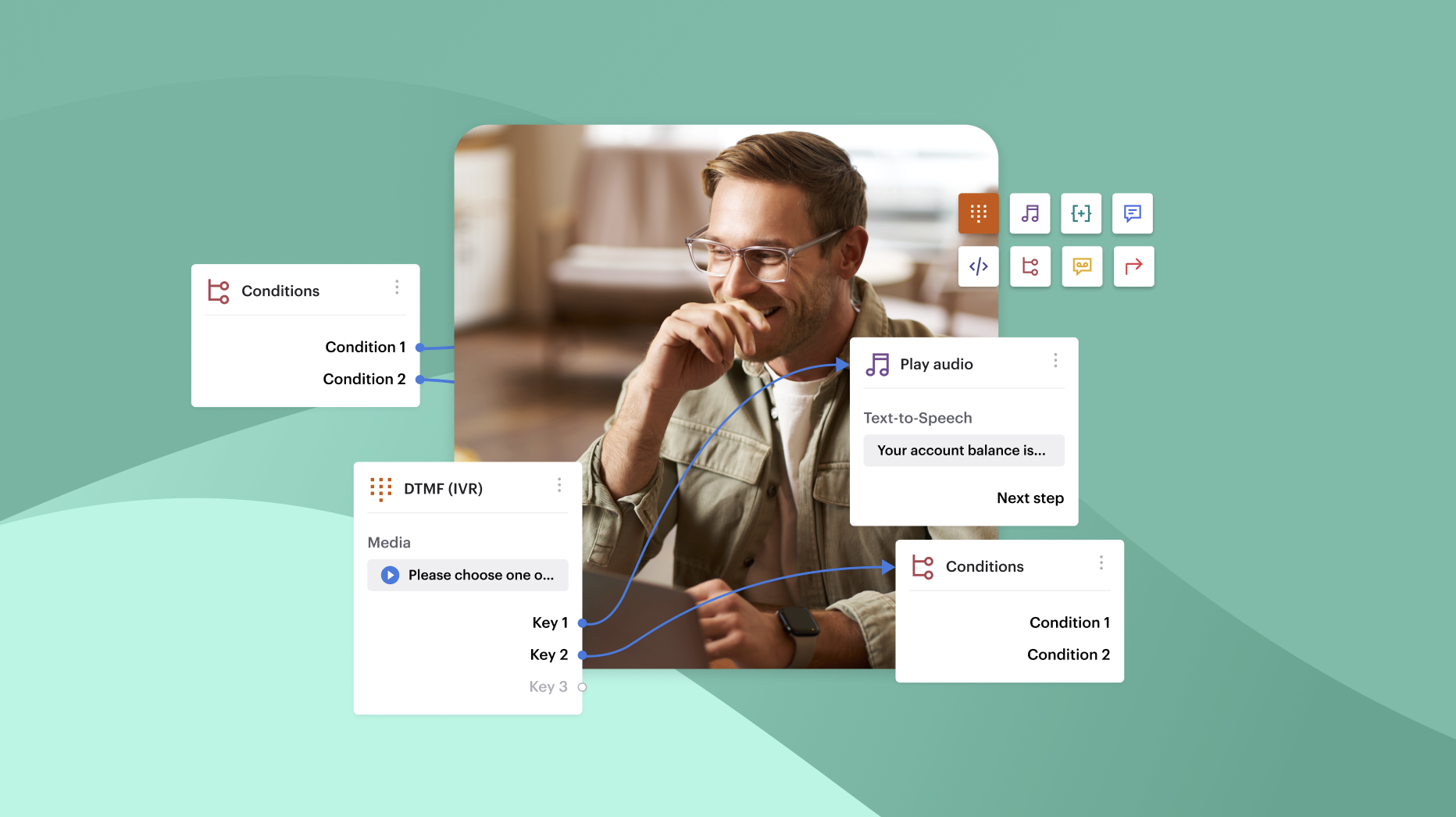


The integration gives agents full visibility over customer details, history and past interactions as soon as they start a call, enabling them to personalize the conversation and respond quickly with relevant information.
The CRM is an agent’s main workspace. It’s where they spend the majority of their work day, whether they’re updating customer information, logging calls, or accessing previous customer interactions. And CCaaS is how agents communicate with customers, whether through phone, web chat, email, social media or third-party messaging apps.
Unifying the two means joining customer data and communication to create a faster, more personalized support system.
Key Takeaways
- Unified interface for agents: Combining CCaaS and CRM allows agents to access customer data, interaction history, and communication tools from a single screen, reducing errors and saving time.
- Efficiency features: Key integration tools include click-to-call/text, dialer integration, CTI screen pops, Call Detail APIs, SMS/messaging APIs, and automation for tasks like data entry and follow-ups.
- Omnichannel capabilities: Support for phone, email, web chat, social media, SMS, and third-party messaging apps enables seamless, consistent interactions across channels.
- Productivity and insights: Agents can handle inquiries faster, while managers gain analytics and trend insights to optimize workflows and improve service quality.
- Customization: Integrations allow branding, workflow, and feature tailoring to match business needs, ensuring personalized agent and customer experiences.
- Native vs API/Zapier integration: Native integrations with major CRMs (Salesforce, HubSpot, Zoho, etc.) provide more features and stability, while API-based solutions may have limitations and compatibility challenges.
- Voiso integration support: Offers native integrations with popular CRMs like Salesforce, Zoho, HubSpot, Zendesk, Pipedrive, ActiveCampaign, Keap, and Kommo, covering top features for efficiency and analytics.
- Overall benefit: Integrating CCaaS with CRM improves call center efficiency, agent productivity, customer satisfaction, and operational insights while enabling a truly omnichannel experience.
How does CCaaS and CRM integration help call center efficiency?
In a nutshell, integrating CCaaS and CRM means agents can handle everything from one screen. Instead of switching between systems, they use a single interface, cutting down on wasted time and potential errors.
Plus, managers have a better understanding of overall performance: they can spot trends, address issues, and improve service, quickly and easily. Integrating the two softwares makes call centers more efficient, which in turn keeps customers happy.
What does CRM and CCaaS integration actually mean?
There are many different ways a CCaaS platform can connect to a CRM system. Let’s take a look at the six key features:
#1 Click-to-call & Click-to-text
An efficient way to streamline interactions by initiating calls or texts directly through the CRM, with a single click. It eliminates the need for agents to manually dial numbers, reducing human error and saving valuable time that could be used for customer engagement.
#2 Dialer Integration
Integrating dialer capabilities within a CCaaS and CRM system enables automated outbound calling. Dialers automatically make calls from contact lists, log interactions, and even route calls to available agents. Whether predictive or progressive, dialer integrations support various dialing modes depending on the needs of the campaign, resulting in more efficient call management.
#3 Screen pop/CTI (Computer Telephony Integration)
Enabled by CTI, screen pops give agents an immediate view of the caller’s profile and contact history as the call connects. It automatically presents relevant customer data to the agent, giving them everything they need in an instant to personalize the interaction.
#4 Call Detail API
Call Detail APIs provide seamless data access on call metrics, directly through the CRM. It allows call centers to analyze agent performance and optimize their strategies based on accurate and real-time data, which makes it a powerful tool for improving call center efficiency.
#5 SMS/Messaging APIs
A centralized hub for all communications, SMS and messaging APIs allow agents to send and receive messages to and from customers directly through the CRM. It’s especially valuable for follow-ups or asynchronous inquiry handling and contributes towards better customer convenience and satisfaction levels.
#6 Automation
Automation in CCaaS and CRM integration makes repetitive tasks like data entry, call logging and follow-up scheduling easy. It streamlines workflows by getting rid of the manual admin associated with call center work, improving productivity and enabling agents to focus more on direct customer interactions. It ultimately enhances the overall efficiency of the call center by reducing admin.
The first step is evaluating your business needs and figuring out which features are right for you. One integration feature may be more suitable for a certain call center, and unsuitable for another: a smaller business might only need a click-to-call feature, whereas a larger call center might need all of the above to optimize efficiency.
Omnichannel Capabilities
Perhaps the biggest bonus of integrating CCaaS and CRM is the ability to communicate with customers over multiple platforms, from one interface. Omnichannel communication unifies phone, email, web chat, social media, SMS and third-party messaging apps, streamlining workflows for agents and providing customers with a seamless communication experience.
Voisio’s Omnichannel capabilities offer numerous benefits for call centers:
- Better productivity: Agents don’t need to switch between windows and get lost trying to find customer information – everything they need is readily available, in a single interface.
- Richer insights: Advanced analytics and metric tracking enables you to easily identify key trends and optimize customer service operations.
- More customization: Voiso tailors to your specific needs, allowing you to personalize branding, workflows and integrations, among many other customization options.
Higher customer satisfaction: Omnichannel enables consistent support across all communication channels, no matter where the customer is contacting from.
Native integration vs Zapier integration
Most contact center software providers focus on building strong, native integrations with major CRMs, like Salesforce, Zoho, or HubSpot. They tend to deliver more features and fewer bugs thanks to dedicated teams of engineers who’ve developed them specifically for each CRM’s unique environment.
But for less common CRMs, contact center software providers often use API-based integrations through platforms like Zapier. While they can work well, they sometimes fall short of native integrations.
Each CRM has its own API structure but they don’t always match up smoothly – HubSpot’s click-to-call API, for instance, might need a completely different input format than Zoho’s, for example. What’s more, some features mightn’t be fully supported when going through third-party APIs, which can limit functionality and cause unexpected compatibility issues.
Which integrations are supported by Voiso?
We’ve worked hard to create well-developed native integrations with Salesforce, Zoho, HubSpot, Zendesk, and Pipedrive, plus ActiveCampaign, Keap and Kommo, to name a few. And we support the top five categories of features for the majority of our integrations.
“We have smoothed our entire business process by integrating systems with the Voiso platform. For example, Facebook-generated leads drop into Zoho and are made available to Voiso, and the call outcome is then communicated back to Zoho.” ~ David M. Shecker, Karma hotels COO
Talk to us today to find out more about Voiso’s integrations and how we can help your call center thrive.